This article is the text from the Major Threats chapter from my book, The Ultimate Preparedness Framework. These brief sections are meant as just an introduction into various threats. I wrote this section in September of 2025 and given the events that began in February of 2026, there are things that are somewhat outdated, but I wanted to include it as a “baseline” for this topic/threat as most of the information is still extremely relevant.
As I write this, in the summer of 2025, there have been a lot of recent developments in this arena. Honestly, most “experts” never would have thought that Iran’s nuclear capabilities could be attacked in the way that it was, by Israel and the United States, without creating a full-blown middle eastern war. But, that’s exactly what happened. However, don’t let these events make you complacent either as both Israel and Iran do not think things are “over” between them.
Specifically, Yahya Rahim Safavi, a senior military adviser to Iran’s Supreme Leader Ali Khamenei, recently told Iranian media that, “We are not in a ceasefire, we are in a stage of war. I think another war may happen, and after that, there may be no more wars.”
While many Americans can see what kind of a threat that Iran may pose to Israel, many don’t see the same threat to the United States. I can see this to some extent as they have no missiles that can reach the United States directly. They have no naval presence outside the Persian Gulf. They have old airplanes and no way to project them much beyond their borders.
History
The Persian people is one of the longest-standing people groups on earth. While they have been invaded and defeated before (by Alexander the Great, the Mongols and by British and Soviet forces during WW2), the nation has endured. They have a resilience and determination that must be appreciated. Unfortunately, this determination comes with great hate.
The reason they were invaded during World War 2 was because they sided with the Nazis. During the war Persia changed its name to Iran as a sign of solidarity with Germany. The word “Iran” means “Aryan.” They were the people group that Germany said was the “master race.” Even though Iran was defeated and surrendered during WW2, this same hatred of the Jewish people remains today. Sometime after the 1979 revolution Iran began using a new name for Israel – “little Satan.” They truly believe that Israel is doing the work of the Devil.
Great Satan
If Israel is considered the “little Satan” then who is the “great Satan?” The United States. While they hate the Jewish people and tried to exterminate them during World War 2, they see the United States as being even worse. As a result, they, as a nation, want nothing more than the destruction of the United States by any means necessary.
To this end, Iran has been the world’s largest state sponsor of terrorism. Most of the efforts have been limited to the middle east, but there may be a time in the future where this terrorism reaches the mainland United States in significant ways. Should the United States and Iran ever reach a formal state of war with one another many believe that the United States will be subjected to terrorist activities here at home.
Islam
The next factor with Iran that needs to be mentioned is their religion. As I pointed out in Chapter 2, worldview is destiny. To understand what Iran might do, you need to understand their driving worldview – their religion. I’m sure you’re aware that Iran is Islamic. What you may not realize is that there are two “factions” within Islam – Shia and Sunni. This split occurred in the 7th century with the death of the prophet Muhammad. The Sunni group believed the successor should be chosen from the Muslim community, while the Shia believed the next leader should be a relative of Muhammad, specifically his cousin and son-in-law. About 15% of world-wide Muslims are Shias and that’s what Iran is. The leader of Iran is a direct descendant of Muhammed because of this.
This split within Islam remains to this day and the Shia and Sunni Muslims do not get along. As a result, Iran is at odds with much of the Islamic World (especially Turkey, Saudi Arabia, etc.). This further isolates Iran and as a result makes them more “extreme” in their beliefs.
One other belief that is unique to Shia Islam is related with what is known as the Twelfth Imam. He is called Muhammad al-Mahdi, or al-Mahdi for short, which means “the awaited one.” He is believed to be the 12th and final Imam (leader of Islam) who went into divine hiding in the 9th century and is still alive but concealed from humanity. The Mahdi is essentially a messianic figure who will reappear in the end times along with Jesus Christ (Islam holds that Jesus was a prophet of Allah) to defeat Satan and establish Islam over the entire earth.
This is important because it explains why Iran calls Israel and the United States the Little and Great Satan, respectively. They see both nations as needing destroyed by the core of their worldview. This is not something they will “give up on.” They see the destruction of these two countries as helping to usher in their “messiah” so it is something they are actively striving to fulfil.
Military and Economic Threat
In addition to the threat of terrorism, Iran also poses a direct military and economic threat to the United States and the world. In 2002, the Millennium Challenge war game was conducted. This exercise involved both live exercises and computer simulations and was the most expensive war game in U.S. military history at the time. The “Blue” team was the United States and the “Red” team was a fictitious state in the Persian Gulf, most likely representing either Iran or Iraq. Part of the scenario was that Red captured several islands in the Strait of Hormuz and used them to enforce tolls for merchants to pass through. It was Blue’s job to stop Red from doing this and they were using the U.S. Navy to do so.
Red was commanded by retired Marine Corps Lieutenant General Paul K. Van Riper. He adopted an asymmetric warfare strategy. He used small boats to ascertain the location of Blue’s naval assets in the area and then launched a massive salvo of cruise missiles. Blue’s defenses were overwhelmed and sixteen warships were sunk, including an aircraft carrier. If it had been real, approximately 20,000 soldiers would have been killed. Then, Red used the small boats to directly attack the remaining ships using conventional and suicide attacks, sinking much of what was left. Essentially, the war game was won as soon as it began – by the “bad guys.” At this point the exercise was reset and General Riper was given “restrictions” so that it was “fairer.” Riper walked out at that point and rightfully so. Instead of learning from the war games, the military leadership ignored the outcome and moved forward “conventionally.” It shows how ill-equipped the U.S. military may be in dealing with an asymmetric foe that possesses significant missiles, which Iran does. Iran even has hypersonic missiles – something the US has yet to successfully test. This test also showed the vulnerability of a traditional Navy in a new world of unconventional warfare.
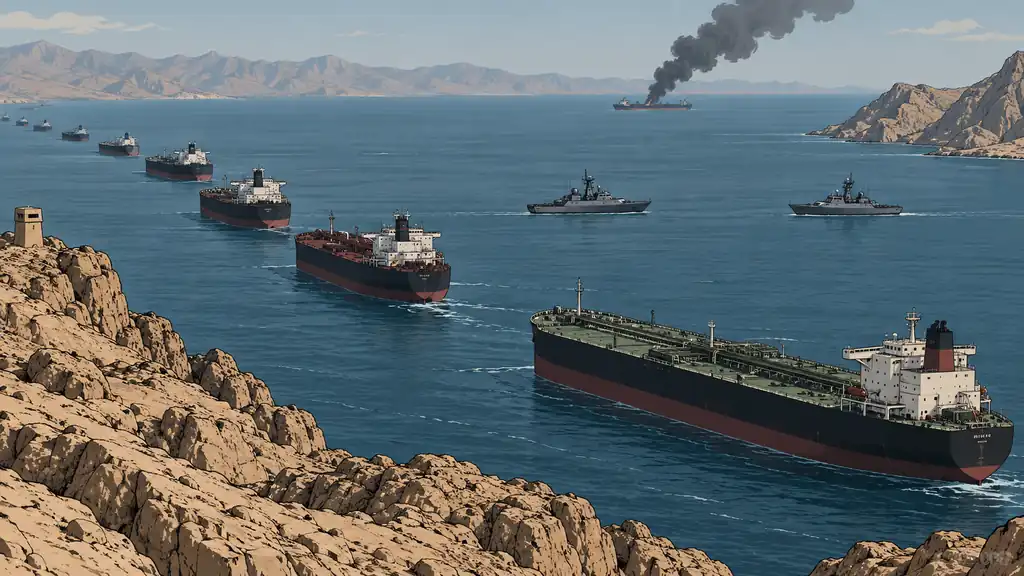
Hopefully you see what kind of a threat Iran can pose to the U.S. military. It’s been projected that if Iran were to close the Strait of Hormuz approximately 25% of the world’s oil supply would be stopped. I’ve heard various estimates of what it would do to gas prices but most of them estimate up to a 4x increase. The economic ramifications to the U.S. would be big and would be even worse for Europe and other places that don’t produce much of their own oil.