


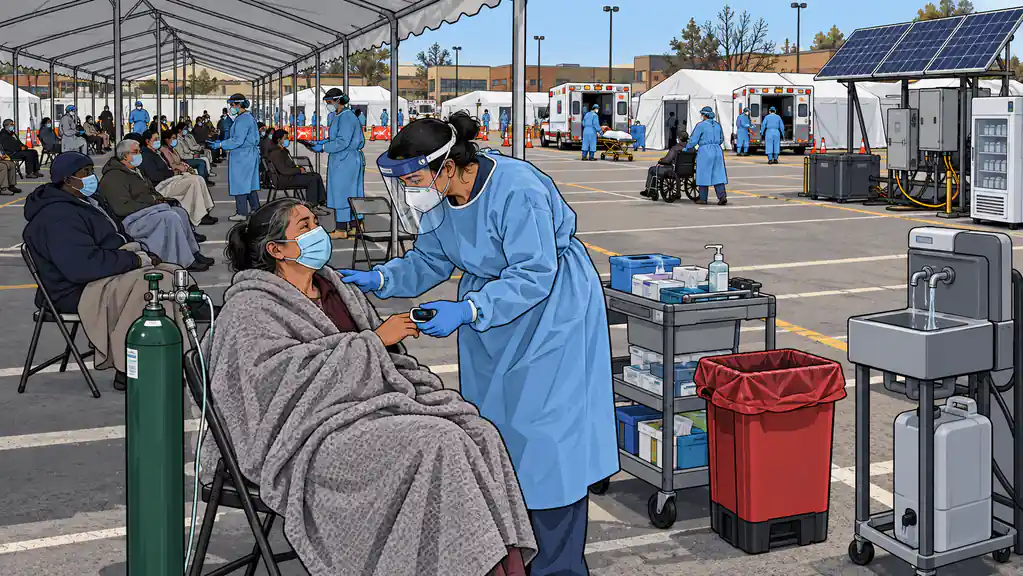
The civilization-scale pandemic sits in the worst corner of any honest threat map: the highest impact paired with the lowest odds. On our scale that’s impact 9, likelihood 1 — a disease bad enough to reshape society for a generation, rare enough that most people will never meet one.
That combination makes this as much a budgeting problem as a prepping one. The severity says build deep. The rarity says don’t let it eat a preparedness budget of money, time, and attention that likelier threats have first claim on. Most people resolve that tension badly — they either ignore the one event that could overwhelm everything, or they pour irreplaceable resources into a once-in-many-generations rarity while the outage that comes every few years catches them flat. There’s a cleaner answer, and the whole plan hangs on it: almost everything this threat asks for is the deeper version of prep that serves the entire list. The extra you spend only for the pandemic tail is small. The depth you build pays off across a dozen likelier events. That’s what makes deep preparation rational even at the bottom of the odds.
Treat it as the far end of one line, not a separate threat
The single most useful move is to stop modeling this as its own exotic scenario and model it as the severe end of the ordinary-pandemic line — same shape, worse in degree. Three things follow, and they structure everything.
You already own the foundation. Your everyday pandemic and general prep — rotated supplies, a medication cushion, a stay-home plan, some financial slack — is the base. Preparing for the tail is mostly extending that base and adding self-reliance, not building a new kit from scratch. The gap between “ready for a normal outbreak” and “ready for the extreme one” is smaller than it looks.
The same depth pays off everywhere. Every capability this tail asks for — deep reserves, water treatment, home medical skill, the ability to seal off, food you can grow — also carries you through an ordinary outbreak, a natural disaster, a long grid-down, a supply shock. So the payoff is high even though the trigger is nearly zero. You’re almost never buying insurance on this event alone; you’re deepening a household that handles many.
You build it last. Cover the likely bases first — general and everyday resilience — then let the tail capacity grow out of that depth. You reach the extreme case calmly, having already handled what’s probable. Front-loading money into the rarest thing on the list, ahead of the common ones, is exactly the mistake to avoid.
What sets the tail apart is three dials turned up: severity, duration, and being cut off from outside help. A normal outbreak is a few weeks with systems mostly intact. The extreme case is months or longer with the store, the utility, and the hospital all possibly degraded or gone. That last dial is the important one. Every ordinary emergency plan quietly assumes rescue and resupply eventually arrive. The tail case is the one where they don’t — and that single change is what forces the shift from finite stockpiles to things that renew.
The scale is real — and so is the rarity
The worst outbreaks on record tell you the top of the range isn’t imaginary. The Black Death killed an estimated one-third or more of Europe’s population in the 1300s. The 1918 influenza killed on the order of 50 million people worldwide. Those are the extreme outliers — the events that define what “generation-altering” means.
And they’re exactly why the impact rating is a 9 and the likelihood is a 1 at the same time. The stakes earn this threat a place on the list. The odds decide how much weight it gets. Both are true, and holding both at once is the whole discipline. There is genuine uncertainty here — nobody can hand you a clean annual probability for a civilization-scale pathogen. That uncertainty is an argument for building depth that’s useful anyway, not for either panic or dismissal.
What a long, unsupported event actually does
Turn all three dials up and the failures stack — and each one points at a specific capability you need.
- The hospital may be closed. Care could be unreachable for a long stretch, which makes your household its own first responder. Home medical skill and depth move from nice-to-have to central.
- The supply chain may go quiet — not briefly scarce, but gone. Food, medications, and goods stop arriving. That’s what drives reserves toward months and, at the far end, toward growing and preserving your own rather than only storing.
- Utilities may fail. Power and water aren’t guaranteed, so water treatment, backup energy, and sanitation join the list.
- Isolation runs for months. Cutting contact for a long time carries a logistical load and a psychological one, and the second is underrated.
- Society strains. A long enough disruption stresses order itself, which is why community and security belong in the plan, not just the pantry.
The thing that kills in a long event isn’t the illness alone — it’s duration times dependence. A modern population isn’t stocked to go months without infrastructure. The second- and third-order effects of a long event — the empty shelves, the failed water treatment, the sanitation breakdown, the sick with nowhere to go — are what turn a bad outbreak into a mass-casualty one. Which points at one blunt sanitation fact worth saying out loud: in prolonged events, waste and water contamination have historically been a leading killer — often rivaling or exceeding the original disease. A wastewater plan you designed in advance is not an afterthought; it’s a core layer.
Build the household that renews, not just the one that’s stocked
Here’s the line the whole advanced plan turns on: a stockpile is a countdown, and the tail case has no fixed end. Anything finite runs out. So you weight the plan toward what renews.
1. Reserves in months — trending toward things you can remake. Extend food, water, and essentials toward months of running on your own, sized by people times consumption times days, built gradually and rotated oldest-first so nothing spoils and no cash sits idle. Water is the hard constraint: four people at two gallons a day is eight a day, ~240 a month, roughly 1,440 gallons over six months — a volume nobody stores. So the real water capability is treatment plus a source: filtration, chemical and heat disinfection, and a source you can reach (a well with a manual or solar pump is the gold standard). At the far end, finite food stores give way to growing and preserving your own, because that’s the only setup that survives an open-ended clock.
2. Medical self-sufficiency, not just a full shelf. Assume professional care is gone. Build deep first-aid and wound-care stocks, the largest safe and legal cushion of any daily medication you can hold, sanitation and disinfection depth, well-fitted respiratory protection — and the skill and reference to actually use it all. At this severity, supplies without competence are just weight. This is the layer that most sharply separates tail prep from ordinary prep, because the fallback of “just go to the ER” is exactly what’s missing.
3. Seal-and-sustain, engineered for months. Plan contact-minimization you can actually keep up over months, a decontamination or quarantine routine for anything that has to come in, a sick-room you can run with caregiver protection, and — the part people skip — how the household stays functional and sane through long confinement: divided tasks, routine, waste management, and the psychological load, which is a real failure mode and not a soft one. Seal-and-sustain is the spine of this plan; everything else feeds it.
4. Infrastructure self-reliance. With utilities uncertain, add backup energy (solar and battery, plus non-electric heat and cooking), the water source-and-treatment above, a sanitation system solved on paper before you need it, and enough repair skill to keep the house working. The target is a household that keeps running with the outside infrastructure degraded or dark.
5. Skills — the reserve that can’t be used up. In an open-ended event, capability outlasts every stockpile, which makes skill the highest-return thing you can build: food production and preservation, water purification, medical and sanitation competence, energy and repair. Skills can’t spoil, can’t be looted off a shelf, and serve every other scenario while improving your normal life. Once the material bases are set, this is where the long-run investment goes, because it turns a finite stockpile into a renewable capacity.
6. Community — because months are longer than any one pantry. This is the honest trade-off in the whole plan. A months-long event outlasts what any single household can store, and a group has redundancy and a breadth of skills no family matches — but drawing closer to people is exactly what a contagious pathogen punishes. You need community for duration and distance from it for contagion, at the same time. That tension is real, and you plan it deliberately: trusted, small, with contact rules that flex as the threat changes. The gear-first crowd ignores this layer hardest, and it’s the one that actually carries people through a long collapse.
How you know you’re ready
- Water, food, and heat sized in months, with a way to make more water rather than only store it.
- Real home-medical skill and a medication cushion that assumes the pharmacy is closed — not just a first-aid box.
- A seal-and-sustain plan you could actually run for months, sanitation and psychology included, not a vague intention to “stay home.”
- Some renewable capacity — a garden, saved seed, preservation skill — so the plan doesn’t simply count down to empty.
- A small, trusted community plan, with the contagion trade-off thought through instead of wished away.
- An honest look at your own spending that confirms the pandemic tail is a small line next to your all-hazards depth — built last, not first.
Bottom Line
- It’s a budgeting problem as much as a prepping one — highest impact, lowest odds, so you build for it calmly and last, as the deep end of a plan you were making anyway.
- Model it as the far end of the ordinary-pandemic line — the extra you spend only for the tail is small, and the depth pays off across many likelier events.
- The tail removes the assumption that help arrives — which is what forces the shift from finite stockpiles to things that renew: water treatment, home-grown food, real medical skill.
- Seal-and-sustain over months is the core — sanitation, household function, and the psychological load are part of it, not extras; waste and water contamination are the historical killers in long events.
- Skills are the reserve that can’t run out, and community is the answer to duration — with the contagion trade-off planned, not ignored.
The unthinkable earns a place on the list for its stakes and a small weight for its odds. Build for it as the renewable deep end of a plan you were building anyway — deep, self-sufficient, and calm — and it never becomes the fear that runs your life.
Scale a months-long, renewable-oriented reserve plan to your household with the Food & Water Storage tool, and keep your isolation plan, medical protocol, and medication list in the Digital Binder.