


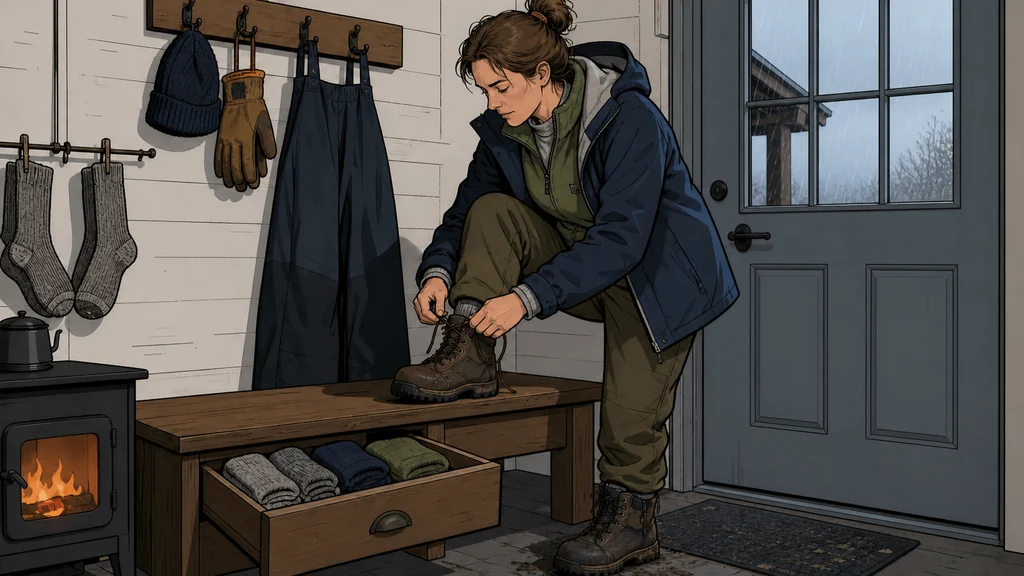
Open most people’s closets and the personal-items category looks handled. Shirts, jeans, jackets, a drawer of socks — clearly enough clothing to last. It’s a fine place to start and a terrible place to stop. A closet full of clothes tells you how you’ll look. It says almost nothing about whether you can work outside, in the wet, at 20°F, for the third day running.
Clothing isn’t a wardrobe. It’s the first level of shelter — the only one you carry on your body — and like any piece of equipment it either does its job or it doesn’t. Not outfits. Gear rated for labor, in weather, for everyone.
Warmth is a system, not a coat
The single most common clothing mistake is treating one heavy coat as “the warm one.” Real thermal management is a system of layers, each doing a separate job:
- Base layer — moves sweat off your skin so you don’t get chilled by your own moisture.
- Mid layer — traps warm air; this is your insulation (fleece, wool, down).
- Shell — blocks wind and rain so the two layers under it can keep working.
The point of layers isn’t just warmth — it’s control. You add and shed them as the work and the weather change, so you’re never soaked in sweat splitting wood and never frozen the second you stop. One big coat can only be on or off.
The other factor is that a coat only keeps your upper body warm or dry. You need to prepare clothing for your lower body or you’ll just freeze to death differently.
Cold rarely kills you outright. Cold plus wet does — and the fabric against your skin decides which one you’re dealing with.
This is where the old outdoors rule earns its keep: cotton kills. Cotton soaks up water and holds it against you, and wet cotton pulls heat out of your body instead of trapping it. The same principles that make cotton great for summer make it dangerous in winter. Wool and modern synthetics keep insulating even when damp — which is exactly why they belong in a working plan and a cotton sweatshirt doesn’t.
Your feet are load-bearing, literally
If any part of your plan involves being on your feet — and all of them do — footwear stops being clothing and becomes the most important tool you own. A person with a blistered, wet, broken-down foot can’t work, can’t stand watch, and can’t walk out.
Two cheap habits protect the most valuable joints you have:
- Boots that are broken in before you need them. A brand-new boot pulled off the shelf in a crisis is a blister factory. Break them in now, on your actual terrain.
- Dry socks, plentiful, in wool or synthetic. Wet feet all day invite trench foot and blisters; the fix is boring — swap to dry socks, keep the wet ones drying on your pack. Socks are a consumable, not a durable. Stock them like ammunition.
Match the clothing to the work and the weather
Everything above points one direction: stock for the hardest thing your plan actually asks a body to do. If your plan involves gardening, cutting wood, walking, and standing watch — outdoors, through every season — then the honest question isn’t “do I have clothes?” It’s:
- Can each person work outside in the coldest week of your year? The wettest? The hottest?
- Is there a full layering system per person, or one coat you’re all mentally counting on?
- Are there work gloves, hats, and rain gear — the small pieces that fail first and get forgotten?
And clothing shares the two clocks every wearable item runs on — wear and growth. Gear that gets used is gear that’s supposed to wear out, so a working wardrobe is one you rotate and replenish, not one you buy once.
Bottom Line
- Clothing is equipment. Judge it by the work and weather it survives, not by how much of it hangs in the closet.
- Warmth is a layered system — base, mid, shell — because control matters as much as insulation. And cotton is the wrong fabric anywhere it might get wet and cold.
- Footwear and socks are load-bearing. Break boots in early; treat dry socks as a consumable you stock deep.
- Stock for the hardest day, for every person — coldest, wettest, hottest — including the gloves, hats, and rain gear that get overlooked.
Log your clothing as a system — sizes, layers, and what’s wearing out — in the Personal Items inventory.