


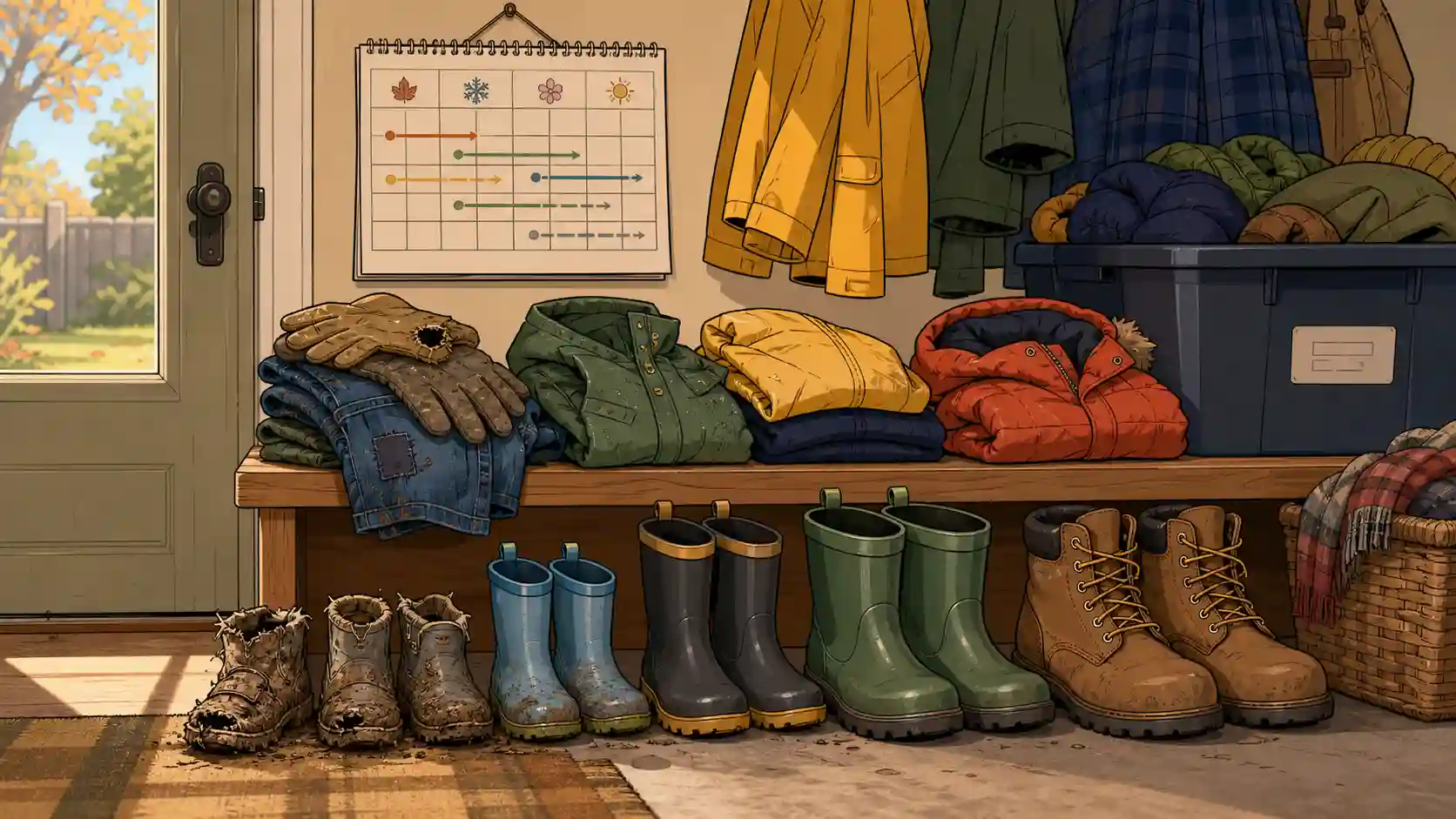
Most preparedness categories degrade slowly and quietly. Canned food is good for years. Ammunition outlasts you. A stored tool sits in a drawer doing nothing until you need it. You can buy those once, put them on a shelf, and mostly forget them.
Personal items — clothing and footwear — don’t work that way. The boots in the closet fit today. They fit today. This is the one category quietly indexed to time, and the clock isn’t set by a shelf life on a can. It’s set by how fast a nine-year-old’s feet grow.
What the framework actually asks for
Personal items are easy to wave off as unglamorous, but that doesn’t change the fact that they’re a critical part of preparedness. Specifically, you need to account for:
- Clothing for working outside in all seasons — because a real preparedness plan involves work, outdoors, in weather.
- Extra shoes and boots as they wear out.
- Larger sizes of clothes and shoes for children.
Let me reiterate: “Work clothes for all members of the family.” Not tactical anything. Just enough of the right clothing and footwear that everyone in the household can do hard outdoor work, through every season, for longer than one set of gear will survive.
Yes, camo and tactical gear have their place, but they’re at the bottom of the list, not the top. You’re much more likely to be gardening than kicking in a door, and gardening is much harder on your clothes.
The two clocks running against you
What makes this category different is that it has not one but two built-in expiration mechanisms, and both are predictable:
-
Wear. If your plan involves physical work — cutting and splitting wood, gardening, repairs, walking — it consumes boots and clothing at a real rate. Work boots die. Jeans blow out. Gloves shred. Unlike a can of beans, this gear is supposed to be used, which means it’s supposed to wear out, which means “I bought good boots once” is not a plan for a multi-year event.
-
Growth. Children don’t hold still. A closet stocked with exactly what fits everyone today is a closet that, in three years, fits nobody who’s still growing. You can have a perfectly organized supply of clothing that is, in a slow-moving crisis, completely useless because the people it was bought for got bigger.
Which is oddly good news
This is the same fundamental problem I wrote about in “everything you’ve bought is already breaking” — the second law of thermodynamics coming for your preps. But here the decay is unusually fast and predictable, and that’s exactly what makes this easy to actually get right.
You can’t predict when a transformer fails or when you’ll get sick. You can predict, with real confidence, that a kid will go up a shoe size, that work boots last roughly a season of hard use, that a coat has a lifespan. Predictable decay is plannable decay. So plan it:
- Buy ahead in sizes. For growing kids, keep the next size or two of shoes and cold-weather clothing on hand, ahead of need. It’s one of the cheapest forms of insurance in preparedness.
- Rotate on a schedule, not on a crisis. Replace and re-stock during normal times, when stores are open and stocked, rather than discovering the gap when there’s no way to fill it.
- Match it to the work. Stock the clothing your actual plan demands — all seasons, outdoor labor — for every member of the family, not just the adults.
Bottom Line
Personal items are the category most likely to be quietly wrong, because the shelf looks full even as it drifts out of date.
- Two clocks are running: things wear out, and kids grow. Both are predictable — so plan against both.
- Buy ahead in sizes and rotate on a schedule. This is the cheapest category to keep current, and the easiest to neglect.
- Stock for the work, for everyone. All-season work clothing and footwear, for every member of the family, is the goal — not a bin of gear that fits the family you had three years ago.