


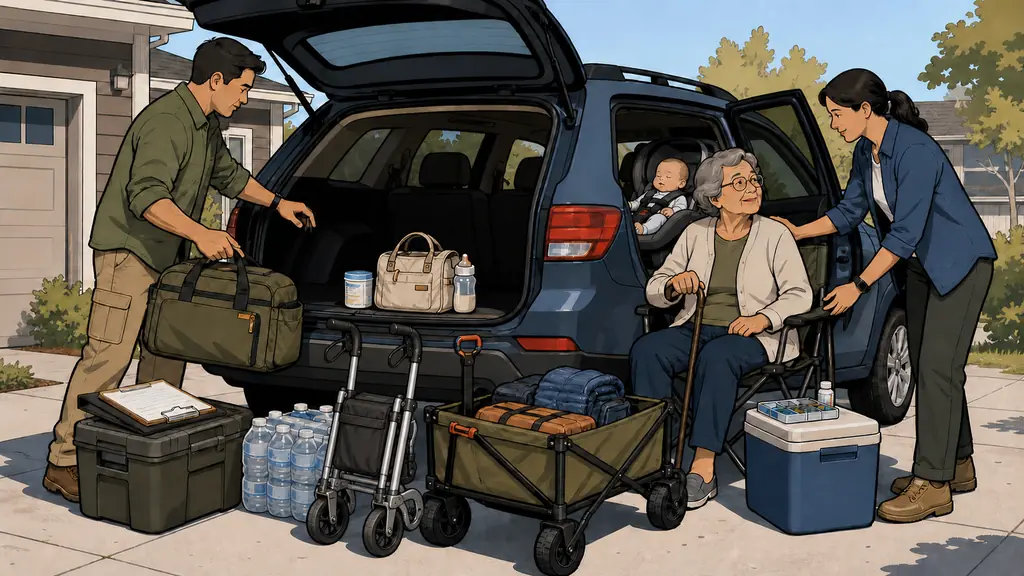
Most preparedness math is built, without anyone deciding to, around a single quiet assumption: a healthy, mobile adult. Calories for an adult. A walk-out distance an adult can cover. A supply of things an adult needs. Then real life shows up — a two-year-old, an aging parent, someone on daily medication — and every one of those numbers is wrong. Usually the plan never gets re-run.
That’s backwards, because the dependents are the reason most people prepare in the first place. A plan that silently assumes them away isn’t a plan for your household — it’s a plan for a household you don’t have. Each dependent doesn’t just add a mouth; they rewrite the consumption, the mobility, and the medical lines all at once.
They rewrite consumption
A dependent’s needs aren’t a smaller copy of an adult’s — they’re often a different list entirely, and frequently one with no substitute:
- Infants run on specialized consumables you can’t improvise: formula (if not breastfeeding), diapers, wipes, specific foods. An infant with the wrong food isn’t inconvenienced; they’re in danger. These burn fast and stock out first.
- The elderly and the ill may need soft or specific diets, more warmth, and far more careful hydration.
- Everyone’s portion is different. A growing child, a large working adult, and a frail elder are three different calorie and water lines — not one number times heads.
The correction is to size the plan per person, by their real needs, not by an average adult multiplied by however many people live there.
They rewrite mobility
If any scenario in your plan involves moving on foot, dependents change it completely. For example, a fit, experienced backpacker covers 8–10 miles a day with a 40-lb pack, and a strong one peaks around 15. Now attach a toddler who has to be carried, or a grandparent who can’t do those miles at all, and your household’s real range collapses.
Your plan doesn’t move at the speed of your fastest member. It moves at the speed of your slowest — and you don’t get to leave the slow ones behind.
Two consequences fall out of that. First, a bug-out plan built on an adult’s walking range is fiction for a household with real dependents — you either solve the mobility problem (carriers, a cart, a vehicle, a shorter destination) or you’re a bug-in household and should plan like one. Second, dependents are one more reason to lean toward community: survival is more work than one healthy adult can carry, and a household weighted with dependents needs help around it, not a lone-wolf fantasy.
They rewrite medical
This is the one that turns dangerous fastest. A person dependent on daily medication is dependent on a supply chain that a serious event breaks early. Insulin, heart and blood-pressure medication, seizure and psychiatric medication, oxygen — for these people, “prepping” starts as a medical problem, not a food one, and much of it can’t be stockpiled freely.
Three moves are within your control:
- Know exactly what each person needs — the drug, the dose, the schedule — and keep it written down somewhere you can reach without a pharmacy or a portal. That’s precisely what the Digital Binder is for.
- Build what buffer you legally can. Talk to the prescriber about a reasonable supply margin, and rotate it so it stays current.
- Know the fallbacks — which needs are truly life-critical within days (and thus a hard limit on how long you can be cut off) versus which can stretch. That single fact reshapes the whole plan.
Dependents also carry the growth clock from the companion piece on kids outgrowing your preps — clothing and footwear sized for today fit no one in three years. Same principle, wider surface: the household you’re planning for is a moving target.
Bottom Line
- Re-run every number per person. Dependents change consumption, mobility, and medical lines — an adult average times heads is the wrong math.
- Infants and the ill need specific, unsubstitutable consumables. Formula, diapers, special diets stock out first and can’t be improvised.
- Plan mobility at your slowest member’s pace. A walk-out built on an adult’s range is fiction with real dependents — and it’s an argument for community.
- Treat medication dependence as a hard limit. Know each person’s exact needs, keep them recorded, build what legal buffer you can, and know which are life-critical in days.
Record every person’s medications, doses, and must-haves in the Digital Binder — the one document a crisis won’t let you rebuild.