


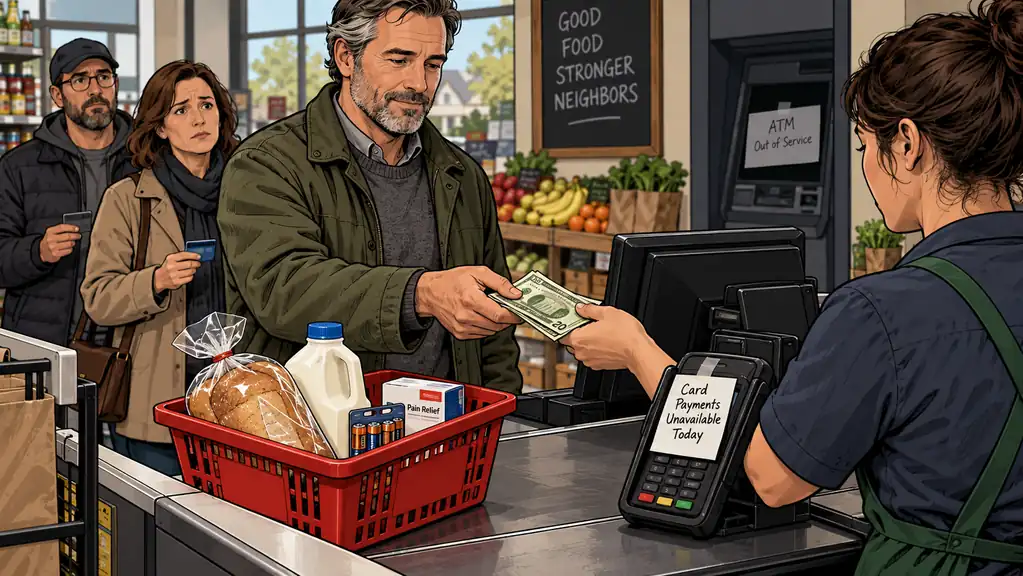
Think about how you actually paid for things this week. A tap of a card. A phone. Maybe an app. Almost none of it was cash. That’s convenient — until the moment it isn’t. Because every one of those payments depends on a chain of computers, networks, and banks all working at once. When any link in that chain goes down — even for a few hours — the tap stops working, and a household that carries no cash suddenly can’t buy groceries, gas, or medicine.
This isn’t about the whole financial system collapsing forever. That’s rare. It’s about the far more common, much smaller version: a temporary outage. A bank’s systems go down. A payment network hiccups. A cyberattack takes a processor offline. The power’s out so the card readers don’t work. In every one of these, the stores may still be open and stocked — but if you can’t pay, none of that helps you.
The fix is refreshingly simple and old-fashioned: keep some cash.
Learned the hard way
Many years ago, I was traveling late at night and didn’t do as good of a job at watching the gas gauge as I should have. With the gauge on empty, I pulled into a small gas station. Unfortunately for me, their card machine wouldn’t work. Thankfully, I did have a little cash and some change in the center console and this got me a couple gallons of fuel. This fuel was barely enough to make it to the next gas station, which thankfully did have a working card machine.
Since that night, I’ve always kept cash on hand. I’ve always had at least one hundred-dollar bill tucked in my wallet. It’s come in handy more than once since then, and not just for fuel.
Why this earns your attention
For a stable financial system, a serious, lasting failure is unlikely — that’s why this rates a low likelihood (3 of 9). But the localized, temporary version happens regularly somewhere: an outage, a freeze, a network problem. And the impact is real (7 of 9) for one blunt reason: if you can only pay electronically and electronic payment stops, you’re stuck, even though everything around you is fine.
The gap between “everything works” and “I can’t buy food” can be as small as a card reader that won’t connect. Cash closes that gap instantly.
What actually happens
When payment systems go down, a few things follow quickly:
- Card readers and taps stop working at stores and gas stations.
- ATMs go offline or run out of cash, so you can’t get more when you need it most.
- Apps and transfers freeze — you can see your money but can’t move it.
- Stores that stay open go cash-only — and the people with cash walk out with groceries while everyone else is stuck.
This is not hypothetical: in July 2024 a single faulty software update — the CrowdStrike outage — knocked bank apps, card systems, and registers offline around the world for hours. The important thing: these events are usually short. But “short” doesn’t help if it’s the day you needed to buy food, fuel, or a prescription and had no way to pay.
What preparedness looks like
Four simple habits cover almost all of this. None of them require you to be a finance expert.
1. Always carry cash. Enough to cover a tank of gas or a cart of groceries. This is the single most important step.
2. Keep more cash at home. Enough to cover a couple of weeks of essentials — groceries, gas, a prescription. Keep it in small bills, because in a larger cash-only situation, making change may get harder.
3. Keep a written record of your money. Somewhere offline — on paper or a file you can open without the internet — note your accounts, roughly what’s in them, and your regular bills and due dates. If systems go down or your access is frozen, this is what lets you pick up where you left off when they come back.
4. Don’t keep everything in one place. If all your money is in one bank and that one bank has a problem, you have a problem too. Spreading funds across more than one institution means one outage doesn’t lock you out of everything.
That’s it. This is one of the simplest and easiest forms of preparedness there is — and one of the most likely to actually get used.
Bottom Line
- Cash is the backup when the cards stop — keep some on you at all times and a couple weeks of essentials’ worth at home, in small bills.
- The threat is usually temporary, but “temporary” still ruins the day you needed food, fuel, or medicine and couldn’t pay.
- Write down your accounts and bills offline so you can rebuild and keep paying when systems return.
- Spread your money across more than one bank so a single outage doesn’t lock you out.
- Keep a backup payment method — a second card, small bills — so you’re never down to one point of failure.
A cashless life is convenient right up until the payment system blinks. A little cash and a written record turn a crisis into an inconvenience.
Keeping offline records of accounts, balances, and bills is exactly what the Digital Binder is built for — an encrypted place to store the financial details that let you rebuild when systems come back.