


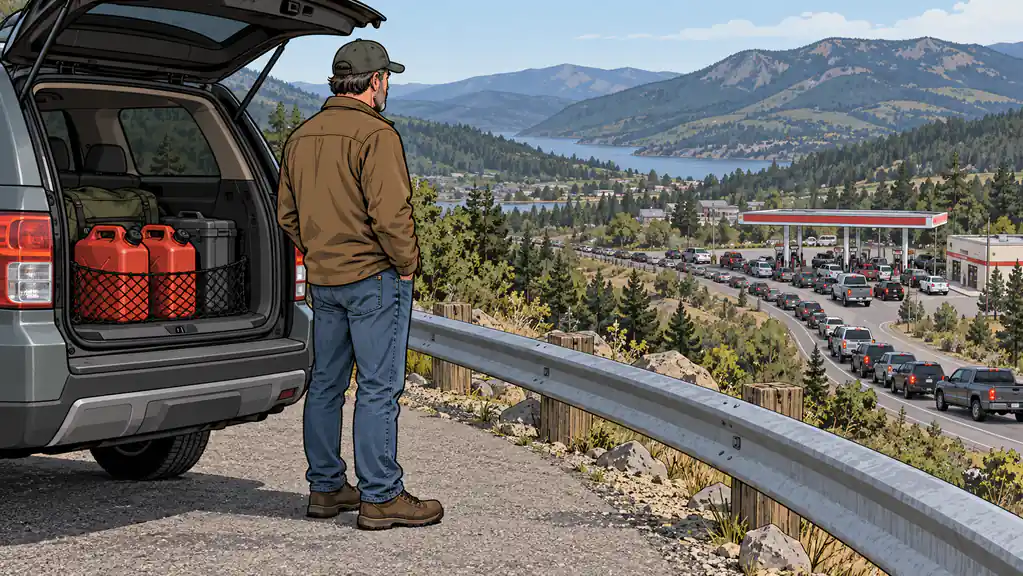
Here’s the part most people get backwards about fuel shortages: the pumps usually run dry not because the fuel is gone, but because everyone tried to buy it at once. A pipeline problem might cut a region’s supply by a modest amount. But if every driver in that region decides to fill up “just in case” on the same afternoon, you get a run on the tanks — and stations that normally cycle their fuel in days empty in hours. The real shortfall is small. The rush is what makes the “No Fuel” signs. Get that straight and your prep points at the right target: staying out of the rush entirely.
Where this threat sits
Fuel shortage is a regional, infrastructure threat, rated impact 4, likelihood 5. It’s one of the few threats where the impact is genuinely low for a household that planned ahead, and the score says so. Likelihood is moderate because the triggers are common and keep recurring. Impact is low because the main fix — never letting the tank drop below half — works so well that a shortage becomes a scheduling annoyance instead of an emergency. That’s not preparedness in the dramatic sense; that’s a habit that quietly deletes the problem.
How a shortage actually forms
Several different triggers all end at the same empty pump:
- Pipeline disruption. A big pipeline going down — mechanical failure, a cyberattack, a shutdown — can starve a whole region, because so much fuel moves by pipe. Pipelines carry roughly 80% of the nation’s refined fuel, and one artery, the Colonial Pipeline, supplies about 45% of the East Coast’s gasoline, diesel, and jet fuel — as its 2021 ransomware shutdown showed.
- Refinery or port disruption. A hurricane that closes Gulf refineries or ports cuts supply at the source and can ripple outward for weeks.
- Last-mile logistics. Not enough tanker trucks or drivers can leave fuel stranded at the terminal even when the fuel exists. Supply and delivery are two different things.
- Panic buying. The multiplier on all of the above. Even a rumor sets it off, and it turns a manageable gap into empty stations.
The thing to hold onto: a station’s stock is thin by design. It holds days, not weeks, and counts on constant resupply. That’s efficient on a normal Tuesday and fragile the moment resupply hiccups or demand spikes. You’re running against a system with almost no slack — so build your own.
The odds, in context
Moderate and recurring, but it depends heavily on where you are. Coastal and hurricane-exposed areas carry a seasonal bump. Anywhere fed by a single big pipeline carries a built-in vulnerability. A quiet year brings nothing; a bad storm season or a pipeline incident brings a tight week or two. Call it a “when, occasionally,” and notice the triggers — storms, cyber risk, aging infrastructure — aren’t going away.
The historical precedent
This isn’t a theoretical threat for the United States - it’s happened before. During the energy crisis of the 1970’s, the US faced two separate major fuel shortages.
The first began in October 1973 when several OPEC nations instituted an oil embargo against the US and several other nations in response to the Yom Kippur War in Israel. This removed roughly 4.5 million barrels of oil per day from the global market, equaling 7% to 9% of global supply. This left the US about 1.2 million barrels short per day. Crude oil prices quadrupled and gas prices increased by 35% (from 39 to 53 cents per gallon). Americans experienced massive, miles-long lines at gas stations. This then led to fights and rampant hoarding, only making the issue worse. In all, this crisis lasted about 5 months.
The second began in early 1979 as the Iranian revolution severely disrupted global oil production. Although the actual drop in global oil supply was small (Iran dropped by 4.8 million barrels, but Saudi Arabia increased production to offset some of it). In all, the US suffered a 2.5 million barrel per day shortfall. Gas prices surged again, reaching $1.19 at the peak (just over 3x from what it was before the first crisis). The same lines and unrest occurred, but for longer this time - this crisis lasted almost a year.
The government responded in the following ways:
- Many states allowed drivers to buy gas only on alternating days, based on whether their license plate ended in an odd or even number.
- A nation-wide 55 MPH speed limit was implemented to optimize vehicle fuel efficiency.
- The US Department of Energy and the Strategic Petroleum Reserve were both created.
These events also caused the public to shift their habits as well. Many Americans switched to smaller, more fuel-efficient cars, leading to greater imports from countries like Japan.
Who actually gets hurt
For most households the direct hit is higher prices and the hassle of hunting for an open station. But the knock-on effects land much harder on some people, so map them:
- People who depend on driving — long commutes, rural distances, gig and delivery work — take a real income and logistics hit, not just an inconvenience.
- Generator users. A fuel shortage that lands during a power outage is the compounding case: your generator is only as good as your fuel, and the shortage is worst exactly when you need the generator most.
- Goods that move by truck. A longer shortage nudges up transport costs, which nudges up prices on everything trucked. Usually mild and temporary, but real in a drawn-out event.
- Essential services. In a severe, prolonged shortage, first responders and critical services get priority, which tightens what’s left for the public.
None of that rises to catastrophe for the prepared. That’s exactly why the impact score sits low.
A worked example — count it in days of driving
Stop thinking in dollars and think in range you’re carrying. Say your tank holds 15 gallons and your vehicle does 30 miles a gallon. Full, that’s 450 miles. Keep it above half and you always have at least ~225 miles of range in the tank. If you drive 40 miles on a normal day, that reserve is five or six days of driving banked at all times — without touching a pump.
So a one-to-two-week regional shortage isn’t an emergency. It’s a stretch where you calmly skip fill-ups while the lines form, then top off after the rush passes. The number is the point: the habit doesn’t just “help,” it hands you a specific cushion of days you can count.
Now the generator side. Say a shortage hits during an outage and your generator burns half a gallon an hour, and you run it 8 hours a day to keep the fridge and a few essentials alive. That’s 4 gallons a day. A 5-gallon can is barely more than a day. Two weeks at that rate is 56 gallons — which tells you fast whether your fuel plan is real or a rounding error.
What preparedness looks like
1. The half-tank rule, treated as a hard floor. Refuel at half, every time — don’t negotiate it down when you’re busy. It means you always carry a full tank’s worth of reserve range, so a one-to-two-week shortage means you skip fill-ups instead of joining lines. And it keeps you out of the rush: you never need to sprint to the pump, which is the exact behavior that causes the shortage. Bonus: a fuller tank cuts condensation and fuel-system trouble over time.
2. A modest, well-managed fuel store — especially if you run a generator. Keep a reasonable supply in approved containers, stored safely — detached, ventilated, away from ignition and living space — and rotated so it stays fresh. Gasoline degrades over months, faster in heat; a stabilizer extends it but doesn’t stop it. Label containers with fill dates and cycle the oldest into your vehicle first. Size the store to your actual generator burn and your target runtime — do the burn-rate math above so you’re not guessing, because guessing gives you either too little or a dangerous amount of stored fuel. Know and follow the local limits on how much you may legally store. For more information about fuel storage, check out this article.
3. Demand reduction, planned in advance. Decide now how you’ll cut driving in a pinch: combine errands into one trip, carpool, work from home, put off non-essential travel. A household that can cut its driving by a third stretches that reserve range by the same third — and now your five or six banked days is more like eight.
4. A backup way to get around. Keep genuinely usable alternatives within reach — a bike in working order, transit options you actually know, a carpool arrangement with a neighbor. The goal is that a tight fuel stretch doesn’t strand you even if your reserve gets low.
Measured in days of mobility on hand instead of dollars, a prepared household rides out a typical regional shortage without changing much of anything about the day.
Bottom Line
- Panic makes it, not empty tankers — the physical gap is usually modest; everyone topping off at once empties the thin station buffers.
- The half-tank rule is a hard floor — it hands you a countable cushion of reserve range and keeps you out of the rush that causes the shortage.
- Generator users need managed fuel storage — approved containers, safe siting, stabilizer, oldest-first rotation, sized to real burn rate.
- Plan your demand cut in advance — combining trips and carpooling can stretch a reserve by a third or more.
- Keep a backup way around — a working bike, transit you know, or a carpool means tight fuel never strands you.
The pumps run dry from panic, not from empty tankers. Fill at half, and you’re already out of the line before it forms.
Sizing backup power and the fuel to run it? The Generator and Solar tools turn your runtime target into an actual fuel figure.