


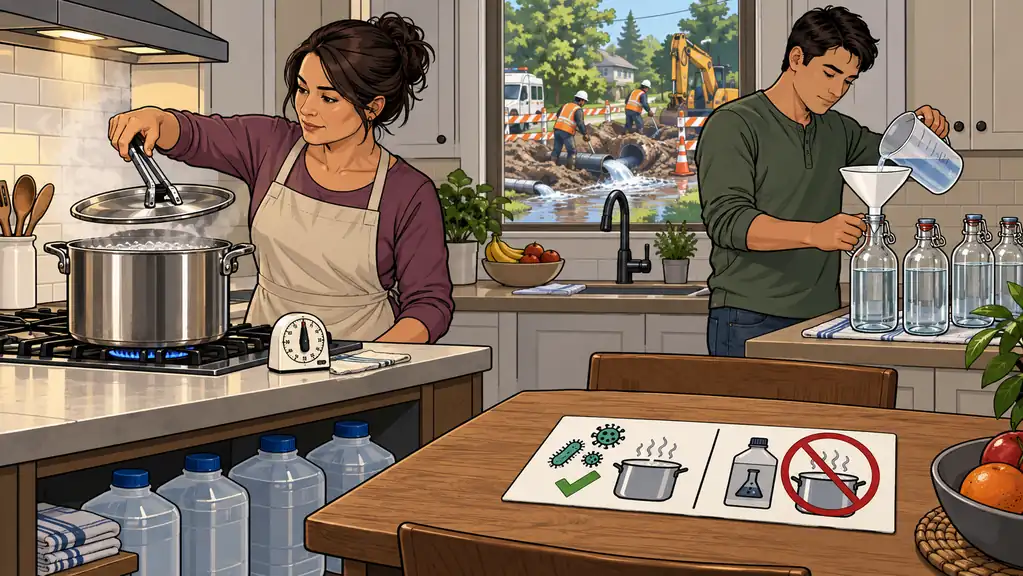
A boil-water advisory is the cheapest point on a line that runs all the way up to prolonged, wide-area loss of drinkable water. For the serious prepper that’s exactly its value: it’s the frequent, low-stakes end of the water-security curve, and if you’ve engineered your setup right, the same thing that makes an advisory invisible also carries you through a week-long main break, a contamination event, or the water problem buried inside a larger disaster. So don’t treat the advisory as trivial. Treat it as the front door to a real household water setup: the systems that fail, the chemistry of making water safe, and a supply sized across durations and failure modes.
The distribution system as a set of things that break
Understanding why advisories happen tells you what your defense actually has to cover. Municipal water runs on a chain — source, treatment, storage, and a pressurized network of pipes — and the advisory is the visible symptom of a fault somewhere along it:
- Positive pressure. Distribution mains are kept under positive pressure on purpose, so that any breach pushes water out rather than letting contaminants in. A main break, a pump failure, a power loss at a pumping station, or a demand spike from major firefighting can drop that pressure and open a path for intrusion — which is why US rules generally require systems to hold a minimum residual of 20 psi, and a drop below it commonly triggers a precautionary advisory. The advisory goes out because intrusion may have happened, not because contamination is confirmed.
- Treatment disruption. A failure or interruption in disinfection or filtration at the plant can let inadequately treated water into the system.
- Detected contamination. A positive test or a known contamination event — biological or chemical — triggers an advisory, or for chemicals, a stronger “do not use / do not boil” order.
- The testing floor. Lifting an advisory means flushing the mains and then confirming with testing — typically no coliform bacteria in samples collected on two consecutive days. That imposes a multi-day floor on many events no matter how fast the physical repair goes. Plan for the testing timeline, not just the repair.
The engineering takeaway: the advisory is a precaution against a possible intrusion, its length is set as much by the testing protocol as by the repair, and its failure modes split cleanly into microbial (boilable) and chemical (not boilable). That last split decides your entire response.
Making water safe — and where each method quits
Your household treatment options are only as good as your understanding of what each one does and doesn’t kill. Match the method to the contaminant.
- Boiling. The gold standard for a microbial advisory. A rolling boil for one minute — three minutes above 6,500 feet, where the lower boiling temperature cuts your thermal margin (CDC) — reliably inactivates bacteria, viruses, and protozoa, including chlorine-resistant bugs like Cryptosporidium. It does nothing for chemical contamination, and it will concentrate some dissolved chemicals as the water boils off. That’s precisely why a chemical advisory is a do-not-boil situation.
- Chemical disinfection. Plain unscented household bleach (5–9% sodium hypochlorite) at the CDC dose of 8 drops (~1/8 tsp) per gallon — 16 drops for cloudy water — with a 30-minute contact time is a reliable microbial backup. Two catches: it targets microbes only, and it degrades in storage — hypochlorite loses strength over roughly a year, so old bleach under-doses without telling you. The faint chlorine smell afterward is a rough confirmation it’s still working. Keep the exact ratios and contact times written down; don’t trust memory.
- Filtration. This is where most people misjudge their own gear. An absolute 1-micron microfilter removes protozoa (Cryptosporidium, Giardia) and is somewhat effective on bacteria — but not viruses, because norovirus is roughly 0.03 micron, far below the pore size. Virus removal generally needs ultrafiltration, a sub-micron rating paired with a disinfection stage, or reverse osmosis. Chemical contaminants need adsorptive media (activated carbon for many organics) or reverse osmosis for dissolved inorganics — things a basic hollow-fiber filter simply can’t do. Look for NSF/ANSI Standard 53 or 58 certification and know your filter’s tested rating and how long its consumables last.
- The other methods. UV and solar disinfection (SODIS) inactivate microbes but need clear water and have their own limits. Distillation handles both microbes and many chemicals but is slow and energy-hungry.
The design rule is layered, independent methods across the contaminant types, so that no single missing input — electricity, fuel, chemical stock, or one specific filter element — leaves you with no path to drinkable water. The advisory tests your microbial layer. A chemical event tests whether you have any answer at all beyond stored water — and for most households, the honest answer is that stored water is the only answer, which is why the base layer below matters most.
The odds, and the duration you’re really sizing for
On our scale this is one of the higher-likelihood entries. The base rate is driven by aging pipes, climate stress (freeze-thaw cycles, flooding, drought moving the ground and stressing mains), and how large and redundant your system is. The more useful advanced framing is the duration spread. Most advisories clear quickly — but because clearance is gated by flushing plus that two-consecutive-day sampling, even a fast repair carries a multi-day testing floor, and larger contamination or infrastructure events form a longer tail, with a rarer tail still of do-not-use chemical events. Size your supply against the tail you choose to cover, not the middle — because the middle is trivial and the tail is where households actually get hurt.
Impact: the low first-order number hides the cascades
The first-order impact is deliberately low — for a prepared household, zero. The rigorous view is in the cascades and the edge cases:
- It rarely comes alone. Advisories frequently co-occur with the thing that caused them — a storm, a freeze, a flood, a regional power loss. The realistic planning scenario isn’t “clean water is off” by itself; it’s “water is off and power, heat, or road access may be degraded at the same time.” Treatment methods that lean on electricity or fuel may be down at the exact moment you need them, which is the whole argument for stored, ready-to-drink water as the layer that can’t fail.
- Some people can’t tolerate the gap. Immunocompromised individuals, infants, dialysis and other medical-equipment users, and elderly members have far less room for both microbial exposure and any interruption in supply. Their needs set a higher, non-negotiable reliability bar for the whole plan.
- It scales straight up to the big one. The same competence — stored volume, multi-method treatment, alerting — is the water piece of every larger scenario on the list, up to prolonged infrastructure failure. Mastering the advisory is the cheapest rehearsal there is for the water problem you’d face in a genuine long-duration event.
Engineering the household supply
Design across three horizons, each with its own reason for existing.
1. Ready base layer (0–7+ days): stored, drinkable water. The floor is one gallon per person per day for drinking and cooking; the honest hygiene-inclusive figure is higher. Do the arithmetic and commit to a number: a one-week base for a family of four is 28 gallons minimum for drinking and cooking, and closer to 56 gallons once you add sanitation and hygiene at two gallons a day. Use rotation-managed containers or long-shelf-life commercial water, track fill dates, and — this is the one that catches people — verify inventory by count, not estimate. This layer needs no power, no fuel, and no skill in the moment, which is exactly why it’s the base and why it’s the only thing that still works when a chemical event takes boiling off the table.
2. Renewable treatment layer (extended events). Multiple independent methods — boiling, chemical, class-appropriate filtration, and ideally one chemical-capable option — with their consumables: spare filter elements, fresh disinfectant stock, fuel for boiling. This is what turns a fixed stockpile into an open-ended capability you can run from an available raw-water source. A stockpile empties; a treatment capability doesn’t.
3. Source and collection layer (prolonged / worst case). Knowing where your raw water is and being able to get it — stored, rainwater capture, local surface water — plus the means to move and treat it. This is where the advisory-scale setup connects to genuine long-duration self-reliance, and it’s the difference between “I have water” and “I can keep making water.”
Alerting and information. Enroll in utility notifications with a power-independent backup — a battery or hand-crank radio, or another offline way to receive official channels. You have to reliably receive both the issuance and the specific nature of an advisory, because microbial versus chemical changes your entire response, and you have to hear the all-clear so you’re not treating water that’s already safe.
Throughout, the metric is days of assured drinkable water and the breadth of independent treatment you own, never dollars.
How you know you’re ready
- You can state how many days your household runs on stored water alone — and you counted it, you didn’t estimate it.
- You can make questionable water safe at least two independent ways, and at least one of them needs no power and no fuel.
- You know, cold, which of your methods do nothing against a chemical event — and your stored base is sized to ride one out.
- You’ve actually run your filter once, you know its NSF rating and consumable life, and you keep spare elements.
- You’ll receive both the advisory and its all-clear even with the grid down, and you know microbial from chemical changes what you do.
- Your most vulnerable member — an infant, someone immunocompromised, someone on medical equipment — has water security handled with zero improvisation.
Bottom Line
- The advisory is the low end of the water-security curve — engineer for it and you’ve built the setup that also covers a week-long break, a contamination event, or the water problem inside a disaster.
- Advisories are a precaution against a possible intrusion, with length set by testing as much as repair — and they split into microbial (boilable) versus chemical (do-not-boil), which decides your response.
- Master the treatment methods and their limits: boiling and bleach kill microbes only; filter capability depends on the class; chemicals need adsorption or RO — so build layered, independent methods.
- Size the supply against the duration tail, not the middle, across three horizons — stored base, renewable treatment, and source/collection — and verify inventory by count.
- Plan for things happening at once and for vulnerable members, and keep power-independent alerting so you receive and correctly read both the advisory’s nature and its all-clear.
The next boil-water advisory is a graded rehearsal for the water emergency you actually fear. Build the setup that makes the rehearsal invisible, and you’ve already passed the real exam.
Model your household’s water needs across the durations you want to cover with the Food & Water Storage tool.