


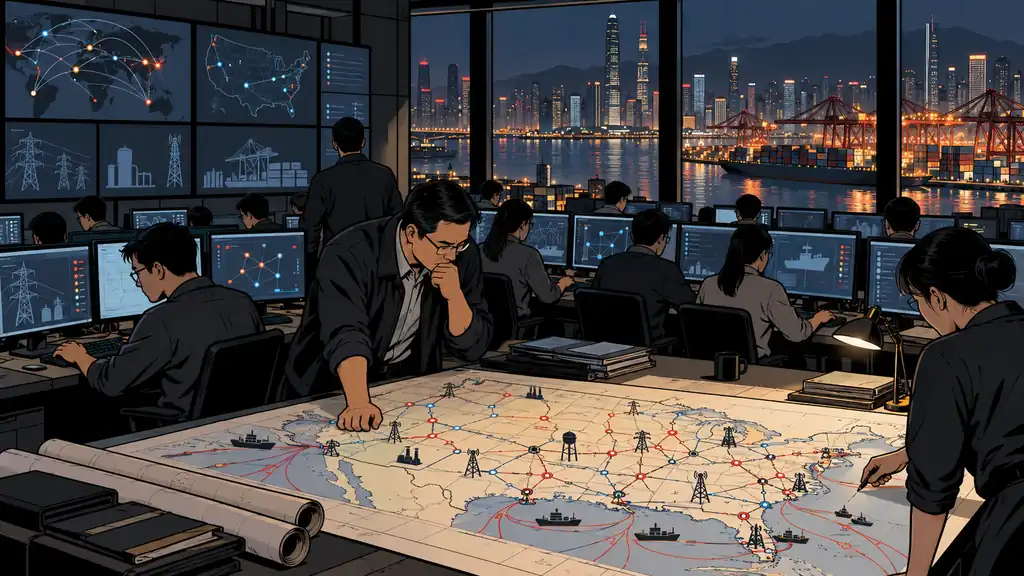
The question in the title sounds paranoid. It stops sounding paranoid the moment you understand what the word “war” means to the people running the People’s Republic of China — because it means something much broader than it does to us, and they have written it down.
We picture war as a thing with a start date: a declaration, a first shot, a line crossed. That mental model is a vulnerability. A rival who knows you’re watching for the first shot can do enormous damage for years simply by never firing it — by waging the conflict through every channel except the one you’re watching for. That’s not my theory. It’s Chinese military doctrine, published a quarter-century ago, and it reframes the whole question of whether we’re “at peace” with Beijing.
The doctrine that erased the line
In 1999, two colonels in China’s People’s Liberation Army, Qiao Liang and Wang Xiangsui, published a book called Unrestricted Warfare — “war beyond bounds.” Its core argument is simple and, frankly, brilliant: a weaker power does not beat a stronger one by meeting it where it’s strongest. It beats it by refusing to fight on the stronger power’s terms at all — by erasing the lines between war and peace, soldier and civilian, military and economic and legal and informational. You prosecute the conflict by every available means, all at once, and you keep each individual move below the threshold where the other side feels entitled to call it an act of war.
Read through that lens, the toolkit stops looking like unrelated headlines and starts looking like a campaign:
- Economic — eroding a rival’s industrial and financial base wherever possible.
- Societal — deepening internal division and distrust.
- Political — widening partisan fracture and cultivating influence over decision-makers.
- Biological and medical — treating disease and the supply of medicine as leverage.
- Lawfare — turning the rival’s own legal and regulatory systems into a weapon.
- Information — contesting what a population believes before any shot is fired.
None of those, taken alone, trips the wire we’re all watching. That’s the entire point. The genius of the doctrine is that it operates in the gap between “suspicious” and “casus belli,” and it lives there permanently.
This isn’t a fringe reading — it comes from the top
It would be easy to wave this off as one provocative book by two colonels. But the intellectual lineage runs straight up the chain of command, and it’s old.
Sun Tzu wrote the Art of War in the 5th century BC. In it are several applicable statements, including, “all warfare is based on deception,” and “attack him where he is unprepared, appear where you are not expected.”
Mao Zedong, who built the regime, was explicit that the political and the military were the same fight by other means. “Politics is war without bloodshed, while war is politics with bloodshed,” he wrote. His operating principle for dealing with an adversary was just as blunt: “support whatever the enemy opposes, and oppose whatever the enemy supports.” That’s not a metaphor. It’s a doctrine of permanent, total, means-agnostic struggle.
Xi Jinping has carried it into the information age and been equally candid. He has directed the PLA to “establish the ideological concept of information warfare” as “central to modern combat,” and he understands precisely where the real front line is: “The crumbling of a regime always starts in the realm of ideas. Once the front lines of human thought have been broken through, other defensive lines also become harder to defend.” When the man at the top tells his own military that the decisive battlefield is what populations believe, you should take him at his word.
The pattern, read through the doctrine
Here is where I have to be careful, because this is exactly the kind of argument that slides from documented into conspiratorial if you let it. So let me separate what’s solidly established from what’s contested, and keep the two in different boxes.
What’s well-documented: (and is alarming enough on its own)
- Chinese state hackers have been caught pre-positioning inside American critical infrastructure — power, water, communications — not stealing secrets but planting the ability to disrupt (the campaigns security researchers labeled Volt Typhoon and Salt Typhoon).
- China dominates the refining of the rare-earth elements that modern electronics and weapons depend on, and has repeatedly used export controls on them as leverage.
- It has been steadily trimming its holdings of US Treasuries while buying gold at record pace — a quiet hedge against the dollar it once underwrote.
- Chinese-linked buyers have purchased farmland near US military installations.
- A surveillance balloon transited the continental United States before it was shot down.
- The precursor chemicals feeding the American fentanyl crisis flow, overwhelmingly, from Chinese suppliers.
- Stealing or “redirecting” sensitive military hardware.
What’s contested:
- While I believe the origin of COVID-19 was definitely from the Wuhan Institute of Virology, it’s unclear whether the release was accidental or on purpose.
- Using platforms like TikTok to harvest data and shape what Americans see is a documented concern, but hard to verify.
You don’t need the contested items. The documented ones, laid against a doctrine that explicitly calls for exactly this kind of multi-domain, below-threshold pressure, make the pattern clear enough.
So — are we at war?
Here’s the honest answer: under unrestricted warfare, “are we at war?” is the wrong question, and asking it is itself the trap. A rival operating this way wins by making “accident” and “operation,” “competition” and “conflict,” impossible to tell apart. If you wait for certainty, you wait forever, and the pressure accumulates the whole time.
I’m not telling you tanks are coming tomorrow. I’m telling you something more useful and more unsettling: the contest is already underway, by means designed never to announce themselves, and the question is not whether it escalates into effects you’d feel at home but when, and with how little warning.
What it means if you’re preparing
This doesn’t hand you a new shopping list. It changes the Likelihood you assign to things you’ve already justified. If a peer adversary is fighting by every means short of open war, then the scenarios downstream of a US–China conflict — supply-chain breakdown, a cyber-stressed grid, economic turbulence, disrupted fuel and food — are not distant “if war comes” hypotheticals. They’re the live edges of a competition that’s running right now. You don’t prep for “the day it starts.” You prep for the day the quiet war gets loud, and you treat the fact that it’s already being waged as a reason to move those preparations up your list, not down it.
Bottom Line
- Beijing’s definition of “war” is broader than ours, and it’s doctrine. Unrestricted Warfare (1999) calls for conflict by every means at once — economic, informational, legal, biological — kept deliberately below the threshold of open war.
- It runs from Mao to Xi. “Politics is war without bloodshed”; “the crumbling of a regime starts in the realm of ideas.” The decisive front, by their own account, is what populations believe.
- Separate the documented from the contested. Infrastructure pre-positioning, rare-earth leverage, de-dollarization, land near bases, the balloon, fentanyl precursors — solidly established. COVID’s origin and specific influence-op claims — unresolved; don’t overstate them.
- The ambiguity is the weapon — so prepare for effects. You can’t wait for a declaration that’s designed never to come. Raise the Likelihood on supply-chain, grid, economic, and fuel/food disruption, because a peer that fights this way is already engaged.
Track the bigger picture on the war with China threat page — and read the companion piece on how Beijing’s logistics games reveal the same doctrine in action.