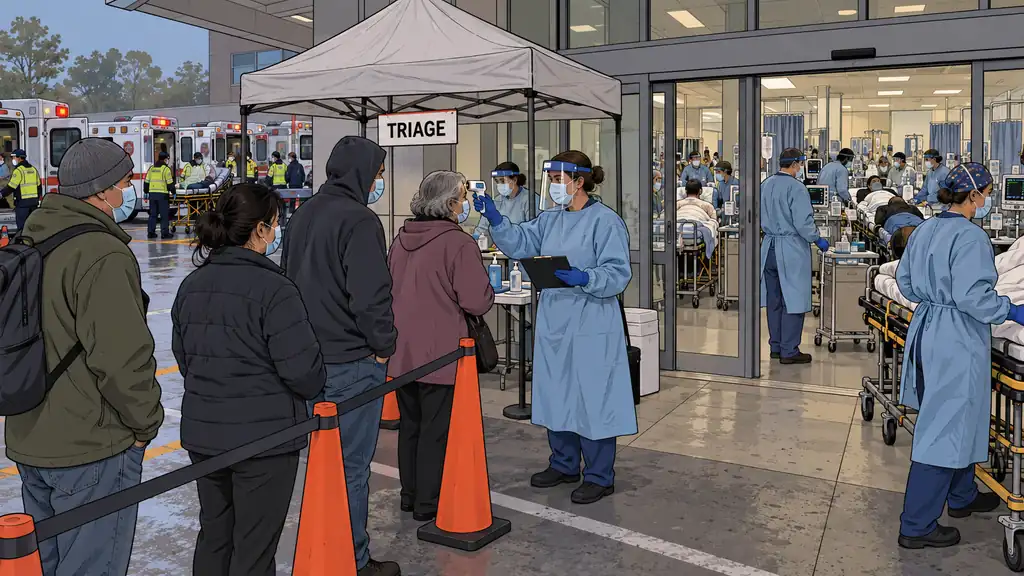
After 2020, the reflexive thought is that we’re done for a while — we just spent our once-in-a-century card, so the odds say the next global pandemic is decades off. It’s a comforting piece of arithmetic and it’s wrong on both ends. Two data points — a pandemic in the early 1900s and another in 2020 — don’t set a 100-year clock; nothing in nature is obligated to space these out politely. And the number that actually decides how bad a pandemic is wasn’t the timing at all. It was the mortality rate. Last time, that number ran around 2%. That’s near the bottom of what a pathogen can do, and it still shut down the planet.
That’s the frame worth sitting with. COVID wasn’t the worst case. On the one metric that matters most, it was close to the mildest case a true pandemic can produce.
The number that decides everything
Run your eye down the list of pathogens that already exist in the wild and could, under the right conditions, go pandemic. Here are the key pathogens:
| Pathogen | Mortality rate | Description |
|---|---|---|
| Ebola | 25–90% | Viral hemorrhagic fever |
| Marburg | 25–90% | Viral hemorrhagic fever |
| CCHF | ~50% | Viral hemorrhagic fever |
| SARS | 9–15% | Coronavirus |
| MERS | ~40% | Coronavirus |
| H5N1 (bird flu) | ~50% | Influenza A |
Put that next to COVID’s ~2% and the point makes itself. A pathogen that keeps even a fraction of these lethality rates while picking up the one thing these mostly lack — easy, pre-symptomatic human-to-human spread — is a fundamentally different event from the one we just lived through. A 2% killer overwhelmed hospitals and supply chains worldwide. A 40% or 50% killer is not that scenario scaled up; it’s a different category of event.
There’s a grim tradeoff that usually works in our favor here, and it’s worth understanding so you don’t over- or under-rate the threat. Pathogens that kill fast and kill most of their hosts tend to burn out — a host too sick to move doesn’t spread much. The genuinely dangerous profile is the one that splits the difference: lethal enough to devastate, but slow and quiet enough in its early days to travel on a symptom-free carrier before anyone knows they’re sick. COVID’s danger was largely that it spread before people felt sick. Pair that transmission behavior with a hemorrhagic-fever mortality rate and you have the scenario the whole list is really pointing at.
”When,” not “if”
This is a matter of when, not if — the only open questions are which pathogen and how severe. Nature supplies the candidates above. But nature is no longer the only supplier.
Labs around the world are actively engineering pathogens. Two examples surfaced just last year: scientists in Brazil producing a “chimeric AH5N1 virus” that caused rapid “hemorrhagic lesions” in exposed chickens, and the Wuhan Institute of Virology (I believe to be the origin of COVID-19) — reportedly working on modifications to monkeypox aimed at disrupting the immune system’s ability to flag viral material.
You don’t have to resolve the lab-origin debate to take the operational point: the number of ways a high-lethality pathogen could reach general circulation is going up, not down. That shifts this from a rare natural event you can round to zero into a standing risk you plan around.
COVID was a 2% event that stopped the world. The list of things that already exist runs from 9% to 90%. Plan for the category, not the rerun.
What actually protects a household
Here’s the good news you should take from all of this: your preparation barely changes with the mortality rate. A 2% pathogen and a 50% pathogen ask almost the same things of you at home. The severity changes the stakes of getting it right, not the tasks. And the core task is simple to state: buy yourself the ability to not leave your house, and not receive visitors, for a long stretch — measured in weeks, not days.
- Depth measured in time, not stuff. The pandemic supply question isn’t “how much do I have,” it’s “how long can I go without contact.” Price your stores in weeks of full isolation. A serious pandemic is one of the few threats where a multi-week — even multi-month — window of self-sufficiency is the realistic ask, because the danger is other people and the danger doesn’t pass in 72 hours.
- Sanitation and water, because the second wave is the failures. In a bad pandemic the workers who run water, power, and waste systems are getting sick too. Historically, a lot of the death in a widespread outbreak comes from the secondary collapse — sanitation, clean water, untreated ordinary illness — not the headline pathogen alone. Have a way to get potable water and have a way to handle waste if services degrade.
- Medical self-sufficiency. Assume the hospital is full, contagious, or both. That means a stocked kit, maintained prescriptions, and the knowledge to manage routine illness and injury at home without a clinic visit.
- Information hygiene. Early in a fast-moving outbreak, the signal is buried in noise and official guidance lags reality. Decide in advance what would make you pull your family into isolation, so you act on your trigger instead of waiting for permission.
None of this is exotic. It’s the same deep-larder, water-to-a-target, time-not-dollars discipline that carries you through most threats — pointed at a scenario where the thing you’re avoiding is contact itself.
Bottom Line
- Stop pricing pandemics by timing and start pricing them by mortality rate. COVID’s ~2% was near the floor; the existing menu runs from 9% to 90%. The next one being worse is not pessimism — it’s the base rate.
- Treat it as “when,” not “if.” Natural candidates already exist, and lab work is widening the paths to circulation. This belongs on your rated threat list, not in the “too unlikely to bother” pile.
- Buy weeks of full isolation, not days of supplies. The measure that matters is how long you can avoid all contact — food, water, sanitation, and medical care that don’t require you to leave or let anyone in.
- Pre-decide your trigger. Write down what conditions pull your household into isolation before the official word comes, because in a fast outbreak the official word comes late.
Model how a pathogen’s transmissibility and lethality actually play out with the pandemic spread sim, then rate this one against your other threats in the Threat Planning tool.