


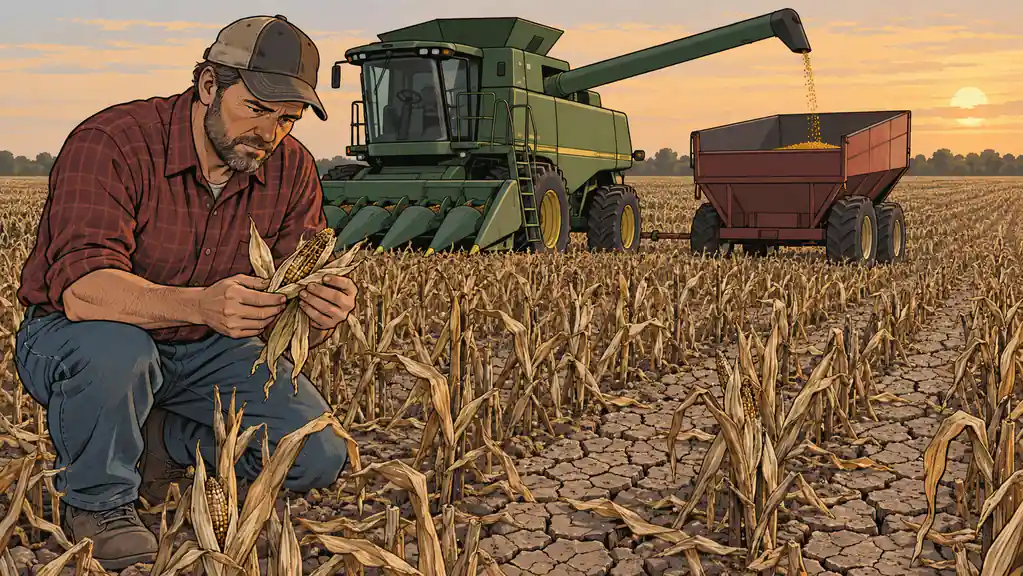
Crop failure is the threat where clear-eyed analysis and prepper folklore split hardest. The folk version is bare shelves and collapse. The real version is a supply shock moving through a well-buffered, globally-connected food system as a price swing and some local scarcity over one crop cycle. For a serious prepper, the payoff here isn’t bracing for famine — in a well-supplied country that’s a thin tail — it’s learning the food system well enough to build a household reserve that actually works as a hedge against price swings and the rare scarcity. It rates a moderate likelihood (periodic, driven by weather and disease) and a low, slow impact for most households — but the analysis rewards rigor, because the worst outcomes cluster in a tail that’s fatter and more correlated than people think. Treat your pantry as what it is: an inventory you manage and a reserve you hold.
Why a small shortfall makes a big price jump
Start with the number that explains everything downstream. Demand for staple food barely bends on price — economists put the short-run price sensitivity of staple food well below one, roughly in the −0.1 to −0.3 range. In plain terms: cut the price in half and people don’t eat twice as much; double it and they don’t stop eating. So supply does almost all the moving of the price. A modest shortfall drives a disproportionate spike.
The 2012 corn crop shows it cleanly. US output fell to about 10.8 billion bushels against a roughly 13 billion forecast — a shortfall on the order of a sixth. Global corn prices spiked roughly 23% in a single month. A one-sixth dent, a near-quarter price jump. That’s inelastic demand doing exactly what the number predicts. From there the shock transmits along the chain: raw commodity → the products made from it → the substitutes people flee to — with the size and timing of each pass-through set by how much of that product’s cost is the commodity itself.
The buffers decide whether it’s a shrug or a spike
Between the field and your receipt sit the shock absorbers. They’re the reason the same weather event is a non-story one year and a crisis the next.
- How full the reserves already are. This is the big one, and the one an advanced observer can actually track. The world and each country carry over stocks from year to year — the stocks-to-use ratio. When stocks are ample, a shortfall gets absorbed and prices barely move. When stocks are already drawn down, the same shortfall produces a sharp spike. Analysts have long tied low grain stocks-to-use to price-spike years — both the 2007–08 and 2010–11 crises hit when stocks were historically tight. The state of the reserves entering the failure matters as much as the failure itself. The USDA publishes stocks-to-use every month in its WASDE reports; you can literally read the shock absorber’s charge level before the shock.
- Sourcing from everywhere. Multi-region, multi-hemisphere supply means failures in different places offset each other — as long as those failures are independent. Hold that word; it’s where the tail lives.
- How easily people substitute. The more readily buyers swap away from the failed crop, the more the shock spreads thin across the food basket instead of concentrating on one item.
- What governments do. Releasing reserves and opening trade dampen a shock. Export bans — like Russia’s in 2010 — amplify it, as producers hoard and everyone else scrambles. Policy is part of the system, and sometimes it’s the part that makes things worse.
The design insight: the path from harvest to household is lumpy and depends on the starting state. The same drought is a shrug in a high-stock, well-spread year and a serious spike in a low-stock, already-stressed one. So you don’t just watch the weather — you watch the reserves.
The failure that actually matters: when everything breaks together
Every buffer above rests on one assumption — that failures are independent, so one region covers for another. The tail worth respecting is the one where that assumption breaks: several major growing regions failing at the same time.
- Synchronized weather. Big climate patterns — El Niño and La Niña (ENSO), and other large-scale atmospheric links — can push bad conditions across multiple breadbaskets at once, turning a set of independent risks into a single event that overwhelms the “we source from everywhere” cushion. This “multiple-breadbasket failure” risk is an active research area precisely because it breaks the independence that diversification leans on. There’s growing evidence we may be facing this in 2027.
- Hidden shared weak points. Genetic sameness in major crops, a common dependence on the same fertilizer or fuel or a handful of exporting regions, and concentrated growing geography all create correlations you can’t see on the shelf. One pathogen, one input disruption, one regional conflict can hit “diversified” supply that was secretly concentrated.
- Buffers already empty. A failure that lands when stocks are low, or on top of other supply-chain stress, produces an outsized effect — the price sensitivity biting hard on an empty reserve.
This tail is low-probability but high-consequence, and it’s the honest reason to hold reserves deeper than a normal pantry. You’re not predicting famine. You’re carrying insurance against the rare year the system’s independence quietly fails.
Likelihood and impact, across the whole spread
Likelihood: moderate and periodic. Somewhere, a meaningful regional failure hits on multi-year cycles from weather and disease, and climate variability plausibly raises the frequency and severity of the weather-driven ones. But the household-relevant number is really a spread of severities: frequent mild wobbles, occasional significant regional spikes (a major one somewhere every few years — 2010, 2012), and rare correlated multi-region shocks like 2007–08.
Impact: low and slow in the usual case — a budget effect over months, which anchors the low score. But run the full spread:
- The bill hits everyone at once. Food-price increases are broad and regressive, landing on every household together and stacking with other inflation.
- People trade down in nutrition. Price pressure shifts diets toward cheaper, often less nourishing food — worst for the constrained.
- The pain concentrates. Low-income and single-staple-dependent households absorb far more than the average; the average hides them.
- The escalation path. In the correlated tail, real local shortages, rationing, and export controls become possible — the scenario that links this threat to broader instability.
Engineering the household reserve
Run the larder as a managed inventory with three jobs: buffer what you eat, hedge the price, and cover the scarcity tail.
1. Depth and rotation as a policy, not a pile. Set a target coverage horizon — weeks to months of normal eating, deeper if you’re hedging the tail — and run it first-in, first-out, folded into normal buying. The pantry is forward-bought groceries, constantly eaten and replaced, so the carrying cost is near zero and spoilage is designed out. Track quantity against how fast you eat it, so “days of coverage” is a known number, not a guess.
2. Buy storable staples against the cycle. Concentrate depth in shelf-stable, calorie- and protein-dense, long-life commodities — grains and rice, dried legumes, pasta, oats, fats and oils, canned and freeze-dried proteins and vegetables, plus salt, sugar, and long-life dairy. Accumulate when prices are low, draw down when high. That’s textbook hedging of a volatile input cost, and staples’ shelf life makes it nearly risk-free. Store against the four enemies of shelf life — heat, moisture, oxygen, light (and pests). Low-moisture, low-oil staples (wheat, white rice, dried beans, oats) sealed in Mylar with oxygen absorbers, kept cool and dark, can last 20–30 years. Temperature is the decisive knob: roughly every 10°F above ~70°F cuts shelf life in half, so a 70°F closet buys you years a 90°F garage throws away. And the food has to be dry going in — moisture at or below about 10% — or you’re sealing in spoilage.
3. Diversify against the correlations you can’t see. Deliberately spread reserves and diet across multiple crops, food groups, and supply origins, so no single crop, pathogen, region, or input failure is decisive — the household version of not betting the whole account on one position. Watch for the hidden overlaps: many products trace back to a few base commodities, so “variety” on the label can be concentration underneath. Include some items whose supply chains are structurally different from your staples.
4. Some production and processing — scoped honestly. Preservation skills (canning, dehydrating, freezing, fermenting) turn cheap seasonal surplus into stored reserve and cut waste, extending the reach of counter-cyclical buying. Home production — a garden, and where feasible small livestock or perennial food — adds a partly independent supply, valuable as both a hedge and a skill. But scope it straight: for most households the realistic calorie contribution is a supplement, not a substitute. Even the WWII victory-garden peak — some 20 million gardens supplying roughly 40% of the nation’s fresh vegetables — was producing vegetables, largely water and micronutrients, not the calories and protein that keep a person alive. Closing the calorie gap takes staple grains, legumes, fats, and animal protein at a scale few backyards reach. Storage and diversification stay the load-bearing measures.
5. Read the leading indicators. The advanced edge is watching the system’s charge level: stocks-to-use, growing conditions in the major regions, and emerging export-policy shifts all give you warning to accelerate your cheap buying before the spike fully reaches retail. You’re front-running the price signal with the same fundamentals the commodity desks watch — and you have the WASDE report for free.
Readiness here is days of assured coverage, buying flexibility, and spread-out dependencies — not dollars. The target: a rotating reserve deep enough to decouple what you eat from short-run price and availability swings, weighted toward long-life staples bought cheap, spread against correlated failure, and backed by preservation and some production — so ordinary crop failures are invisible to your household and even a severe correlated shock is a managed inconvenience.
Community and scale
A single pantry, however deep, is one household’s buffer. A sustained, multi-region shock is bigger than that. What extends past your own shelves is a few prepared households and a bit of local production: shared bulk buying, a grower or two nearby, seed and skill sharing, and a preservation setup that can put up a neighbor’s surplus. This isn’t the survivalist fantasy of feeding the block; it’s the plain fact that a longer shock is easier to ride when a handful of families aren’t all hitting the empty shelf in the same week. It’s the highest-order hedge, and the one a bucket-counting mindset skips.
Honest uncertainty
Say the quiet part: nobody can call the timing or the severity of the next failure, and the correlated tail is exactly the kind of low-frequency risk humans estimate badly. The response isn’t a confident forecast — it’s a reserve sized so you don’t need one. You hold enough that a mild year is invisible and a bad year is manageable, and you watch the indicators so you can lean in early. That’s not predicting the shock; it’s making yourself indifferent to it.
How you know you’re ready
- You can state your coverage in days, because you track quantity against how fast you eat — not “we’ve got a bunch of rice.”
- Your depth is weighted toward long-life, calorie-dense staples stored cold, dry, and dark, so it’ll actually be good when you reach for it.
- Your diet and your reserve are spread across enough crops and origins that no single failure is decisive.
- You’ve buttoned up preservation with tested USDA/NCHFP methods, not internet guesswork.
- You check stocks-to-use and major-region conditions occasionally, so a building spike isn’t news to you.
- An honest look confirms this reserve is already earning its keep against ordinary grocery inflation — so the crop-failure scenario is just one more thing it happens to cover.
Bottom Line
- Because staple demand barely bends on price, a small shortfall makes a big spike — and how big depends as much on the world’s stocks-to-use entering the failure as on the failure itself.
- The system’s resilience assumes independent failures; the tail to engineer against is a correlated, multi-region failure (ENSO-driven weather, shared inputs), where diversification quietly breaks.
- Run the larder as a first-in, first-out inventory hedge: set a coverage horizon, rotate through normal eating, and buy long-life staples when they’re cheap — stored cold, dry, and dark for the 20–30 year life.
- Spread against hidden correlations across crops, food groups, and origins, and add preservation and some production — scoped honestly as supplements to storage.
- Read the leading indicators (stocks, conditions, export policy) to buy ahead of the retail spike, and measure readiness in days of coverage, not dollars.
Crop failure rewards the analyst, not the alarmist. Read the system’s buffers, hold your own reserve against the year they fail together, and a bad harvest becomes a line item you already hedged — not a crisis you’re caught in.
Engineer your rotating reserve — coverage horizon, staples, and expiry tracking — with the Food & Water Storage tool.