When people picture World War 3, they picture a duel. The United States against China over Taiwan. The United States against Russia over Ukraine or the Baltics. One enemy, one theater, one problem to solve. It’s a comforting frame because it’s a manageable frame — a fight you could imagine winning by concentrating force.
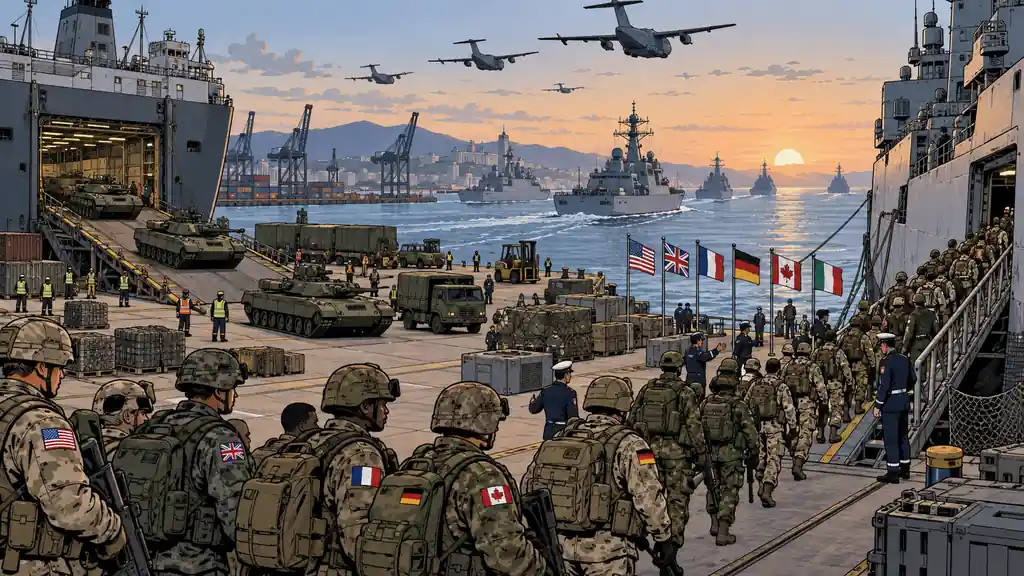
The uncomfortable version is that our adversaries aren’t lining up to fight us one at a time. Russia, China, Iran, and North Korea are already cooperating militarily — joint drills, shared arms, and, in the case of Ukraine, troops and weapons flowing to Russia from all of them. They coordinate the way NATO coordinates. And if you take that coordination seriously, the shape of a future great-power war changes completely. It stops being a duel and becomes something much worse: the United States against all of them, at once.
Four fronts, not one
Here’s the structure that falls out of that cooperation. Line up the likely flashpoints and you don’t get one war — you get four near-simultaneous ones:
| Party 1 | Party 2 |
|---|---|
| Russia | NATO |
| China | Taiwan & Japan |
| North Korea | South Korea |
| Iran | Israel |
Now look at the right-hand column. The United States is allied with every party on it. NATO obligates us in Europe. We have standing commitments and forces tied to Taiwan, Japan, South Korea, and Israel. So four regional conflicts on four different continents don’t stay regional for us — they collapse into a single, simultaneous demand on one military. That’s the whole problem in one sentence: our adversaries can pick the timing, and our alliances mean we can’t pick the number of fronts.
Since World War 2, the military posture of the United States has been the ability to wage war on two fronts at once. Prior to this we never expected to need it, and we learned our lessons during that war. As a result, we’ve built a military to fight two fronts at once. That’s the good and the bad - we can multitask, but not four different ways.
This isn’t a fringe reading. NATO Secretary General Mark Rutte made effectively the same argument in an interview reported by The New York Times in July of 2025. His scenario was blunt: if Xi Jinping moved on Taiwan, he’d first call Putin and ask him to “keep them busy in Europe by attacking NATO territory.” Rutte’s framing was that the two moves would be coordinated — a Pacific war and a European war lit deliberately at the same time to split the response.
Rutte also pointed at the cooperation directly, noting that the Russians are “working together with the North Koreans, with the Chinese and Iranians” in the war against Ukraine. That’s the part worth sitting with. The coalition isn’t hypothetical. It’s already operating — in one theater — right now.
Military cooperation & integration
As I said, Russia, China, North Korea and Iran have been working together actively in Ukraine, but also in other areas:
Maritime Security Belt
Beginning in 2019 and most recently in February of 2026, China, Russia and Iran have conducted regular joint naval exercises in the Gulf of Oman and the Indian Ocean.
The “Ocean” drills
During Russia’s massive multi-theater “Ocean” naval exercises in 2024 (Russia’s largest exercise in over 30 years), China participated with vessels in the Pacific portions and North Korea joined as an official “observer”.
”Joint Sea” drills
China and Russia conduct annual highly synchronized drills. The most recent, conducted in July 2026, was held in the Yellow Sea — the body of water separating China and the Korean Peninsula.
Naval Flotilla patrols
In 2022 and 2023, Russian and Chinese warships joined in large naval exercises. The 2022 exercise included seven warships and was only 86 miles from Alaska. The 2023 exercise included eleven warships near the Aleutian Islands. In the 2023 exercise, the US military responded by deploying 4 Navy destroyers to the area.
Coast Guard patrols
In October 2024, a formation of two Chinese Coast Guard (CCG) and two Russian Border Guard ships transited the Bering Sea. They remained only 5 miles within the Russian Exclusive Economic Zone. Following this, the CCG announced it had crossed through the Bering Strait into the Arctic Ocean for the first time in history.
Joint Air Force missions
In July of 2024, two Chinese H-6 bombers and two Russian Tu-95 bombers took off from the same base in northern Russia to fly a joint strategic air patrol. The aircraft flew within 200 miles of the US and Canadian coasts.
Logistics integration
On September 7, 2026, Russia and North Korea officially opened the Yakov Novichenko bridge as the first permanent road corridor linking the two countries. It was constructed to be a secure, long-term military transport corridor that is immune to international maritime interdiction.
Russia and Iran have established a heavily guarded, continuous supply route through the Caspian Sea.
The preparations are visible
The other side of this is what NATO’s own members are doing. You don’t spend money and political capital on wartime measures for a threat you think is imaginary. Over the last two years, we’ve seen significant news come out in this space:
- March 2025 — Poland introduced mandatory military training for every adult male.
- March 2025 — Norway began restoring Cold War-era military bunkers.
- June 2025 — Reporting surfaced that Western intelligence believes Putin is preparing for a large-scale conflict with NATO by 2030.
- August 2025 — Germany’s cabinet passed a bill to allow conscription — a draft — if needed.
- August 2025 — Germany announced a goal of doubling military spending.
- August 2025 — French hospitals were ordered to prepare, by March 2026, to handle casualties from a major engagement.
- November 2025 — Poland expanded its earlier announcement to provide basic survival, medical triage and threat response training to 400,000 citizens by 2027.
- November 2025 — The Netherlands distributed emergency preparedness manuals directly to every household in the country.
- January 2026 — Sweden advanced a long-term budgetary framework to massively scale up its civil defense infrastructure, spending $2.1 billion by 2028, a near ten-fold increase from its 2022 baseline.
- February 2026 — Germany followed France’s directive and finalized updates to its own federal civil-defense frameworks, overhauling regional hospital data structures to seamlessly integrate mass-casualty triage systems in coordination with NATO military transport commands.
You don’t have to accept any single item to get the signal. The direction is what matters: multiple NATO governments, independently, are reintroducing conscription, hardening infrastructure, and telling their hospitals to get ready. That is not the behavior of countries that expect the next twenty years to look like the last twenty.
The US is preparing for war as well.
It’s not only NATO and our potential adversaries that are preparing for war - the United States is as well.
- March 2021 — During testimony before the Senate Armed Services Committee, Admiral Philip Davidson, then-Commander of U.S. Indo-Pacific Command said, “Taiwan is clearly one of their ambitions… I think the threat is manifest during this decade, in fact in the next six years—meaning by 2027.”
- September 2021 — Air Force Secretary Frank Kendall delivered a speech where he said, “We are running out of time. If we do not change how we do business to match the 2027 timeline, we run the risk of losing before the fight even begins.”
- March 2024 — During a congressional hearing, Admiral John Aquilino said, “all indications point to the PLA meeting President Xi Jinping’s directive to be ready to invade Taiwan by 2027… we must act with a greater sense of urgency every day.”
- April 2026 — Launch of the U.S. Army’s largest structural redesign in decades, dubbed “The Great 2027 Transformation”. It would cut legacy units to pivot toward long-range weapons systems and hypersonic missile integration.
- July 2026 — During high-level defense summits, the Pentagon issued European allies a policy brief that contained a firm deadline of 2027 to independently assume conventional deterrence burdens so that the U.S. could allocate heavy strike assets to the Pacific theater.
- August 2026 — INDOPACOM Chief, Admiral Samuel Paparo, issued an urgent directive, explicitly demanding immediate funding increases for Pacific defenses to meet the 2027 readiness window.
- August 2026 — The Pentagon initiated the largest doctrinal nuclear shift in decades, supposedly prompted by intelligence detailing coordinated efforts between Russia and China.
How it would actually play out
Before I get into a scenario, I want to first give a real-world example. Once upon a time, I was very active in full-contact martial arts (essentially MMA before MMA was a thing). I’m not a very big guy, so generally when sparring, I’m fighting at a disadvantage in height, reach, weight, etc. Do you know how you fight when you’re at a physical disadvantage? There are two key points:
- You strike first, and you don’t let up — because if you give them an inch, they’ll use their advantages to beat you.
- You use what you do have as an advantage. Smaller guys fight better in close, so that’s what I would do — close the distance and fight from “inside” their reach. I’m also good on the ground, so I would use that to my advantage as well.
The key is to not let their advantages come into play and leverage my own. This is essentially the same playbook that our adversaries would use against the United States.
The US is the big, muscular, well-trained, experienced fighter in this analogy. And the response from China, Russia, or any other “smaller” fighter will be the same. As a result, they’ll follow my playbook and do two things:
- They’ll strike first. If they see a fight as “inevitable”, they won’t wait for a small skirmish to escalate — they’ll hit first with the goal of it being a knockout.
- They’ll use their advantages — hypersonic missiles being a major one.
Think about it. If you were on the other side — if you were China or Russia planning to fight the United States — your first objective wouldn’t be to win a long war. It would be to take the U.S. out of the fight as fast as possible, before American industrial and military weight could be brought to bear. We have a bigger navy and bigger air force than either, both with better capabilities (excluding hypersonic missiles). Destroying these capabilities is the only way they can win. That single objective drives a very specific playbook. Here are the moves an adversary might make, in some combination:
- Long-range missile strikes on the U.S. Navy — aircraft carriers and destroyers first, because they’re mobile launch platforms for retaliation using nuclear weapons and the primary way we project military might around the world.
- Strikes on land-based nuclear silos and key military bases — to eliminate the fixed leg of the strategic arsenal on the ground.
- An EMP attack against the continental United States — to blind and disable the remaining means of coordination and limit the ability for the US industrial base to rally.
- Nuclear decapitation strikes on Washington, New York, NORAD, and other command-and-decision centers.
Follow that logic to its end and you find the genuinely chilling part. Those four moves, executed together, would remove nearly every leg of American nuclear capability except the submarines already at sea. And here’s the trap in the design: if the strikes also erased the civilian and military command structure as I suspect would occur, it’s not clear the surviving subs would ever launch. They can launch independently — but a submarine commander with no chain of command, no intelligence, and a destroyed homeland can’t be sure whom to retaliate against. The strategy isn’t just to win the exchange. It’s to sever the authority to answer it at all.
The goal of a first strike like this isn’t to survive a nuclear war. It’s to make sure the other side never gets to have one — by killing the decision, not just the weapons.
That’s a sobering conclusion, and it’s speculative by nature — no one has run this experiment, and I’d rather flag the uncertainty than pretend the scenario is a forecast. But it’s the kind of cold reasoning that competent adversaries actually do, and it explains why the smartest people watching this are not relaxed.
Where this sits on your list
Here’s the honest part. A four-front great-power war is, by any measure, low-probability — and if it happened at the scale above, no household stockpile “solves” it. That’s exactly the trap. Because it feels unsurvivable, people file it under nothing I can do and move on. That’s the wrong instinct twice over.
First, the results of this scenario — the ones that would actually reach your street — are the same threats you should already be preparing for: grid failure, an EMP, supply-chain collapse, economic shock, and the disruption that comes long before any warhead does. Preparedness for a “normal” grid-down month is most of the preparedness for the opening days of this scenario. You don’t need a separate plan; you need a deeper version of the plan you already have.
Second, this is precisely the kind of low-likelihood, catastrophic-impact threat that you should not discount. You don’t reorganize your whole life around it. You rate it honestly, place it on the list, and let it earn its share of attention — no more, no less.
Bottom Line
- Assume coordination, not a duel. The realistic worst case isn’t America versus one rival — it’s a coordinated, near-simultaneous war on multiple fronts, timed by the other side. Plan for the possibility that help and attention are split.
- Prepare the precursors, because those are what reach you. Grid-down, EMP, supply-chain, and economic disruption are the survivable edges of this scenario and the threats you can actually do something about. Depth there is depth here.
- Rate it; don’t obsess over it. It’s low-probability and high-impact. That combination earns it a place on your threat list and a measured share of your effort — not the top slot, and not the trash.
- Watch the signals. Conscription laws, bunker restoration, and hospital surge orders across NATO are the kind of leading indicators worth tracking. If the direction accelerates, so should your timeline.
Rate this against everything else on your list before it eats attention it hasn’t earned using the Threat Planning tool, and if you want to understand the physics of the decapitation logic above, walk through it using the Detonation Simulator.