


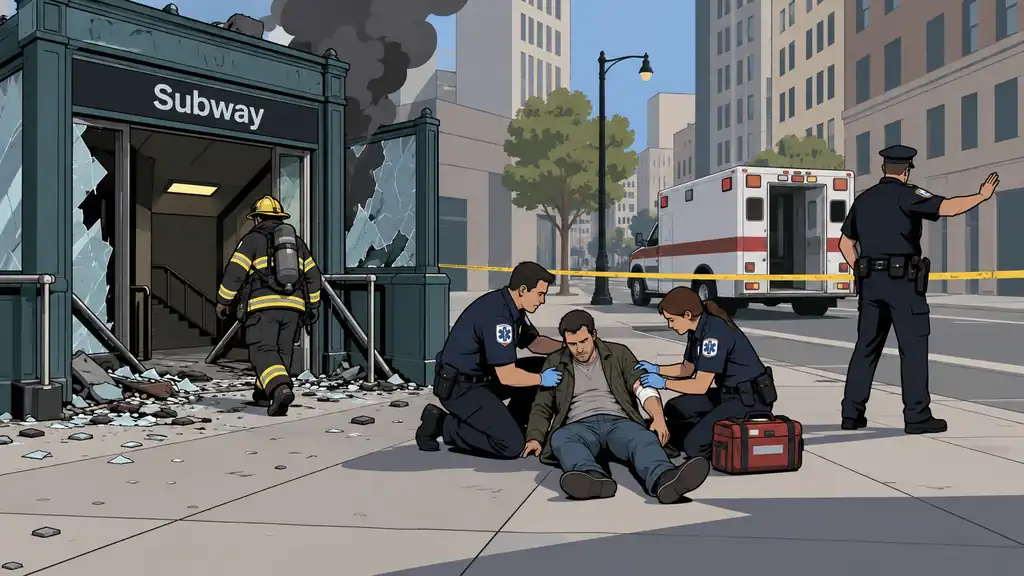
Terrorism sits in a strange spot on any honest threat list: low odds of touching you personally, huge weight in your head, and a disruption footprint far bigger than the physical one. The word “terror” is the whole mission — the point is to scare millions through a rare event that harms very few. For a prepper who thinks in numbers, that sets up one specific discipline: don’t let the fear an event is designed to create warp how you spend your time and money, and still build the genuinely useful stuff that an attack — or any crowded-place emergency — actually calls for. The good news is that the useful stuff isn’t specialized. It’s the same awareness and communication that serve you across a dozen scenarios.
Split the threat in two
The one analytical move that fixes most people’s thinking is to separate two very different numbers:
- The physical risk to you personally — genuinely low. Attacks are uncommon and usually hit a small area. Your chance of being inside the actual attack radius in a given year is small enough that reorganizing your life around it makes no sense.
- The disruption that spreads out from it — potentially large. One incident can shut down regional transit, jam the cell network for hours, tighten security everywhere, ripple through the economy, and scramble normal life for a whole metro for days.
Most preppers instinctively prepare for the first — the blast — and neglect the second. But it’s the second that actually reaches them. That’s not the attack touching you; that’s the aftermath. Turning your attention toward the aftermath is what makes your prep both proportional and useful.
Read the record for the pattern, not the horror
Terrorism spans a wide range — from mass-casualty attacks like 9/11 (2,977 killed), which reshaped national security policy, to the 1995 Oklahoma City bombing (168 killed), to smaller attacks on crowds and transit like the 2013 Boston Marathon bombing (3 killed, roughly 260 injured), 2025 Bourbon Street Truck Attack (14 killed, 57 injured), or the 2002 DC Sniper Attacks (10 killed, 3 critically injured). Read them for the mechanism rather than the shock, and the same lessons repeat for the ordinary bystander:
- The phone network jams in minutes — from congestion, not damage. Everyone in the area calls and texts at once and the network chokes. Voice calls fail first; texts and data get through better. Families can’t confirm the others are safe at exactly the moment the anxiety peaks.
- Transportation locks up. Transit halts, roads close for the response and investigation, and “just get home” turns genuinely hard.
- Information is a mess. Early reports are frequently wrong. Rumors of a second attack spread. The real picture lags the panic by hours.
- The fear does more damage than the blast. The whole intent is to make millions afraid, and the overreaction routinely costs more than the attack itself. 9/11 killed 2,977 people directly; Brown University’s Costs of War project estimates the two decades of post-9/11 wars that followed cost the US roughly $8 trillion and hundreds of thousands of additional lives. The aftermath dwarfed the attack.
Every one of those is something you can prepare for without knowing the attack in advance — and every one of those preparations gets reused.
The odds — low, and say so plainly
On any honest scale this rates near the bottom for likelihood, and stating that flatly matters. For any given person in any given place, a terrorist attack is rare. You are vastly more likely to face a house fire, a serious car wreck, a medical emergency, or a job loss. Under-hyping this isn’t negligence — it’s accuracy, and it’s a correction to a news environment that systematically inflates it.
So why prepare at all? Two reasons. First, the preps that help are dual-use — they serve many likelier emergencies. Second, practicing proportion here — matching effort to real odds instead of to fear — is itself a skill. If terrorism teaches a prepper one durable lesson, it’s that how scared you feel is a terrible guide to how you should spend.
What it actually costs you
For the small number of people physically present, the danger is immediate and there’s little a general prepper can do about being in the wrong spot at the wrong moment beyond basic awareness and knowing how to react — move away, get to cover or an exit, help the injured.
For the vast majority affected, the cost is indirect and manageable:
- A comms blackout from congestion — hours of not being able to reach the people you love.
- Being stranded — stuck at work, school, or mid-commute, with getting the family back together suddenly complicated.
- Fog — not knowing what’s real, whether it’s over, or what to do.
- Days of aftermath — heightened security, transit disruptions, and economic and emotional ripples.
The thing worth planning against isn’t the explosion. It’s a family scattered across a city that just lost its phones and its transit at the same time, each person unable to confirm the others are okay. That’s a solvable problem with a plan and a night of panic without one.
Put a number on why the plan matters. Say your office is 8 miles from home. On foot, at a normal walking pace of about 3 miles an hour, that’s a two-and-a-half to three-hour walk — completely doable in the shoes and jacket stashed in your desk, and a miserable, maybe impossible, night in dress shoes and no water. The plan is the difference between a long walk and a crisis.
What preparedness looks like
Keep it proportional and dual-purpose.
1. Awareness as a habit, not paranoia. In crowded places — transit, stadiums, events — quietly note where the exits are and keep a simple trigger: if something feels wrong, you leave. The standard response to an active attack is “run, hide, fight” — get away if you can, hide and barricade if you can’t, and resist only as a last resort. That same awareness serves you in a fire, a crowd crush, or any sudden danger.
2. A real family communication plan — the highest-value prep.
- Pick an out-of-area contact as the family hub. Long-distance routing and texts often get through when local calls won’t. Everyone checks in with that one person instead of trying to reach each other directly and clogging the local network further.
- Text, don’t call. A text uses a sliver of the bandwidth a voice call does and slips through congestion far better.
- Set meeting points — one near home, one near work or school, and a regional fallback — and make sure the kids know the plan cold.
- Structure it as PACE — Primary, Alternate, Contingency, Emergency ways to make contact — so one failure doesn’t cut you off completely.
3. Get-home capability.
- Know more than one route home from the places you’re regularly at, on foot if it comes to that, since transit and main roads may be closed.
- A modest get-home bag — water, a snack, comfortable shoes, a light, a charged power bank, a small first-aid kit, and some cash — turns a stranded evening into a non-event. That bag serves every “stuck away from home” situation, not just this one.
4. Information discipline. Have a trusted way to get verified information — official alerts, reputable sources — and the discipline to discount the early rumors and unconfirmed second-attack claims that always circulate.
5. Proportion in what you spend. Deliberately cap what you put toward this compared to likelier threats. The right stance is calm competence, not fear-driven buying. Refusing to overreact is itself a form of resilience — and it happens to be the exact thing terrorism is built to defeat.
Bottom Line
- Split the threat — low physical odds for you, high disruption reach for the region. Prepare for the reach.
- The aftermath is the real event — jammed phones, halted transit, and rumor are what actually touch most people.
- A PACE family communication plan is the keystone — an out-of-area contact, text over voice, and meeting points everyone knows.
- All of it is dual-use — awareness, a get-home bag, and a comms plan serve a dozen likelier emergencies.
- Refuse the fear tax — keep spending and attention matched to real odds; overreaction is the attack’s actual goal.
Terrorism’s weapon is fear, and its target is your judgment. The prepared answer isn’t more fear — it’s a calm awareness habit and a plan to find your family when the phones go down.
Structure your family’s contacts, methods, and meeting points into a PACE communication plan.