


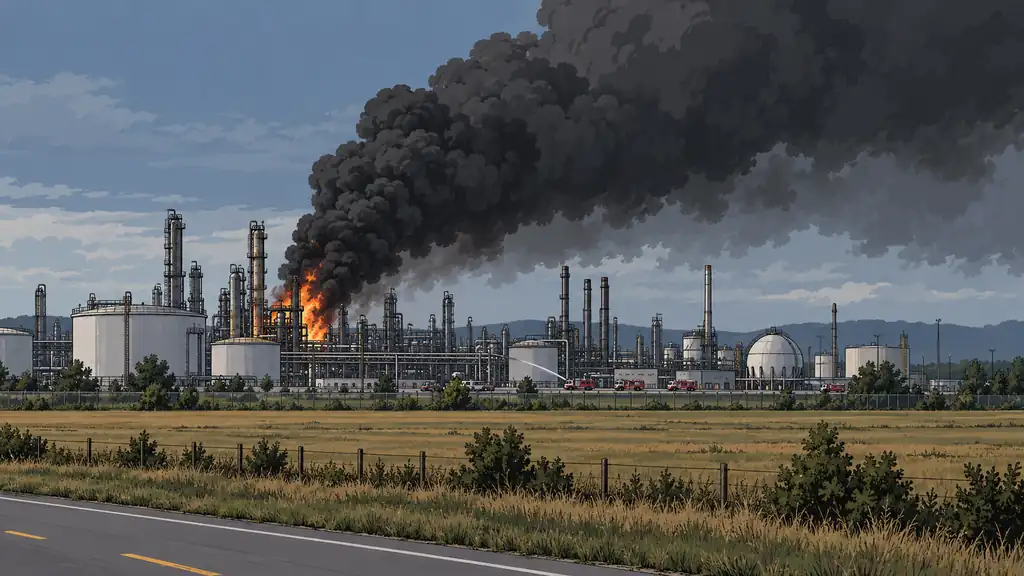
Most threats you prepare for scale with time or severity. This one scales with where you live. An industrial or pipeline accident rates a 2 out of 9 for likelihood across the country — genuinely rare — but a 7 for impact where it lands. That gap is the whole story. The risk isn’t spread evenly across the population; it’s packed into a ring around every refinery, chemical plant, rail corridor, and buried pipeline. Your job is two steps: first, find out whether you live in one of those rings. Second, build the two very different responses these events demand.
This is the threat you research your way out of, not stock your way out of
For most threats, you buy supplies. For this one, the most valuable thing you can own is information — a clear picture of the industrial hazards around your home and your workplace. A household with a modest go-bag and an accurate map of what runs past the street is far better off than one with a huge stockpile and no idea a high-pressure gas line crosses the backyard. You figure this one out before you ever supply for it.
The three ways it goes wrong
Industrial and pipeline failures fall into a few recognizable shapes, and the shape tells you what to expect:
- Pipeline ruptures. High-pressure gas and hazardous-liquid lines run under neighborhoods, roads, and rivers, unseen. When one fails, you usually get a large fire or explosion right around the break. The 2010 San Bruno, California disaster is the standing example: a 30-inch PG&E gas transmission line ruptured in a residential neighborhood, and the blast and fire killed 8 people and destroyed 38 homes — and most residents never knew the line ran beneath their street.
- Toxic release accidents. A plant failure can release hazardous material that drifts downwind as a cloud, forcing people out far beyond the site itself — and the danger zone is set by wind, not by the fence line.
- Plant explosions and fires. Refineries, chemical storage, and fertilizer facilities that fail hard, damaging nearby buildings and triggering orders to either evacuate or seal up. A recent example is the March 23, 2026 explosion at the Valero Oil Refinery in Port Arthur, TX. Nearby residents had to shelter in place, and thankfully no injuries were reported.
The common thread across all three: little warning, a hazard that develops fast, and a damage zone set by how close you are and which way the wind blows. That tells you exactly what to prepare — a decision you can make in the few minutes you’ll actually have.
Likelihood — low, but bunched up
The national 2 is honest: the average person will probably never be touched by one of these. But an average hides the concentration. If you live or work within a mile of a hazardous facility, or near a major pipeline or a rail line hauling hazardous cargo, your own odds are far above the national number. And if you’re in a purely residential area with no industry and no transport corridors nearby, you can rate this low and move on with a clear conscience.
So the honest takeaway is this: you can’t rate this threat until you localize it. The generic number is nearly useless. Your address-specific number is the one that matters, and finding out which one you are is the first and most important task.
Impact — the footprint and its knock-on effects
Impact rates a 7 because where it lands, it’s severe and hits several ways at once:
- Immediate physical hazard. Blast, fire, or a toxic cloud — injury or death close to the source, and property damage to nearby buildings.
- Forced evacuation. Orders can move thousands of people on a few minutes’ notice. The roads clog, and the same routes everyone else needs become the bottleneck.
- Cut services. A serious accident can knock out power, gas, or water to an area and close roads and rail for a long stretch — turning a local event into a days-long disruption for a wider region.
- Fouled air and water. A chemical release can make the air unsafe to breathe down a whole downwind corridor and can contaminate local water, dragging the impact well past the initial event.
The planning insight is that the hazard is directional and distance-driven. Two houses on the same street can face completely different situations depending on which side of the cloud they’re on. That’s why the response isn’t one plan. It’s two opposite ones.
What preparedness looks like
Knowledge first, then a two-mode response, then a way to get warned.
1. Map what’s around you
Do the recon now, calmly, while nothing is on fire:
- Find the pipelines (gas and hazardous liquid), the fixed facilities (chemical plants, refineries, fertilizer and ag-chemical storage), and the transport corridors (rail lines and major truck routes) within a few miles of home and work.
- Note the usual wind direction for your area — it tells you which facilities put you downwind, and those are the ones that matter most for a drifting cloud.
- Talk to long-time neighbors and local officials. They often know the history the maps don’t show.
The output is a simple map, on paper or in your head: what’s near me, in which direction, and which way does the wind usually carry it.
If you want help doing this, we developed the Area Recon tool specifically for this purpose - it has maps containing pipelines, hazardous plants and even the prevailing wind directions.
2. Build both responses: leave, and seal up
These events demand one of two opposite actions, and the authorities will tell you which. Prepare both, so you can do either without freezing:
Evacuation. Keep a go-bag — three-plus days of essentials: water, meds, documents, clothes, chargers, cash — staged and ready. Plan at least two routes out of your area, because the obvious road may be the exact one that’s closed or gridlocked. Keep the vehicles at least half full of fuel. Set a family meeting point and an out-of-area contact everyone can check in with.
Shelter-in-place. For a toxic cloud, staying inside and sealing up is often safer than driving through it. Know how: go inside, close and lock every window and door, shut off the HVAC, fans, and anything that pulls in outside air, move to an interior room, and seal the gaps — a roll of plastic sheeting and a roll of duct tape lets you close off a room’s vents and door in a few minutes. Then listen for the all-clear. Do a dry run once so it’s muscle memory.
The skill isn’t either plan by itself. It’s knowing the two are opposites and being ready to switch between them on a moment’s notice, based on the guidance you get.
3. Get on the alert list
You’ll usually get little or no warning of the event itself — the alert system is your early notice. Put every phone in the house on your local emergency notification system (usually run by the county or city), and keep a battery or hand-crank radio as a backup channel for official instructions if the cell network is swamped. It’s free, and it’s frequently the difference between reacting in time and not.
Bottom Line
- Rare for the country, severe up close — your real risk is set by how far you are from the hazard and which way the wind blows, not the national average.
- Map it first — find the pipelines, facilities, and rail corridors around your home before you buy anything.
- Two responses, opposite actions — a ready go-bag with more than one route out, and the ability to seal a room and stay put.
- Get on local alerts and keep a backup radio — usually your only warning.
- Localize before you rate it — this threat is nothing for some people and top-tier for others; find out which you are.
This is the threat where a map beats a stockpile. You can’t flee, or seal out, a hazard you never knew was buried under your street — so the work starts with finding out what’s already there.
See the pipelines and industrial sites around any address with the Area Recon tool, and keep your evacuation routes and shelter plan in the threat plan tool.