


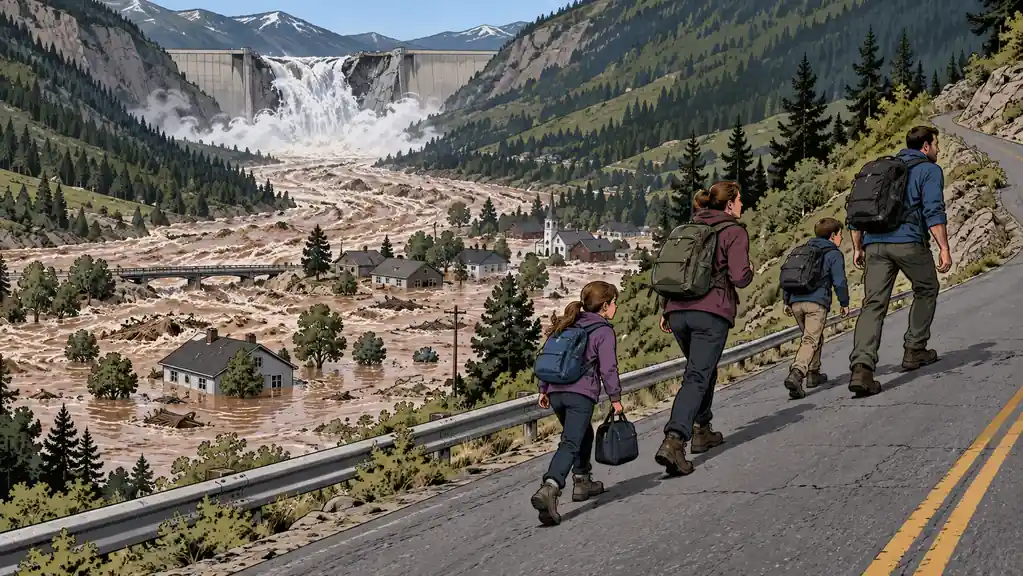
Nearly every threat you prep for, you answer with stuff. Stored water. Backup power. Medical gear. A skill you drilled. Dam failure doesn’t work that way. This is the one hazard where your supplies barely matter and your location and your reaction time are everything. You can’t stockpile your way out of a wall of water that arrives in minutes. Either you’re in the flood path with a route to high ground you’ve already walked, or you’re not. This piece is about answering that one question exactly, and building the only defense that works: getting uphill, fast, on a route you picked in advance.
The one thing that decides this: are you in the path?
Most hazards spread risk across a whole region. Everyone gets some. Dam failure isn’t like that. The danger sits inside the inundation zone — the mapped area engineers know would flood if a specific dam let go — and drops to almost nothing outside it. Outside the zone, your real risk is close to zero. Inside it, you carry a small chance of a total loss.
That changes the whole job. There’s no middle ground to hedge with a bigger pantry. The first and most valuable thing you do is find out which side of the line you’re on. For most people, five minutes of checking takes this threat off the list for good. For the ones who live below a real dam, it becomes one of the most important things they’ll ever plan for — because it’s so survivable with a plan, and so deadly without one.
What the history actually teaches
Dam failures are uncommon, but when they go wrong they go wrong badly — and the lesson is always the same. The 1889 Johnstown Flood (South Fork Dam, Pennsylvania) killed 2,209 people. The 1928 St. Francis Dam collapse in California killed roughly 430. Now hold those against Teton Dam in Idaho, 1976: a brand-new federal dam failed completely and still killed only 11 people — because the towns downstream got word and got out in time.
Read those three together and the pattern jumps out. It wasn’t the size of the dam that set the death toll. It was warning and escape. Two things show up every time:
- The warning was thin or nonexistent. A dam can fail and dump its reservoir faster than any official alert reaches everyone below it. The people who lived usually moved to high ground on their own read of the situation, not because a perfect warning arrived.
- Old dams and overtopping are the modern risk. The average US dam is now about 56 years old. ASCE’s 2025 report card gives the country’s dams a D+, counts nearly 17,000 high-hazard-potential dams — the ones whose failure would likely kill people — with about 15% rated poor or unsatisfactory and roughly a quarter still without an emergency action plan.
The odds: very low, very concentrated
On our scale this sits near the bottom for likelihood, and that’s honest. For any one dam in any one year, failure is rare. Inspection, monitoring, and modern engineering keep catastrophic failures uncommon. You could live below a dam your whole life and never see it fail.
Two things keep it on the list anyway. First, age. A big share of our dams are past the life they were designed for, maintenance gets deferred, and the heavy-rain events that cause overtopping are showing up more often — so the tail risk creeps up over time. Second, the cost of being wrong is total. A tiny chance times a fast, low-warning, life-or-death outcome still earns a plan — especially when the plan is nearly free. That’s not fear; that’s a cheap standing plan for a rare event with an absolute downside.
What the flood actually does
A dam break isn’t a slow river rise you watch creep up the yard. It’s a fast, high-energy surge. Moving water carries far more force than it looks like it should — a foot or two is enough to sweep a person or a car off the ground — and a dam-break flood brings depth and speed together. In the path it takes out homes, roads, bridges, and utilities, and it does it faster than the flooding most people picture.
Here’s why reaction time is the whole problem: your warning is short, and how short depends on how far below the dam you are. Close in, it might be near zero. Farther down, you get more time, but the water has spread to more people. This is not a hazard you shelter in place for, and it’s not one you supply against. It’s one you escape — straight uphill — and the escape has to be fast and already decided, because you won’t have time to figure out a route while the water’s coming.
For the wider region there’s a second wave of trouble: the reservoir is gone (water supply, sometimes hydropower), roads and utilities are wrecked, there’s downstream contamination, and recovery runs long and expensive. But for the household in the path, none of that matters next to the first ten minutes.
What preparedness looks like
The plan is short, and it’s mostly knowledge — not gear.
1. Find out if you’re in the path. This is the whole ballgame.
- Check whether your home, your work, your kids’ school, and the roads you drive every day fall inside a dam inundation zone. Look to your state dam-safety office, county emergency management, and the inundation maps many areas keep (some public, some on request). Find out which dam, how it’s classified, and how far downstream you are — distance is basically your warning time.
- If you’re not in any zone, write that down and move on. That’s a real, evidence-based answer, and you’re done.
2. If you’re downstream, build the escape.
- Find the fastest way to ground above the flood level — not just “away.” Up beats out. You want to climb out of the valley and off to the side, not race the water down the channel.
- Map more than one route, because the flood may cut the first one, and know them for every place you spend real time.
- Walk it and drive it, and time yourself. This is the math that matters: if your fastest safe route takes 8 minutes and the dam a few miles up gives you maybe 15, you have margin. If the route takes 12 against a 10-minute wave, you don’t have a plan yet — you need a closer high spot or a faster way to one.
3. Get every scrap of warning you can.
- Sign up for county emergency alerts (Wireless Emergency Alerts, opt-in text and call systems) and any dam-specific siren or notification program. Assume the alert may lag the water — treat obvious signs (a sudden rise, a roar upstream, an order to evacuate) as your cue to move now, not to go looking for confirmation.
4. Make leaving take seconds.
- A go-bag by the door so getting out needs no packing. Keep the vehicle fueled and the keys and documents grab-ready. “Leave now” should mean no decisions — just go.
Measured in time and effort, that’s it: a five-minute exposure check for most people, and for those downstream, a mapped high-ground route, enrolled alerts, and a grab-and-go bag. Almost no gear. Almost no money. Just the knowledge that buys back the minutes.
Bottom Line
- Answer one question first — are you in a dam’s inundation zone? For most people, that check clears this threat off the board.
- You can’t supply your way out — this is a location-and-reaction problem, not a stockpile problem.
- Escape is straight up, and decided in advance — know the fastest route to high ground, with a backup, for every place you spend time.
- Warning may be almost nothing — sign up for every alert, and treat obvious signs as the order to move.
- Make leaving instant — a ready go-bag and a fueled vehicle so “go now” costs you no time.
You can’t stockpile against a wall of water. For dam failure, the whole plan is knowing which way is up — and having already decided to run for it.
Map your inundation exposure and a high-ground escape route with Area Recon.