


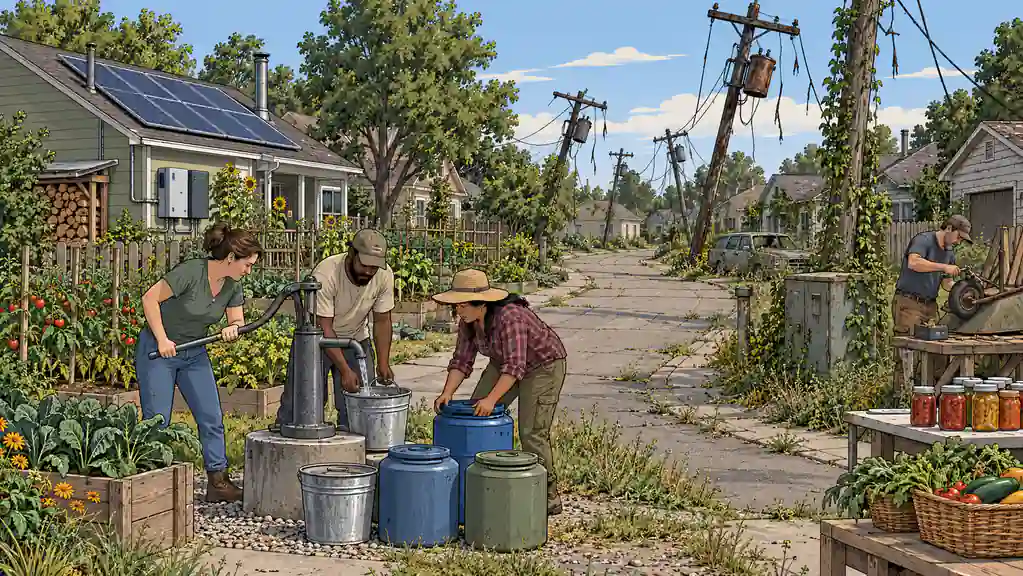
Every prepper eventually runs into the big one: not an outage, not a disaster you recover from, but the permanent version — the grid down for a decade, nobody coming to fix it, self-sufficiency as the only option left. It’s the scenario lots of fiction is built on, and it’s the one that tempts preppers into their worst habit: pouring money and worry into an event so unlikely it crowds out the things that will actually happen. The honest way to handle it is to treat it as a direction, not a destination — a north star you steer by, valuable not because you expect to arrive but because what it asks for is everything the likely emergencies ask for, scaled up.
On a 1-to-9 scale this scores 9 for impact and 1 for likelihood — the highest consequence on the list paired with the lowest odds on the list. That extreme split is the lesson. Respect it, understand it, and keep it in ruthless proportion — because a threat this improbable must never push the car wreck, the job loss, or the blizzard down your priority list.
Why it’s on the list — and why proportion is the point
Preparedness is sorting threats by how likely × how bad. This one is deliberately the far corner: as bad as it gets, as unlikely as it gets. It earns a spot for two reasons. First, honesty — a serious framework names the far edge instead of pretending it isn’t there. Second, and more useful: it’s the one case that contains all the others. Real long-term self-sufficiency in water, food, energy, heat, sanitation, security, and community is just the sum of everything else on the list. Build toward it on purpose and in order, and you’ve covered the whole spectrum of likely emergencies as a side effect.
The discipline that matters is order. You don’t prepare for the decade by buying decade-scale gear first. You prepare by building the things that pay off immediately for common events — a deep pantry, a water plan, backup heat — and letting them deepen over time toward the extreme. Every dollar and hour has to earn its place against a likely threat before it earns anything against the improbable one. That order is the whole difference between real preparedness and apocalypse cosplay.
What history shows — and doesn’t
The most important fact about this scenario is that it’s never happened. There’s no modern precedent for a permanent, nationwide grid collapse. The grid fails locally and regionally, sometimes dramatically, but the outcome is always the same: it gets repaired. The 2003 Northeast blackout put more than 50 million people across the US and Canada in the dark — and power came back in two hours to about four days, depending on where you were. The 2012 India blackouts, the largest in history by population, cut power to about 620 million people (roughly 9% of everyone alive) and were restored in about a day. Even Texas’s brutal 2021 winter-storm outage ran days, not weeks.
Big footprint, short duration — that’s the pattern, every time. The crews, the spare equipment, and the mutual-aid agreements between utilities that put the power back are far tougher than the collapse story assumes. That resilience is exactly why this sits at likelihood 1. History gives you plenty of short grid failures to learn from. Those, not the fictional decade, are what your real planning should center on.
What would even cause it — and the one honest wrinkle
A truly permanent, wide-area grid-down would need a catastrophe severe and sustained enough to block repair indefinitely — itself something at the very bottom of the odds. The usual suspects (a massive coordinated attack, a continent-scale natural event, a full societal collapse) are each remote on their own, and the permanence — never being able to rebuild — is the least believable part, because it means losing not just the grid but the entire ability to fix it.
There’s one real wrinkle worth understanding, though, instead of waving it away. As The New York Times Magazine reported in August 2026, the grid’s biggest power transformers are a genuine chokepoint: they’re imported far more than they’re built here, and average wait times have stretched to multiple years since 2021, with demand expected to more than double. There’s no fast way to swap out many large transformers at once. The same reporting revisited a former federal energy regulator’s warning that a blackout from lost transformers “could last 18 months or longer” — a modeled worst case, not a forecast, but a concrete measure of how slow a deep repair could run. None of that makes a permanent collapse likely. It’s simply why a severe, widespread hit would take months to years to claw back, not the hours of an ordinary blackout — which is exactly why “direction, not destination” is the right way to hold it.
So treat this as a thought experiment with a real payoff, not a forecast. Its worth is in what building toward it teaches you, not in the odds of it happening.
What it would actually do
If it ever came, a permanent grid-down would lay bare how completely modern life sits downstream of electricity. The cascade is total:
- Water fails. City treatment and pumping, and most private wells, run on electric pumps. Before long, no tap water — the fastest thing to turn deadly.
- Food runs out and doesn’t come back. Refrigeration, food processing, and the just-in-time delivery network all stop. Stores empty and don’t restock. Home fridges and most cooking end.
- Heat, cooling, and light go dark. Furnaces (even gas ones need electric controls), all electric heat and AC, and every light — connecting this straight to the blizzard and heat-wave threats at their worst.
- Sanitation fails. Sewer systems that rely on pumping back up; with no plan, waste turns into a disease problem fast.
- Everything else stops. Communications, payments, fuel pumps, medical systems, the whole service economy. Life reorganizes around making the essentials by hand.
The impact is a 9 because surviving past the point where your stored supplies run out means producing — not just storing — water, food, and heat, indefinitely, and defending and organizing to do it. That’s the far edge of self-reliance.
What preparedness looks like
You’re building real, layered self-sufficiency — in the order that pays off for likely events first. Four pillars, each of which also solves a common emergency, so none of the effort is wasted.
Water and food — storage first, growing your own over time.
- Water: get good at storage, filtration, and collection (rainwater, and treating surface water). A water plan is the first thing that fails in any outage, so it pays off immediately — and it’s the non-negotiable base of the extreme case.
- Food: a deep pantry first (it covers every likely emergency), then the slow build toward producing — gardening, preserving (canning, drying), and livestock where you can. Storage gets you through weeks; production is what gets you through years. Build the storage now; grow the production skills over seasons.
Off-grid power, heat, and sanitation — durable and simple.
- Heat: a grid-independent source (a wood stove or similar) with fuel you can store — this solves the blizzard and the winter outage directly, and anchors the extreme case.
- Power: modest, maintainable generation and storage (solar plus batteries) sized to the essentials — lights, comms, water pumping, medical needs. You’re not rebuilding the grid; you’re keeping the critical loads alive. Ordinary outages get solved too.
- Sanitation: a plan for when the toilet quits — composting or bucket systems, keeping waste away from people, hygiene discipline. Unglamorous and decisive; in a long breakdown, disease is what kills.
Low-tech skills — the wealth that doesn’t need power.
- Food preservation, first aid, repair and building, gardening, cooking from raw staples. These pay off exactly when the machines stop, carry across every threat on the list, and make normal life better in the meantime. Skills are the most portable prep there is, and nobody can take them.
Community — the real long-term survival unit.
- No household rides out a true long-term collapse alone; the labor, the range of skills, and the security you’d need are more than any one person has. The deepest prep isn’t a stockpile — it’s a group of capable, trusted people with different skills who can lean on each other. And community carries you through every smaller hardship — job loss, illness, a local disaster — long before any collapse. It’s the highest-leverage prep and the most neglected.
Notice the pattern: every single step earns its keep right now, for likely emergencies. That’s the whole point. You never prepare only for the decade. You prepare for real life, in a way that would also cover the extreme.
Bottom Line
- A decade-long grid-down is one of the least likely things on the list (1/9) and the worst if it came (9/9) — respect it, understand it, keep it in ruthless proportion.
- There’s no historical precedent — real grid failures are regional and get repaired, usually in hours to days. That resilience is why permanence is so improbable.
- Treat it as a direction, not a destination — the one case that contains all the others, its needs being every likely emergency’s needs scaled up.
- Build the four pillars in order — water/food, off-grid power/heat/sanitation, skills, community — each of which solves a likely threat first.
- The discipline is order — never let the improbable decade crowd out the near-certain everyday emergencies. Prepare for real life in a way that would also cover the extreme.
You will almost certainly never see the permanent blackout. Aim at self-sufficiency in honest proportion anyway — because the road to being ready for the impossible runs straight through being ready for everything likely.
Build the foundation that serves both the likely and the extreme — plan storage and production with Food & Water Storage and size off-grid power with the Solar calculator.