


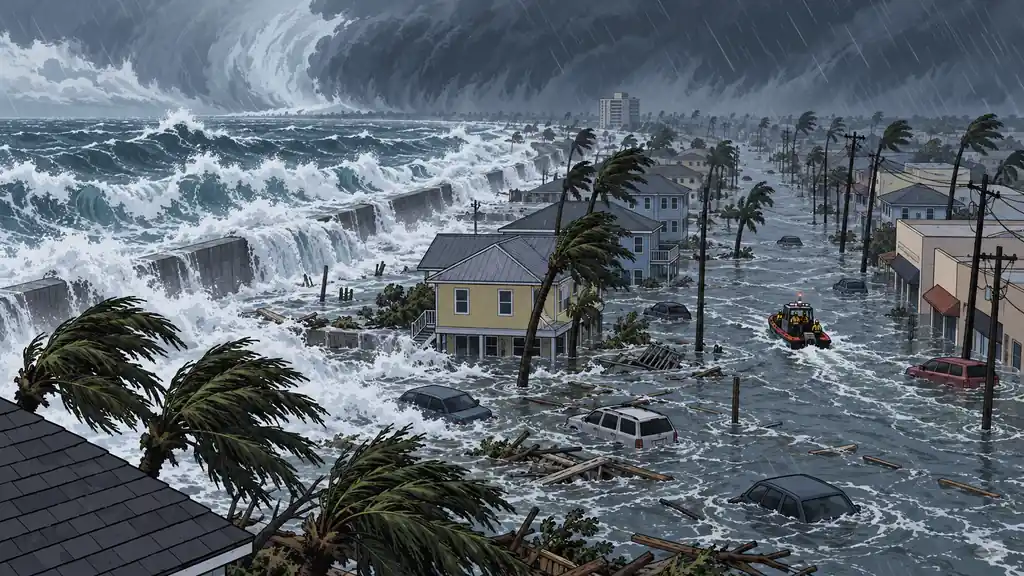
Hurricanes pay back preparation better than almost any other hazard, because they hand you the one thing most disasters never do: time. Days of forecast, a defined threat area, and a short list of decisions. And they still kill people and still wreck households — not because the storm can’t be beaten, but because people spend the warning window arguing instead of moving. If you already prep, the upgrade here isn’t more gear. It’s turning a vague “we’ll leave if it gets bad” into a line you drew before the season — the exact conditions that launch your plan without a family debate in the driveway while the first bands come in.
The category number is the wrong headline
The Saffir-Simpson category everyone quotes measures one thing: sustained wind speed. And wind is not what kills most people. Most US hurricane deaths come from water — storm surge and inland flooding. In the National Hurricane Center’s landmark study of US tropical-cyclone deaths (Rappaport, 1963–2012), nearly 90% were water-related — about 49% from storm surge, 27% from rainfall flooding — against only about 8% from wind.
That flips how you read a forecast. A storm the TV calls “only a Category 1” can carry a catastrophic surge or drop feet of rain. A compact major hurricane can do less water damage than a sprawling weaker one. So plan to the water, not the wind number. Your leave-or-stay line should be driven by your surge and flood exposure and the evacuation order for your zone — not by whether the storm crosses some category on the ticker. That’s not a technicality; that’s the difference between watching the wrong number and the right one.
What the storms keep teaching
The named storms people remember are remembered for their water. Katrina (2005) drove a surge of up to about 28 feet that overwhelmed New Orleans’ levees and killed more than 1,800 — the catastrophic-surge case. Harvey (2017) stalled over Texas and dumped upward of 50 inches of rain, flooding Houston as freshwater, nowhere near the coast. The lesson that keeps repeating: inland flooding kills people who never saw the ocean.
Two patterns show up in almost every bad outcome:
- Late or refused evacuation — people waited to “see what it does,” then couldn’t leave safely once the roads flooded and conditions fell apart.
- No plan for the aftermath — they survived the storm, then got caught by a week or more with no power, no water, and no open stores.
Both are preparation failures. Both are fixable months in advance.
Likelihood — high where you are, or near zero
Hurricane odds are almost entirely about geography. On the Gulf and Atlantic coasts and along the established inland tracks, the threat is there most seasons, which is why it rates solidly on our scale in those places. Away from those corridors it drops off fast — though a dying storm still throws flooding rain and wind hundreds of miles inland.
The thing that defines this hazard is lead time. Unlike an earthquake or a tornado, you usually get days of notice with a forecast that keeps tightening. That’s what makes a high-likelihood hazard so survivable: the warning lets early decisions win. The threat isn’t that the storm exists. The threat is whether you turn the warning into action before the window closes.
The two halves of the problem
During the storm — three hazards at once:
- Storm surge — the wall of seawater pushed ashore, the deadliest piece, able to flood and destroy low-lying areas in minutes. This is why surge-zone evacuation is non-negotiable.
- Wind — roofs, trees, power lines, and anything loose turned into a projectile.
- Rainfall flooding — freshwater flooding from extreme rain totals, dangerous well inland and the usual surprise killer for people watching only the coast.
After the storm — the week that’s actually harder for most:
- Power out for days to weeks, taking refrigeration, heat or AC, well pumps, and medical devices with it.
- Water system down — outages and boil advisories.
- Stores closed or emptied, fuel gone, card readers and ATMs dead.
- Roads blocked or flooded, and emergency crews spread thin across a whole region.
- The health cascade — heat with no AC, spoiled food, sanitation problems, and generator carbon-monoxide poisoning, which is a genuine post-storm killer.
Hold onto this: “survive landfall” and “survive the aftermath” are two different problems. The first is a decision. The second is a week of self-reliance. You have to solve both.
What preparedness looks like
Draw your line before the season — this is the core move.
- Look up your official evacuation zone and your surge and flood risk (county or state emergency management, FEMA flood maps). Know whether you’re in a mandatory-evacuation zone.
- Write down the exact conditions that make you go: a mandatory order, a forecast surge above a set number for your area, a track inside a set distance. A written line removes the fatal argument. It fires, you execute.
- Map two routes out and a destination — inland family, a hotel, a shelter. Plan to leave early.
Now put a clock on “early.” Your deadline to leave isn’t landfall. It’s landfall minus the time it actually takes to get out. A drive that’s 3 hours on a normal day becomes 8 or more when everyone leaves at once and the fuel and hotels along the route run dry — and surge and rain flood the low crossings before landfall, so the road can close hours early. If landfall is Friday morning and your real clearance time is 10 hours, your honest deadline is Thursday evening, not Friday at dawn. Miss it and “we’ll leave if it turns bad” becomes “we’re riding it out because we can’t get out.” That’s why the rule is leave early or shelter on purpose — never leave late.
Build a week of self-reliance (the shelter-in-place case).
- Water: the planning floor is 1 gallon per person per day. A family of four for 7 days is 28 gallons just for drinking and cooking — and closer to 56 once you add hygiene and sanitation. Store that, and fill bathtubs and containers as the storm approaches.
- Food: a week of no-cook food, plus a way to cook safely — fuel stoves outdoors only.
- Power: flashlights, batteries, power banks. If you run a generator, outdoors only, far from windows — CO kills after storms, every season.
- Comms: a battery or crank NOAA weather radio, and every device charged before the storm.
- Meds and health: a prescription buffer, first aid, and a plan to stay cool in the heat.
- Cash in small bills, because the cashless systems go down with the power.
Harden the house as it nears.
- Cover or shutter windows, bring in or tie down everything loose outside, clear gutters and drains, fill the vehicles early, and photograph the property for insurance.
Protect documents and coordinate the family.
- Vital records waterproofed or scanned off-site, and a family communication plan with an out-of-area contact and a meeting point in case you’re separated.
Measured in time and capability, the target is a written evacuation line, two routes, and seven days of living without the grid. That beats nearly every hurricane a household will ever face.
The wind earns the category; the water earns the casualties. Draw your leave-or-stay line before the storm has a name, and the days of warning do the rest.
Bottom Line
- Plan to the water, not the category — surge and inland flooding cause most deaths; wind just gets the headline.
- Turn intention into a written line — the exact order or forecast that launches your evacuation, decided before the season.
- Leave early or not at all — your deadline is landfall minus clearance time, and late evacuation into flooded, gridlocked roads is how the warning gets wasted.
- The aftermath is a separate problem — prep a full week without power, water, or stores, and treat generator CO as a real killer.
- Know your zone and two routes — geography decides your risk; preparation decides your outcome.
Map your evacuation zone, surge risk, and routes with Area Recon; size a week of supplies with Food & Water Storage.