


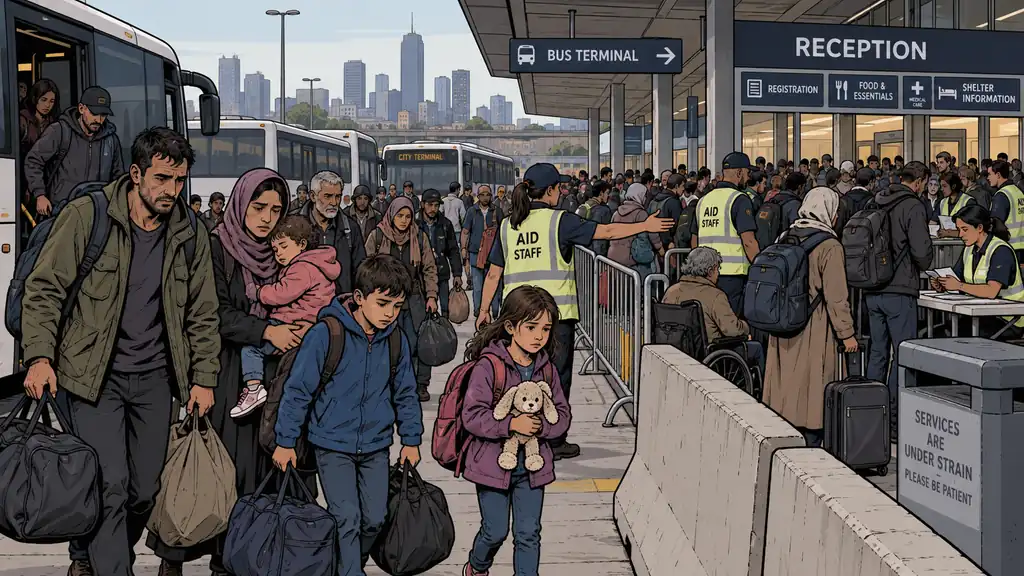
Most threats on a prep list are events. A storm hits, the power fails, it’s over, you clean up. Mass migration isn’t shaped like that, and treating it like it is leads to bad prep. It’s a slow pressure — driven by conflict, economic gaps, climate, and disaster — that reshapes a region over years. It doesn’t arrive on a Tuesday. It builds.
It rates 6 out of 9 for likelihood (Possible) and 4 out of 9 for impact: an active, ongoing pressure with a modest direct effect on any one household. The whole job at this level is to get the framing right, because the response to a slow pressure is nothing like the response to a sudden event. This is a threat you understand your way through, not one you fear your way through.
To be honest, I really struggled with the rating for this. On one hand, we’ve had one for a few years. But historically, it hasn’t been this severe and we’re currently in a reprieve. Additionally, the likelihood and impact vary widely based on geography. I compromised and set these levels as the aggregate based on these factors.
Why the framing is the whole game
Prepping done badly turns every threat into the same reflex: buy more, fear worse. Point that reflex at mass migration and you get anxiety with no actual readiness — because the threat isn’t shaped like a stockpile. There’s no “migration event” to shelter from. There’s a gradual shift in a region’s people, economy, and demand on services, and you get years to watch it and adjust.
So match the response to the real thing. A slow pressure calls for awareness and general, adaptable resilience — not a wall of cans stacked against a wave that was never coming as a wave. Getting that clear also inoculates you against the loudest distortion on this topic: the tendency to present it in headlines as a sudden, existential shock. The reality is slower, more regional, and more manageable than the framing. A clear-eyed prepper benefits from seeing it straight.
The precedent — a process, not an event
Large movements of people are one of the oldest constants in history, and the modern cases show the pattern:
- Displacement from conflict and disaster has repeatedly moved big populations across borders into neighboring regions. Syria’s civil war is the modern reference point: it displaced millions, and in 2015 alone more than 1 million refugees and migrants reached Europe by sea, per UNHCR — straining the receiving areas’ housing, services, and resources. That strain played out over months and years, with communities gradually absorbing it.
- Economic-driven migration moves even slower — a steady flow shaped by opportunity and pressure, reshaping the demographics and economies of both the places people leave and the places they arrive across decades.
The consistent lesson: mass migration changes a region the way erosion changes a coastline — steadily, cumulatively, with time to see it coming. Occasionally an influx outpaces a community’s ability to adapt and creates real local strain. But even that is a regional and social problem far more than a household-survival one.
The US crisis
President Trump achieved the Republican Nomination for the 2016 election largely because of his stance on illegal immigration and the southern border. His call for “build the wall” became a rallying cry for many in America.
In the following years, Trump did slow the rate of immigration, but once the Covid lockdowns subsided, immigration surged to record levels. During Trump’s second term, immigration has almost come to a halt. In all, here are the inflows over the last 20 years:
| Year | Immigration (thousands) |
|---|---|
| 2006 | 930 |
| 2007 | 915 |
| 2008 | 863 |
| 2009 | 855 |
| 2010 | 713 |
| 2011 | 770 |
| 2012 | 812 |
| 2013 | 843 |
| 2014 | 911 |
| 2015 | 975 |
| 2016 | 1,051 |
| 2017 | 955 |
| 2018 | 702 |
| 2019 | 595 |
| 2020 | 477 |
| 2021 | 241 |
| 2022 | 1,010 |
| 2023 | 1,139 |
| 2024 | 2,700 |
| 2025 | 1,300 |
| 2026 | 321 |
| Total | 19,078 |
Over the last 20 years, 19 million people have entered the USA, many of them illegally. About 500,000 were even flown directly into the US by the Biden administration as part of the CHNV (Cuba, Haiti, Nicaragua and Venezuela) Humanitarian Parole Program.
Even if immigration stopped today, this issue is far from over. I don’t think we can fathom what the long-term effects of this will be as this is a significant number of people. For perspective, 19 million people is three times the population of Missouri. 19 million people would make a state the 5th most populous in the USA, the 7th most populous country in South America or the 9th most populous country in Europe. The influx of this many people will most certainly shape the economy, political elections, public policy, and countless other aspects of the nation for decades to come, especially as this group multiplies.
Impact: modest, regional, cumulative
The impact rating of 4 is honestly low for direct household effect. Here’s how it actually shows up:
- Demand on shared resources. A significant influx raises demand for housing, jobs, schools, healthcare, and public services. Prices — housing especially — can rise; services can stretch. Real, but gradual and community-scale.
- Economic shifts. Local economies change. Sometimes they grow and gain energy; sometimes there’s more competition for jobs and resources. Both are diffuse and play out over time.
- Social change and occasional friction. Demographic change reshapes a community, bringing both integration and, at times, tension. That’s a normal part of how regions evolve.
- Acute local strain — the tail case. Where an influx is fast and large relative to a community’s capacity, the adjustment can outpace adaptation and create temporary difficulty in that specific area.
None of this typically shows up as a survival threat to a prepared household. It’s a change in the environment your region operates in — which is why the answer is adaptable resilience and awareness, not emergency supplies.
The mistakes people make
- Treating a trend like an event. Bracing for a “day it hits” and buying gear against it. There’s no acute spike to buffer, so the gear does nothing but soak up money and worry.
- Trusting the headline over the trend. The amplified national version and the measured local reality can be very far apart. Acting on the first instead of the second drives bad long-run decisions — about where you live and what you fear.
- Absorbing anxiety instead of building. Consuming distant coverage feels like doing something. It isn’t. It produces fear without a single practical improvement to your household.
What preparedness looks like
Deliberately low-key and general, because that’s what matches the threat. Four disciplines:
1. Understand the real trend where you live
Spend your effort on accurate understanding, not emotional reaction. Learn what’s genuinely happening in your region — the actual demographic and economic trends, from credible sources, not the amplified headline version. A clear, factual picture lets you make sound long-run calls about where you live and what pressures are building, and it inoculates you against both complacency and panic. For this threat, understanding is the primary prep. Much of what you’ll want to know is contained in our Area Recon tool.
2. Know your community and its resources
Know your local ground: your neighbors, your local services and their capacity, how housing and jobs work where you are, and where your community is strong or fragile. This awareness is broadly useful. It helps you read any slow local change — migration-driven or not — and position your household sensibly.
3. Keep the same broad reserves that cover any strain
The same general resilience that covers storms, downturns, and supply disruptions — a deep pantry, water reserves, a financial buffer, household self-sufficiency — also covers any resource pressure a migration trend might add to. Build general prep well and this threat is largely handled already.
4. Engage locally instead of reacting to headlines
The highest-leverage response to a slow regional pressure is being a constructive, engaged part of your local community. Knowing your neighbors, taking part in local institutions, contributing to local resilience — that does more real good than consuming anxious national coverage. A connected, cohesive community absorbs demographic and economic change far better than an atomized, fearful one. This is prep expressed as showing up, and for this particular threat it’s genuinely the most effective move you’ve got.
Bottom Line
- A process, not an event — mass migration reshapes a region slowly over years. Match your response to that clock.
- Modest, regional, cumulative impact — for a prepared household it’s a change in the operating environment, not a survival threat.
- Understanding is the primary prep — an accurate read of your region’s real trends beats reacting to amplified headlines.
- No special supplies needed — the same general reserves that cover any strain cover this. Build broad and it’s handled.
- Engage locally — a cohesive, involved community adapts to change far better than a fearful, disconnected one.
Some threats you prepare for with cans. This one you prepare for with clarity. Understand your region, keep your general reserves, and invest in your community — that handles a slow pressure far better than any stockpile could.
Keep the broad, all-purpose reserves that cover any strain with the Food & Water Storage tool, and understand your region’s fuller risk picture with the Threat Report.