


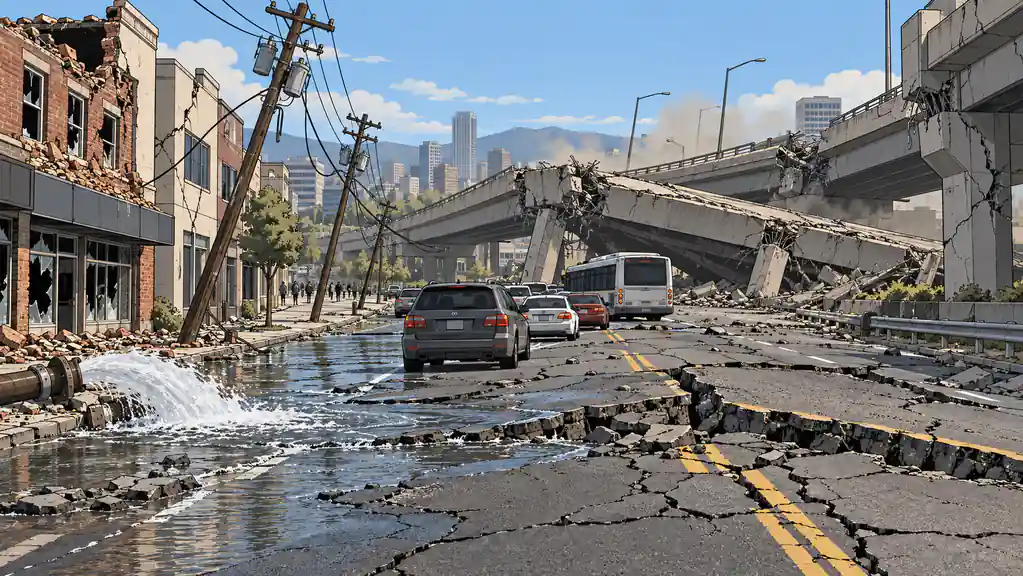
The standard 72-hour kit hides an assumption inside it: that help arrives in three days because the disaster is local and the region around it is intact and able to come rescue you. A house fire, a car wreck, a flooded street — the rest of the city is fine and can respond. An earthquake destroys that assumption. A major quake damages an entire region in the same instant: every household needs help at once, every road and hospital and utility crew is degraded at the same time, and there’s no undamaged neighbor-region sitting next door ready to rush in. That’s not a three-day problem; that’s a two-week one. And once you understand why, you understand how to prepare for it.
An earthquake is the sudden release of strain that’s been building along a fault, radiating out as seismic waves. It rates impact 8 of 9 and likelihood 4 of 9 — but that likelihood number is badly misleading if you read it as one flat figure for everyone. It’s an average across a country where a few regions carry near-certain long-term risk and most carry almost none. Your first job is figuring out which one you live in.
The mechanism, and why it changes the prep
Faults build up strain as tectonic plates grind against each other, then let it go all at once when the friction finally gives. Two features of that physics drive everything about how you prepare:
- No warning you can use. There’s no reliable heads-up before the main shock. Early-warning systems exist in some places and can buy you seconds — enough to drop and cover, nowhere near enough to prepare. So everything that matters has to already be in place before the ground moves.
- It’s not one shock — it’s a sequence. Aftershocks, sometimes large, follow for days to weeks, and they finish off the structures the main shock cracked. That’s why re-entering a damaged building is dangerous, and why your plan has to assume repeated shaking, not a single jolt.
And how hard your house shakes isn’t just about the quake’s size. It depends on distance, on depth, and — the part homeowners miss — on the dirt under your foundation. Soft, water-saturated soil amplifies the shaking, and can liquefy — lose its strength and behave like a liquid, so it can’t hold a building up. Two houses the same distance from the same fault can fare completely differently based on what they’re sitting on. Knowing your soil and your fault distance turns a vague worry into a specific number you can plan against.
Likelihood, tied to your actual ground
Treat that 4-of-9 as a placeholder and replace it with your location’s real risk. On the West Coast’s major faults, in Alaska, and in a few surprising interior zones like New Madrid, geologists forecast serious events on planning-relevant timeframes — this is a when, not an if. The USGS puts the chance of a magnitude 6.7 or larger quake in the next 30 years at about 72% for the San Francisco Bay Area and 93% for Southern California, and estimates a 10–15% chance of a full magnitude-9 rupture of the Cascadia Subduction Zone off the Pacific Northwest within the next 50 years. In most of the interior and the East, damaging quakes are rare enough that baseline readiness is plenty. The trap is judging your risk by your region’s reputation — some of the highest-consequence zones are places residents don’t associate with earthquakes at all.
The cascade is the real threat
The direct damage — a cracked building, an injury — is just the opening. What makes a quake a two-week emergency is what fails next, all at once:
- The utilities rupture together. Shaking snaps brittle infrastructure. Gas mains break (fire and explosion risk — post-quake fires have historically done as much damage as the shaking itself). Water mains break, which takes out your drinking water and the water the fire department needs, at the same moment. Electrical lines go down, sometimes for weeks in hard-hit areas.
- Everyone needs help in the same second. Because the whole region is hit at once, emergency services are instantly swamped. You’re not one household waiting in line — you’re one of hundreds of thousands, and the responders’ own homes and stations are damaged too. Help from other regions takes days to organize and route over broken roads.
- You can get cut off. Damaged bridges, landslides, and debris isolate neighborhoods. “Help is coming” and “help can physically reach you” are two very different statements after a quake.
- The injuries come from your own stuff. In modern buildings, most injuries aren’t from collapse — they’re from falling and flying objects: unsecured furniture, the water heater, ceiling fixtures, everything on a high shelf. That’s the single most controllable part of the whole event.
The 8 impact reflects the pile-up: the shaking is over in a minute, but the lost services, the isolation, and the aftershocks stretch the emergency into weeks.
What preparedness looks like
Secure the heavy stuff first — it’s the highest return there is. Since falling objects cause the injuries, strapping them down is your top move, and it’s nearly free. Strap tall furniture and bookcases to the studs. Strap the water heater properly — it’s both an injury risk and, if it topples, a broken gas line and lost water reserve. Latch the cabinets. Get heavy objects off high shelves. This protects people, not property, and it’s the exact work most households skip.
Store two weeks of water and no-utility food. Water is the hard limit. Plan roughly a gallon per person per day for drinking and basic hygiene — that’s 14+ gallons per person for two weeks, and more in heat or for medical needs. A family of four is looking at 56 gallons minimum just to hit that floor. Store food that needs no cooking and no refrigeration, because gas and power may both be gone. And your water heater, once it’s strapped down and you know how to draw from it safely, is an emergency reserve of dozens of gallons on its own.
Learn your shutoffs. Know how to turn off gas and water, keep the right wrench secured at the gas meter, and understand that once you shut the gas off, only a professional should turn it back on. Shutting the gas after a quake — if you smell it or suspect a leak — isn’t a chore; it’s a genuine life-safety skill.
Drill Drop, Cover, and Hold On until it’s a reflex. You’ll have no time to think, so your body has to already know: drop before the shaking drops you, get under sturdy cover to protect from falling objects, and hold on through the shaking and the aftershocks. Do not run outside during shaking — the building’s exterior and falling glass are among the most dangerous places to be. And the old “stand in a doorway” advice is outdated for modern homes; forget it.
Handle the boring essentials. Sturdy shoes and a flashlight secured at every bed, because broken glass is everywhere afterward. A plan for medications and anything refrigerated. A way to get information when power and cell service are degraded. And an out-of-area contact, because local circuits jam but long-distance and text often get through. Measure your readiness in days you can run on your own and the speed of your automatic response, not in dollars spent.
Bottom Line
- The 72-hour kit assumes a local disaster with an intact outside world. A regional quake breaks that assumption — plan for two weeks.
- Location is destiny. Replace the generic likelihood with your real fault-and-soil risk, and don’t trust your region’s reputation.
- Secure your contents first — falling objects cause most injuries, and strapping them down is cheap and high-return.
- The cascade is the threat: utilities rupturing together, emergency services swamped, and neighborhoods cut off stretch a 60-second event into a weeks-long one.
- Drill Drop-Cover-Hold and your gas shutoff until they’re reflexes — there’s no time to learn them once it starts.
A quake is over in a minute; the emergency it starts runs for two weeks — and the region can’t rescue itself, because it all got hurt in the same second you did.
Check your fault-and-hazard risk with the county Threat Report, size two weeks of water and food with Food & Water Storage, and build your household response plan in the Digital Binder.