


If you’ve done any prepping, you already respect flooding. The trap is that it doesn’t feel exotic. No fallout, no grid collapse, no mushroom cloud — just water. That familiarity is exactly why people under-build for it. Flooding is the most widespread natural hazard in the United States, hitting more counties in a given year than any other single threat. But widespread isn’t everywhere-every-year: for a typical household a damaging flood is an every-few-years risk that climbs sharply along rivers, coasts, and flash-flood corridors — and it’s one of the most damaging hazards when it does hit.
Doing it well means getting past “I’ve got some sandbags” to actually understanding three things: how water behaves, how much warning you’ll get, and which specific roads between you and safety go under first. Get those right and you’ve handled most of the danger. Miss them and no amount of gear at the door helps.
Why it rates mid on odds but high on impact
Rate flooding 5 for likelihood and 7 for impact. The likelihood sits mid-scale, not at the top: for a typical household a damaging flood is an every-few-years risk, not an every-year one. What makes flooding stand out is reach — floods aren’t stuck to coastlines and big rivers; a flash flood can happen almost anywhere rain falls faster than the ground and drains can move it, which is why it’s the most widespread hazard even when any one household’s yearly odds are only moderate. Along rivers, coasts, and flash-flood corridors your county layer pushes that likelihood up. Impact is high because moving water is one of the few common hazards that both wrecks property wholesale and kills fast. A foot of water that looks like a nuisance floats a car; a few feet in the house is a gut-to-the-studs rebuild.
Two kinds of flood, two different problems
Flash floods are a warning-time problem. They build in minutes to a few hours — a stalled downpour, a dam or levee letting go, a debris jam breaking loose. The water moves with real force and carries debris. Because you get almost no lead time, your defense isn’t last-minute logistics; it’s decisions you already made and a habit of paying attention to the sky. And this is where people die: the NWS reports that roughly 75% of flash-flood deaths happen at night, when people are caught mid-commute or asleep, and more than half of all flood deaths are vehicle-related.
River flooding is a magnitude problem. Rivers crest days after the rain that caused it, often from rain that fell far upstream. You usually get warning, sometimes a lot of it, through river-gauge forecasts. The question isn’t “will I have time” but “how high, how long, and does my spot go under at that crest?” Learning to read the gauge forecasts for the water upstream of you is the intermediate skill — they tell you the crest height and timing before a drop reaches you.
The thing that actually kills: moving water
These numbers are counterintuitive, so internalize them:
- 6 inches of moving water can sweep an adult off their feet.
- ~12 inches floats most cars.
- ~18–24 inches carries away most trucks and SUVs.
Here’s the part people miss: the force of moving water rises with the square of its speed. Double the speed and you roughly quadruple the push. So a fast, shallow flow hits harder than a deep, still one — and you can’t judge speed from a stopped car. Worse, you can’t see whether the roadbed under the water is even still there or has been scoured out into a hole. Unknown depth, unknown speed, unknown road: that’s three unknowns, two of them lethal. That’s not a judgment call; that’s a no. Turn Around, Don’t Drown isn’t a slogan — it’s the single highest-value behavior in the whole flood playbook, and nearly every vehicle death was avoidable.
What the water does after it’s in
The direct damage is structural, and it’s fast. A few inches ruins flooring, appliances, and drywall — which wicks moisture upward well past the waterline. Then the second wave starts:
- Contamination. Floodwater is not clean water; it carries sewage, fuel, farm chemicals, and debris. Every wet surface is a biohazard, and the standing water breeds mosquitoes for weeks after.
- Mold. Wet drywall, carpet, and insulation start growing mold within 24–48 hours. That’s a hard clock — miss it and a survivable soaking becomes an uninhabitable house.
- Isolation. At the town scale, floods take out roads, bridges, water treatment, and power. You can be perfectly fine and still be cut off — no way in or out, no safe tap water — for days.
That last one is why flooding rewards the same deep-water, deep-pantry prep you’d build for any multi-day event. The flood may never reach your shelves; it can still strand you next to them.
What preparedness looks like
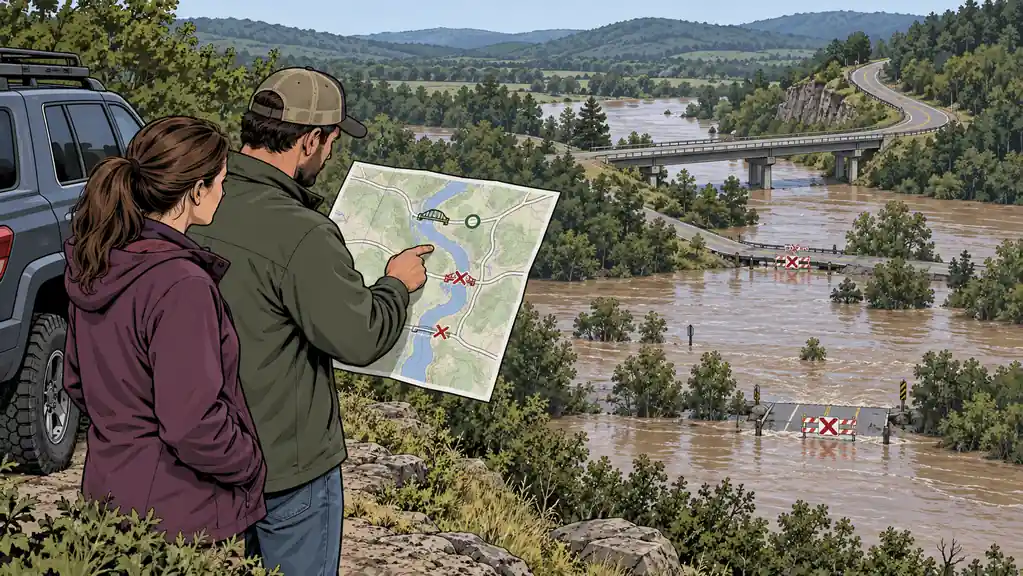
Map your crossings. This is the core skill. Drive your routes and mark every low spot, underpass, creek crossing, and bridge between home, work, school, and where you’d evacuate to. Rank them by which goes under first. Then set a primary and an alternate route to high ground that dodge the worst ones. A flood plan is fundamentally a routing problem — you’re solving the decision now so you don’t improvise it in the dark, in the rain, with your kids in the back seat.
Know your zone, and distrust the line. Look up your FEMA flood zone, but understand what it is: a map of known risk. FEMA reports that more than 40% of national flood-insurance claims come from properties outside the mapped high-risk zones. “Not in a flood zone” means lower odds, not immune.
Elevate what matters. Documents, medications, electronics, irreplaceables — keep them above your realistic flood level, on upper floors or high shelves. Utilities and appliances in a flood-prone basement can go up on platforms. If you get warning, your pre-flood checklist moves the movable stuff up.
Stage the go-bag and the water. Because a flash flood gives you almost nothing, readiness here is measured in how fast you can leave — target single-digit minutes. That means a go-bag already packed with documents, meds, and essentials; the vehicle kept above half a tank, because pumps need power the flood may have cut; and several days of stored water in case you’re isolated with a municipal supply you can’t trust. A floor to plan against: 1 gallon per person per day for two weeks — 56 gallons for a family of four.
Buy flood insurance early. This one surprises people: standard homeowner’s and renter’s policies don’t cover flood. It’s a separate NFIP or private policy, and the standard NFIP policy has a 30-day waiting period — you can’t buy it as the storm rolls in. NFIP residential coverage also caps at $250,000 on the building and $100,000 on contents, so a high-value household may need private coverage on top. This is an off-season decision, made before the water is in the forecast.
Bottom Line
- Flooding is the most widespread natural hazard in the country and hits hard on damage too — respect it accordingly.
- Map your crossings and pre-plan routes to high ground. A flood plan is a routing plan, not a pile of sandbags.
- Never enter moving water — 12 inches floats a car, and you can’t see whether the road survived. This one rule prevents most flood deaths.
- Elevate documents and essentials; stage a go-bag and stored water for a fast exit or for being stranded.
- Flood insurance is separate and has a ~30-day delay — buy it in the off-season.
A flood plan isn’t sandbags at the door. It’s knowing, before the rain, exactly which roads go under and which one still gets your family to high ground.
Map the roads, creek crossings, and high ground around your home with Area Recon, and check your county’s flood exposure in the Threat Report.