


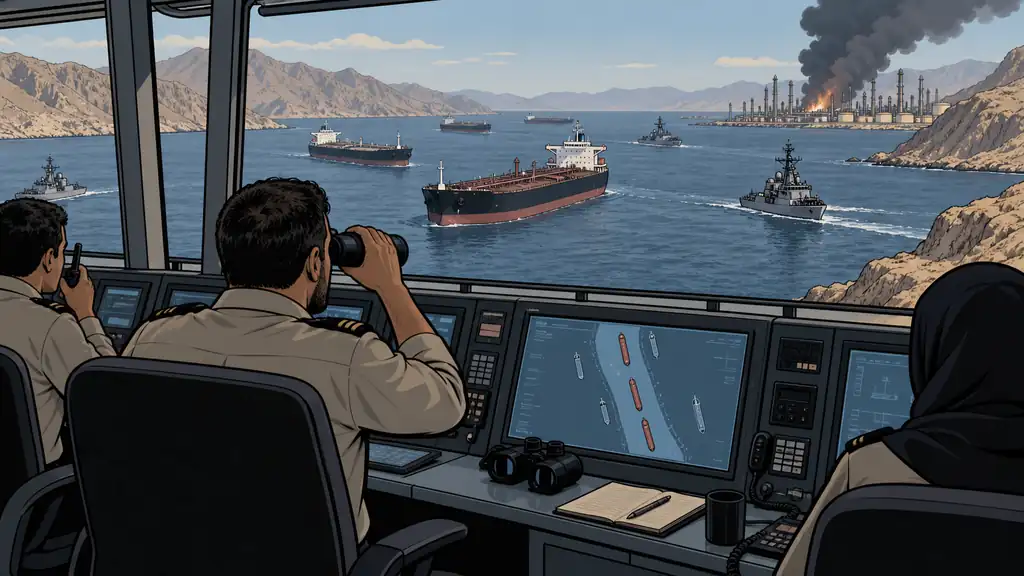
It’s easy to let a Middle East war trip the wrong prepping reflex — to treat a distant conflict as a threat to your front door. For almost everyone, it isn’t. Conflict with Iran reaches most of us as an energy and supply-chain event, not a battlefield threat. It shows up at the gas pump and, later, on the grocery receipt — because of where it happens, sitting on a big share of the world’s oil and one of its most important shipping lanes.
Getting that straight matters, because it tells you exactly what to prepare for. This isn’t bunkers and bullets; it’s price spikes and volatility. You hedge it like a household bracing for a rough stretch of prices, not like a survivalist bracing for invasion. And that’s a much calmer, cheaper kind of prep.
How a distant war reaches your budget
The chain from a Gulf conflict to your wallet is short once you see it.
- Fear moves the price before any barrels are lost. A big slice of the world’s traded oil passes through the region, and especially through the Strait of Hormuz — the EIA puts it at roughly 21 million barrels a day, about a fifth of world petroleum consumption, with some 83% of it bound for Asia. Any credible threat to that flow adds a risk premium to the price of oil. That’s the part people miss: the market prices the chance of a disruption, so prices can jump on the threat alone, days before a single tanker is actually stopped.
- Crude prices hit the pump fast. Oil feeds into gasoline and diesel within days to weeks, so a spike shows up at your local station quickly.
- Then it seeps into everything else. Fuel is an input to nearly everything — farming, manufacturing, and the trucks and ships that move all of it. So a sustained oil-price jump slowly lifts the price of a broad basket of goods. An energy shock isn’t a single bill; it’s a slow, wide one.
- Shipping gets tangled too. Beyond oil, conflict in the region can snarl shipping — higher freight costs and delays rippling through supply chains.
The upshot: the impact is mostly financial and spread out, it arrives partly on fear instead of actual shortage, and it can reach you even from a war your country never joins.
What the record actually shows
The pattern with Middle East tensions is remarkably consistent: a flare-up drives an oil-price spike and a stretch of volatility, sometimes sharp — and then things settle as the situation resolves or the market adapts.
Two clean examples. When Iraq invaded Kuwait in 1990, oil roughly doubled — WTI up about 90% from July to October, from around $17 to about $36 — and the feared spiral faded. When drones hit Saudi Arabia’s Abqaiq facility in 2019 and knocked out 5.7 million barrels a day, Brent posted its biggest-ever intraday jump, about 19% — and then largely gave it back within weeks.
The lesson cuts both ways. The price-and-volatility effect is real and worth hedging. But the doomsday version — a prolonged, total shutdown of the strait — has generally not happened, or not lasted. Markets reroute. Spare capacity and reserves get tapped. So you prepare for the likely thing (volatility) while noting the unlikely tail (a severe, lasting supply shock) exists — without pouring money into it.
The current conflict numbers
The current war with Iran is showing a similar pattern of oil and gas price spikes. On February 27, the day before the US and Israel attacked Iran, WTI crude closed at $67.02 and Brent crude settled at $72.48 per barrel. The national average price for gasoline was $3.07 and diesel was $3.81 per gallon.
WTI peaked at $122 and Brent at $126.41 in April of 2026. Gasoline and diesel prices have lagged for the most part. As I write this in early September of 2026, gasoline is at $4.15 and diesel is at $5.85 and climbing. According to Axios, consumer energy costs have surpassed $100 billion due to these increases so far.
While gas and diesel prices have increased substantially, they haven’t risen nearly as much as many “experts” forecasted. I believe there are three reasons for this:
- Intense political pressure on the oil & gas administration by President Trump.
- Commercial stockpiles of oil & fuel have been drawn down.
- Releases of oil from the Strategic Petroleum Reserve.
In June, the Cushing WTI hub (Cushing, OK), dropped below 20 million barrels for the first time since 2014. Some say that 20 million barrels is the minimum level to keep it functioning and the level has hovered around this point since so I believe this won’t drop any further.
The releases from the Strategic Petroleum Reserve (SPR) is below 300 million barrels for the first time since it was filled in 1983. Some say that 300 million barrels is the minimum level and that going below this will permanently damage the caverns where it’s stored. In August, the SPR was drawn down by almost 20 million barrels and there is no sign of stopping, so I guess we will find out. In any case, releases from the SPR will stop at some point, and when they do, gas prices will rise further.
You can see the full history for all these metrics yourself at our Infrastructure History tool.
In addition to the fuel costs, the military costs are approaching $40 billion and the Pentagon has asked Congress for $100 billion in funding to continue the efforts. This spending will add to the deficit, ultimately increasing inflation as well.
The odds: a flashpoint that keeps coming back
We rate this Possible (6 out of 9). As I write this, it’s an active threat, so wouldn’t that make it a 9? No, we rate this based on history — it’s a recurring flashpoint that is currently active, not a rare or a constant one. Tensions flare around specific incidents and then subside, over and over. So the realistic expectation isn’t one decisive event; it’s an on-and-off pattern of episodes, each carrying some chance of a price move.
Could this time be different and things escalate further or hostilities last longer than normal? Yes, it’s possible. I want this article to serve as a central marker for this threat and as a result, I’m going to limit speculation here. Look for future articles that will explore these ideas in more depth.
What preparedness looks like
1. Be aware of events. Hopefully, you heard about the attack on Iran that Saturday morning and immediately went and topped off your vehicles and more importantly any fuel stores you keep on hand. Simply being aware of events allows you to react before the markets can.
2. Reduce dependency on fuels. The less fuel you depend on, the less any spike hurts. Combine errands, keep the vehicle maintained so it runs efficiently, cut unnecessary driving, and — over the longer haul — tighten up home heating and energy. Efficiency is the rare hedge that pays off every single day, spike or not, which makes it the highest-quality prep on this threat.
3. Build financial slack for the swings. Because this is fundamentally a money event, the core prep is money: room in the budget to absorb higher fuel and goods prices, and a general cushion that lets you ride out a stretch of elevated costs without stress. Some modest reserves help — a bit of storable food, and fuel where you can keep it safely — but the primary hedge is financial flexibility, not stockpiling.
Readiness here is measured in awareness, an efficient household, and financial room to absorb swings — not stockpiles, and not dollars poured into fear. The real test: could your household absorb a sustained jump in fuel and goods prices without strain, so a spike is an annoyance instead of an emergency?
Bottom Line
- For most households, conflict with Iran is an energy-price and supply-chain threat, not a physical one — hedge the volatility, don’t defend a front line.
- It reaches you through oil markets and the Strait of Hormuz, often as a risk premium priced on fear, before any real shortage.
- It’s a recurring, on-and-off flashpoint with a moderate, mostly financial impact — plus a real but historically over-feared catastrophic tail.
- Top off your preps and cut your fuel dependence — the cheapest hedges, and efficiency pays off every day regardless.
- Build financial slack for the swings and keep a steady head — panic buying is how a moderate event becomes a personal crisis.
A Gulf war reaches you as a price, not a projectile. Hedge the volatility, cut your fuel dependence, and keep your composure — and it stays a line item, never an emergency.
See where your energy dependence and price exposure actually sit with the Heating Fuel.