


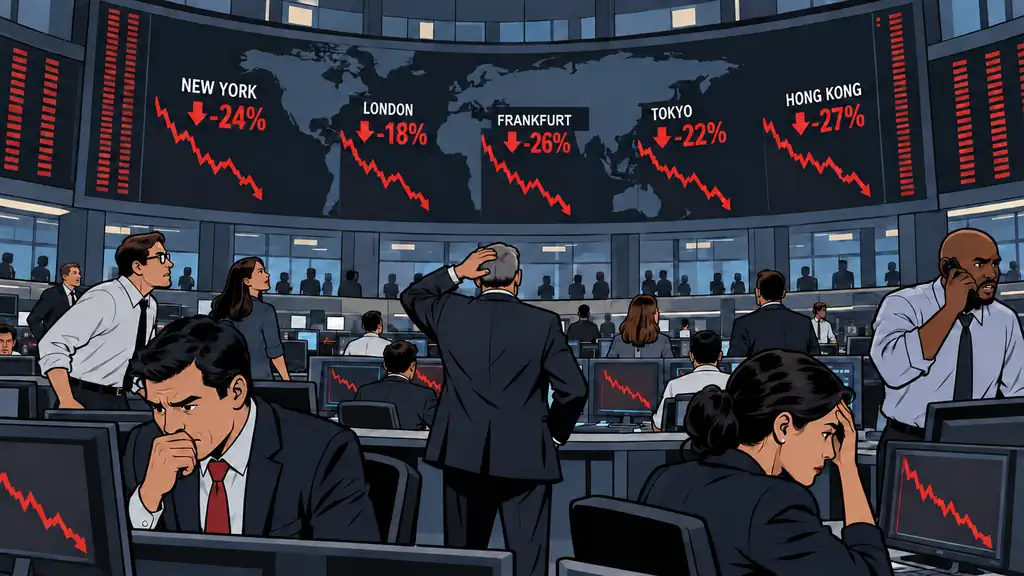
A financial collapse spreads. That’s the whole nature of it. A failure in one bank, one market, one country doesn’t stay put — it jumps to the next one, and the next, because the modern economy is one big wired-together machine. You can’t stop that spread. It happens at a level no household reaches. But here’s the part most people miss: the crisis travels along connections, and you get to choose how many connections tie your household to the fire. That’s not a metaphor. Debt and dependence on the system running smoothly are the actual wires. Cut them, and the collapse can rage across the economy and still arrive at a door it can’t get through.
Where this threat sits
Global financial collapse is a worldwide, economic-cause threat, rated impact 8, likelihood 2. The impact is high because when a collapse spreads, it erodes savings and jobs broadly and for a long time — it’s one of the few threats that can grind down a household’s finances for years, not days. The likelihood is low: true global collapses are uncommon, though history shows they do come around. So the math is insurance math — low odds, high cost, and a firewall that pays you back even if the fire never comes.
How a collapse actually spreads
Financial systems are wired together in ways that make them efficient in good times and fragile in bad ones. A few of the wires are worth knowing by name:
- Borrowed money forces selling. When prices fall, anyone who bought with borrowed money has to sell to cover the debt — which pushes prices down further, which forces more selling. A downward spiral that feeds itself.
- Everyone owes everyone. Banks and firms are each other’s creditors. When one fails, the people it owed take the loss, and that can topple them, and so on down the line.
- Lending stops. In a panic, credit freezes. Even healthy businesses and households that count on rolling over a loan suddenly can’t — and payrolls, supply chains, and jobs seize up.
- Trust evaporates. Modern finance runs on confidence. When it goes, people all demand their money at once, and even a sound bank can fail in a run.
Notice what every one of those has in common: debt, and depending on the system to keep working. Those are the wires. A household that carries little debt and holds cash it can actually reach has fewer wires running to the fire. That’s the mechanical reason the people buried in debt get hurt worst — not bad luck, wiring.
The odds, honestly
Low. A genuine global collapse is rare, and most years carry no real risk of one. But “rare” over a long enough stretch becomes “eventually,” and the connectedness that spreads a collapse isn’t shrinking. The honest stance is neither of the two loud ones — not the guy predicting collapse every January, and not the guy insisting it can’t happen. It’s keeping a standing firewall sized to a rare-but-serious event, and not losing sleep over timing you can’t forecast anyway.
What it does, and how long it lasts
A serious collapse isn’t one dramatic day. It’s a long, broad grind:
- Savings shrink. Investments and retirement accounts lose value, sometimes hard, and can take years to come back.
- Jobs go. Businesses cut and fail; unemployment rises and stays up. Losing income is usually how a global crisis actually reaches a specific household. In 2008, U.S. unemployment doubled to 10%; in the Great Depression it hit about 25%.
- Credit dries up. Loans and mortgages get scarce and expensive, squeezing anyone who leans on borrowing.
- Prices get weird. Currency stress and supply trouble can swing the cost and availability of goods, essentials included.
- It runs long. Unlike a storm that’s over in a day, the hardship phase of a financial crisis is measured in months to years. That’s why a two-week kit isn’t the point here — durable runway is.
The 2008 crisis wiped out roughly $13 trillion in U.S. household net worth. The households that came through it best weren’t the ones who predicted it. They were the ones who were simply hard to knock over: low fixed bills, real reserves, and more than one way to earn.
The common mistakes
- Trying to time it. Pouring energy into predicting the crash instead of building the firewall. You can’t forecast the date, and you don’t need to.
- Chasing exotic hedges before the basics. Buying precious metals and using complicated strategies while still carrying a pile of high-interest debt and holding zero cash. Pay down the debt and stack the cash first; that’s the firewall.
- Counting on the card reader. Assuming electronic access always works. In a systemic crisis it can stutter — frozen accounts, bank holidays, payment systems down. Some physical cash bridges that gap.
- A stockpile but no earning plan. A full pantry doesn’t pay a mortgage over a two-year downturn. Earning capability is the reserve that outlasts the stores.
A worked example: measure it in months
Stop measuring readiness in a dollar figure and measure it in months of runway — how long your household can run if the income stops.
Say your fixed bills — housing, utilities, insurance, minimum debt payments, food — come to $3,000 a month, and you hold $18,000 you can actually reach. That’s six months of runway at full burn. Now cut the fixed side: pay off a loan and trim to $2,000 a month, and the same $18,000 becomes nine months. You didn’t save another dime — you bought three extra months by cutting the debt.
That’s the lever. In a long collapse, the household that lasted nine months while the neighbor lasted three is the one that found new work, adjusted, and never had to sell at the bottom. Runway is time, and time is what a slow crisis takes from you.
What preparedness looks like
1. Low debt — the main firewall. Debt is a fixed bill that a crisis doesn’t pause. High debt is exactly what turns a downturn into a personal disaster — the forced-selling, can’t-make-the-payment spiral, at the kitchen-table level. Pay down high-interest and unstable debt while times are good, and don’t take on obligations that assume your income only ever goes up. The mechanism is direct: less debt means more of your income stays yours when things tighten, and fewer wires run from the system’s failure to yours.
2. Reachable cash, some of it physical. Build an emergency fund measured in months of expenses — money you can get to, not value locked up somewhere. In a systemic crisis, electronic access can stutter, so keep a sensible amount of physical cash at home to bridge a short freeze. The reserve is your shock absorber: it buys time and options the moment income stops or credit vanishes.
3. Don’t keep it all in one place. Spread where you hold value — some liquid, some tangible, across more than one institution — so a failure in one spot doesn’t erase everything. This is just not putting every egg in one basket, applied to your household. (It’s not investment advice — it’s the principle of not having a single point of failure.)
4. Essentials, skills, and more than one way to earn. Keep a store of essentials — food, water, supplies — so a price spike or a supply hiccup during a crisis doesn’t force you to buy high in a panic. And build the most durable reserve there is: skills and more than one income. The ability to earn across different conditions, fix and make things yourself, and adapt your livelihood is a reserve no market can devalue and no freeze can lock. In a long downturn, that beats any stockpile.
Sized right, readiness here is months of runway plus durable earning power — time and capability, not a number chasing the market. You build the firewall in calm times, and it quietly protects you whether or not the fire ever comes.
Bottom Line
- A collapse spreads through debt and dependence — so cutting both is how you stop it at your door.
- Low debt is the main firewall — it’s the wire that turns a downturn into a personal crisis, and it’s fully in your control.
- Hold months of reachable cash, some physical, so a frozen system doesn’t strand you.
- Don’t keep it all in one place — no single institution or asset should be able to wipe you out.
- Skills and more than one income are the most durable reserve — earning power survives what markets don’t.
You can’t stop the spread. You can make sure your household has fewer wires running to the fire — and that firewall is low debt and reserves you built when things were calm.
Build the essentials layer of your firewall, sized to your household, with the Food & Water Storage tool.