


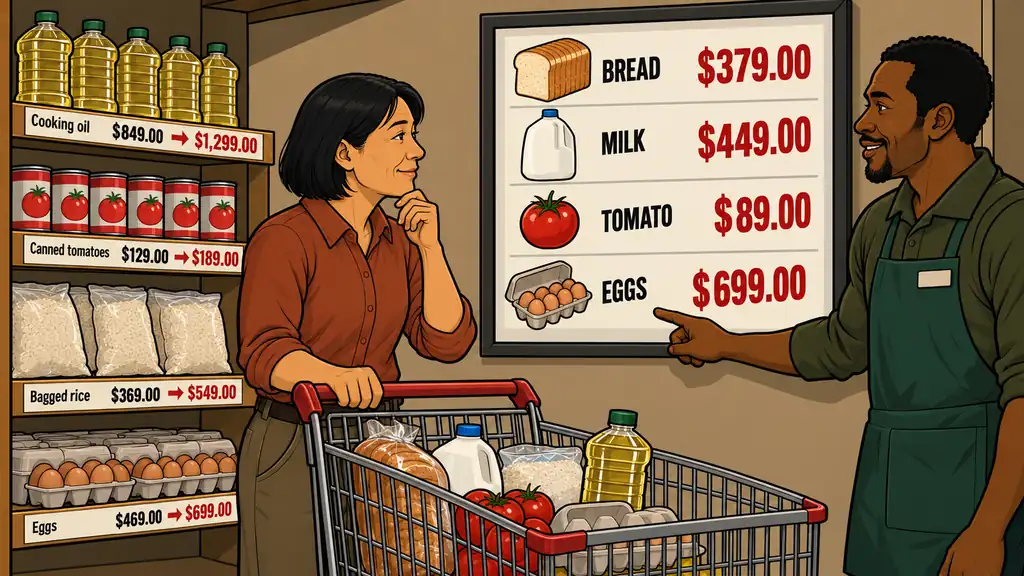
Most threats a prepper plans for are physical. You can point at the storm or the outage. Hyperinflation is different. It’s a failure of trust, and it goes after the one asset most people assume is safe: their money. The mechanism is brutally simple. A currency loses credibility, so its value falls, so people spend it faster to get rid of it, so prices climb, so the value falls more — a spiral that feeds itself, until a paycheck loses real buying power between the day you earn it and the day you spend it. It’s a race between your income and the price tag. In a true hyperinflation, the price tag wins.
On a 1-to-9 scale this scores 7 for impact and 3 for likelihood — a severe consequence with a low base rate where currencies are stable. That shape decides the whole prep. You don’t reorganize your life around it. But because the hedge overlaps almost perfectly with good general preparedness and plain personal finance, you build it anyway. It costs little to be wrong and protects a lot if you’re right.
Why it earns a place on the list
Preparedness is likelihood times impact, and hyperinflation is the classic low-odds, high-severity item — the kind you insure against cheaply instead of obsessing over. What makes it worth including isn’t that it’s likely. It’s that it’s impossible to insure the normal way and total in its reach. You can’t board it up, evacuate from it, or wait it out in a bunker. It hits every cash-holder in the economy at the same instant, and the tools that protect you have to be in place before it starts — because once it’s running, all you can do is scramble.
The deeper reason is that the hedge is nearly free. A deep pantry, marketable skills, savings that aren’t all in one place, and sensibly structured debt are things a prudent household wants regardless. That’s not single-purpose insurance you’ll probably waste; that’s broad resilience that happens to cover this tail — and covers ordinary high inflation, the far likelier cousin, on the way.
What history shows
Hyperinflation isn’t hypothetical. It has recurred across the last century in many countries, with a consistent recipe: a government paying its bills by printing money, a collapse in public confidence in the currency, or both — usually with war, debt crisis, or political breakdown behind it. The Hanke-Krus World Hyperinflation Table (Cato Institute) documents dozens of episodes. Weimar Germany peaked in October 1923 at roughly 29,500% per month — prices doubling about every 3.7 days. Zimbabwe hit an estimated 79.6 billion percent in November 2008 and abandoned its currency the next year. Yugoslavia in early 1994 and Venezuela in the late 2010s ran the same spiral, and the worst on record — Hungary in July 1946 — saw prices double roughly every 15 hours. In the severe episodes, workers were paid daily, or twice daily, so they could spend before the money died. Physical cash became worthless.
Sit with the Weimar number for a second, because “doubling every 3.7 days” is easy to skim past. Do the arithmetic: that’s about eight doublings in a month, which turns a $1 loaf into roughly a $250 loaf in thirty days. Your savings didn’t take a bad year. They got cut in half twice a week. That’s not a market dip you ride out; that’s your life’s cash evaporating while the lights stay on.
The recurring lessons are remarkably consistent:
- Cash and cash savings were destroyed — the safest-seeming asset was the one that vanished.
- Tangible goods, productive assets, and hard skills held value — a stocked pantry, tools, land, and the ability to do useful work kept their worth when the currency didn’t.
- People with fixed-rate debt often came out ahead, because their debt got inflated away, while savers and pensioners were wiped out.
- Barter and side currencies appeared as people routed around the failing money.
None of that requires anything exotic. It points at a plain set of moves.
How likely — and for whom
Low in a stable, trusted-currency economy. The odds rise with fiscal and monetary stress — big sustained deficits financed by printing, a central bank that loses its independence, or a shock to confidence. And it’s worth keeping two things separate: hyperinflation is the rare, currency-destroying spiral; elevated inflation is the common, painful-but-survivable erosion. The same hedges cover both, and the second is far more likely to actually touch you — which is another reason to build them.
Inside a household, the most exposed are savers holding wealth in cash, and people on fixed incomes — pensions, fixed annuities, salaries slow to adjust. The least exposed are people with tangible assets, marketable skills, income that reprices with inflation, and fixed-rate debt. Where you sit on that spectrum is something you can change, in the calm, before any of this starts.
What it actually does, step by step
- Onset. Inflation runs hot, then accelerates past normal control. Early on it looks exactly like ordinary inflation.
- The behavior flips. People stop holding the currency. Money gets spent the moment it arrives; savings move into goods, hard assets, or foreign currency. That flight itself speeds the spiral up — everyone spending faster is part of what drives prices.
- Repricing chaos. Prices update daily or faster. Menus, contracts, and wages can’t keep up. Planning becomes impossible, and everything bends toward getting goods now.
- Savings destroyed, society strained. Cash savings evaporate; the middle class and retirees get hit hardest. Shortages, hoarding, and black-market pricing show up. Trust in institutions erodes.
- Resolution. Eventually a currency reform, a new currency, dollarization, or a return to monetary discipline ends it — usually after enormous, uneven wealth destruction.
The prepper’s window is before step 1, because every hedge is far cheaper and easier to get then. Once you’re in step 2, the hard assets are already expensive or gone.
What preparedness looks like
You’re buying wealth that doesn’t evaporate when the currency does, plus the ability to function in a repricing, half-barter economy. Most of it is ordinary finance and prepping, done on purpose.
Don’t hold all your value in cash — proportionately, not dramatically.
- Keep some of what you own in tangible and productive forms: a deep pantry and consumables, quality tools and durable goods, and productive assets that fit your situation. The goal isn’t to abandon currency — you need cash for daily life and for the far-more-likely normal times. The goal is to not hold all your value in a single currency that could lose it.
- Spread savings across asset types, and where it’s prudent and legal for you, forms that have historically held value through currency stress. This is diversification — the oldest, dullest financial wisdom — applied to a tail risk. (This is general education, not personalized investment advice. What you hold, and in what proportion, is yours to decide with your own situation and, for significant moves, a professional.)
Store essentials deep — the universal hedge.
- A deep pantry hedges price spikes of any size: goods bought at today’s prices feed you at tomorrow’s, whatever the tag says. Concentrate on essentials you’ll use regardless — food, hygiene, medications, fuel, consumables — so the hedge pays off even if hyperinflation never comes. This is the single lowest-regret action on the list.
Set up your debt to your advantage.
- Prefer fixed-rate debt over variable. In an inflationary stretch, fixed debt gets repaid in cheaper money — inflation eats the real value of what you owe — while a variable rate climbs with everything else and compounds the pain. That’s a quiet, high-leverage detail: the structure of your debt, decided in calm times, changes your outcome in a bad one.
- Don’t take on debt you couldn’t service if your income doesn’t keep pace, because wages lag prices.
Invest in skills and community — the wealth that never devalues.
- Hard, marketable skills — trades, repair, food production, medical, mechanical — hold value in any monetary regime, and become more valuable when money is unreliable and barter returns. That’s inflation-proof wealth you carry in your head. A savings account is a promise a currency can break; a skill isn’t.
- A community that can trade goods, labor, and skills is a working micro-economy when the formal one seizes up. Barter networks are a recurring feature of every hyperinflation. Pre-building the relationships puts you inside that economy instead of outside it.
Hyperinflation is a race between your paycheck and the price tag. You can’t slow the price tag — but you can stock the finish line, and hold your wealth in things a falling currency can’t take.
Bottom Line
- Hyperinflation is a failure of trust in money — a spiral that feeds itself and destroys cash savings while the lights stay on. Rare in stable economies (3/9), devastating where it strikes (7/9).
- It hits savers and fixed incomes hardest and can actually help fixed-rate debtors — the structure of your finances decides your outcome.
- The hedge is nearly free and broadly useful: don’t hold everything as cash — spread into goods, skills, and varied assets — measures that also cover ordinary, far-likelier inflation.
- A deep pantry of essentials you’ll use anyway is the lowest-regret hedge — it pays off at any inflation rate, or none.
- Prefer fixed-rate debt, spread your savings, and invest in hard skills and community — the wealth no currency can erode.
A deep pantry hedges price spikes of any size and pays off regardless — build one you’ll actually use with the Food & Water Storage tool.