


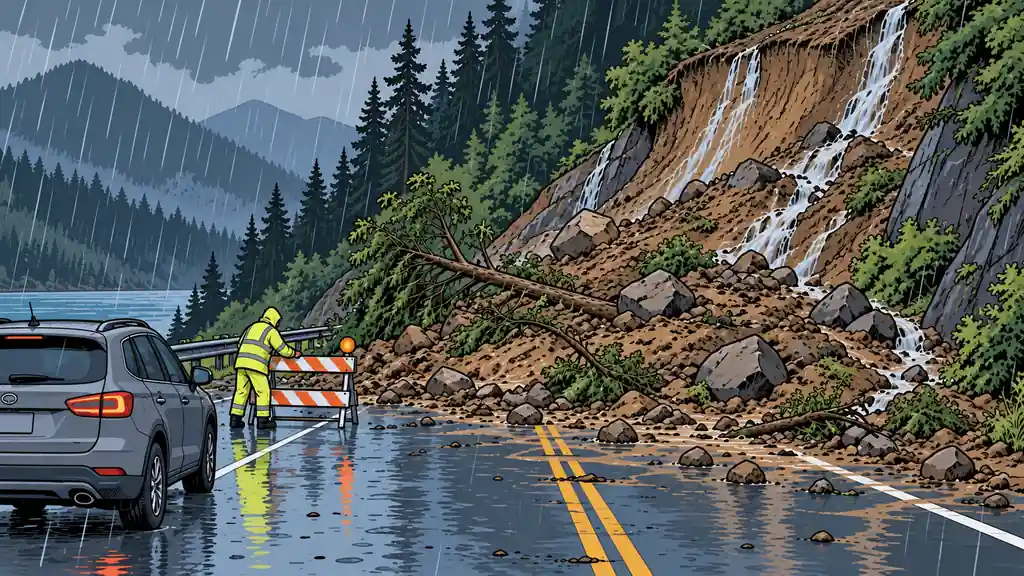
Landslide is the threat where a one-size answer is useless. Ask “how worried should I be?” and the only honest reply is “depends entirely on your ground.” Two neighbors a mile apart can have completely different exposure based on how steep the slope is, what’s under the soil, and how water moves through it. That’s why this one rates a low likelihood overall but a high impact where it lands — meaningless to most people, potentially lethal to a specific few. So the smart approach isn’t generic prep. It’s answering one question first — is my ground the kind that slides? — and only then deciding what to do about it.
That makes this the rare threat where the prep isn’t gear at all. It’s homework and a decision. Know your ground, watch it during the storms that load it up, and be somewhere else when it lets go.
Why slopes fail — the mechanism
A slope is a tug-of-war. Gravity pulls the dirt and rock downhill; friction and cohesion in the soil hold it in place. A landslide happens when the pull wins — and water is usually what lets it win. Rain soaks into the ground and fills the tiny spaces between soil particles. That water pressure pushes the particles apart and cuts the friction holding the slope together. Add enough water and the strength holding the hill drops below the force pulling it down, and it goes. Water tipping that balance is the mechanism the USGS points to as the main landslide trigger.
That one idea explains the patterns that matter:
- It’s driven by rain, often with a delay. Slides usually happen during or just after long or intense rain — sometimes after days of earlier rain have already primed the ground. Saturation adds up. A long wet spell sets the trap; a final downpour springs it. So the danger isn’t just “it’s raining now” — it’s “it’s been wet for a week and now it’s really coming down.”
- A recent burn scar above you is a serious flag. Wildfire kills the roots and plants that hold soil together and soak up water, and it can bake the soil into a water-repellent layer. The result is far more runoff and debris-flow risk in a burned watershed. The USGS finds this elevated risk lasts at least two years after a fire, easing only after several seasons of regrowth. If the hillside above you burned last year, your risk this rainy season is not normal.
- Steeper is worse, and history repeats. Slope angle, soil type, the rock underneath, and past slides all shape the risk. Ground that has failed before tends to fail again.
What the record shows
You don’t need invented figures to draw the lesson. Landslides keep striking in the same three situations: during extreme rain, in burn areas when the first big storms arrive, and in places with a known history of instability where people built anyway. The fast ones — debris flows, dense slurries of mud, rock, and water — are the killers, because they move too fast to outrun once they start.
The 2018 Montecito, California debris flow is the textbook case. An intense burst of rain fell on the fresh Thomas Fire burn scar on January 9, 2018, and the flows killed 23 people and damaged or destroyed more than 400 homes — and a USGS emergency assessment had flagged the high potential just a week earlier. The 2014 Oso, Washington slide, which killed 43 people, hit ground with a documented history of prior failure. The recurring theme: the hazard was usually knowable ahead of time from the terrain and the conditions, even when the exact hour wasn’t. That’s the opening. You generally can’t predict the moment, but you can identify the risk and the dangerous windows — which is most of the battle.
Low odds, but concentrated
For most people, low — most of us don’t live on vulnerable ground, and we rate the likelihood accordingly. Nationally the USGS attributes 25 to 50 deaths and $2–4 billion in losses to landslides each year — a real toll, but a geographically concentrated one. This is a threat where the average badly misrepresents the individual. Your own odds come down to concrete, checkable things:
- Slope: Are you on, above, or below steep ground? Below a slope puts you in the runout path even if your own lot is flat.
- Geology and history: Is your area mapped as slide-prone? Has it slid before?
- Burn status: Has the watershed above you burned recently?
- What’s been changed: Cut slopes, poor drainage, undercut banks, and rerouted runoff can all create or worsen instability.
Run those honestly and you’ll land in one of two places: negligible risk — which is where most people land, and it’s fine to say so out loud — or real risk that earns real preparation. That’s not a stockpiling problem; it’s a homework problem. The assessment is the work.
What happens when it hits
Where it lands, the impact is high and fast. First the structure is destroyed and people are hurt or killed with little warning, especially in a fast debris flow. Then it cascades:
- You get cut off. Slides bury and block roads, isolating homes and delaying help for hours or days.
- Utilities snap. Moving earth shears water, power, and gas lines, stacking a services failure on top of the immediate danger.
- It comes back. One slide can destabilize the ground next to it, and a primed slope can fail again in a later storm.
- Recovery is long and ugly — rebuilding on or below unstable ground raises the hard question of whether to come back at all.
Because the event gives you so little time, the whole emphasis shifts to knowing your risk and leaving early — not riding it out. There’s no riding this out.
What preparedness looks like
1. Do a real site assessment. This is the foundation. Check the USGS Landslide Hazards Program and your state geological survey for susceptibility and inventory maps — and, after a nearby fire, the USGS post-wildfire debris-flow assessments. Check your county’s records for prior slides. And if you’re genuinely in a risk zone or planning to build, hire a licensed geotechnical or engineering-geology professional. Look not just at your own lot but at the slope above you and the runout path — you can be in danger from ground you don’t own.
2. Learn the warning signs. Slopes often drop hints before they fail: new or widening cracks in ground, pavement, walls, or foundations; trees, poles, fences, or retaining walls starting to tilt; doors and windows that suddenly stick; new seeps or springs where there weren’t any; a creek that goes muddy or rises and falls oddly. During heavy rain, a low rumble can mean a slide has already started uphill. Where there’s no official warning system, these signs are yours.
3. Build a rain-triggered evacuation plan. Tie your response to the trigger — heavy, sustained rain on already-wet ground. Decide in advance the conditions under which you leave (say, during a major storm warning if you’re below a burn scar), where you go, and your route — knowing roads may already be compromised. Keep a go-bag ready and sign up for weather and emergency alerts.
Here’s the decision, stated plainly. A false alarm costs you one inconvenient night somewhere else — a motel, a friend’s couch, a bad night’s sleep. Waiting too long can cost you the house and the people in it. That’s not a close call. When a dangerous storm is bearing down and you’re in a risk zone, leaving early is the winning move every time.
4. Cut your exposure where you can. Improve drainage to move water away from slopes, don’t undercut or overload them, keep vegetation in place, and — most of all — don’t build or buy on or below known unstable ground. Where you choose to live is the highest-leverage decision there is.
Readiness here is measured in knowledge and decision speed, not stockpiles or dollars: do you know your true risk, can you read the signs, and have you already decided when you leave?
Bottom Line
- Landslide risk is entirely about terrain and rain — low likelihood overall, high impact where it lands, and meaningless as a generic worry.
- The mechanism is water tipping a slope’s balance — long saturation, and especially a recent burn scar above you, are the big multipliers.
- Assess your site honestly — slope, geology, slide history, burn status, and the runout path above you — because that answer scopes everything else.
- Learn the warning signs (cracks, tilting, sticking doors, new seeps) as your early-warning system, and treat heavy sustained rain as the trigger.
- Build a rain-triggered evacuation plan and leave early when in doubt — the event gives too little time to ride out, so the whole game is not being there.
You can’t predict the hour a hillside fails. But you can know whether you live on one, watch it during the storms that prime it, and decide in advance to be gone before it lets go.
Check whether landslide and other hazards rate for your specific location with the Threat Report tool, and plan evacuation routes with Area Recon.