


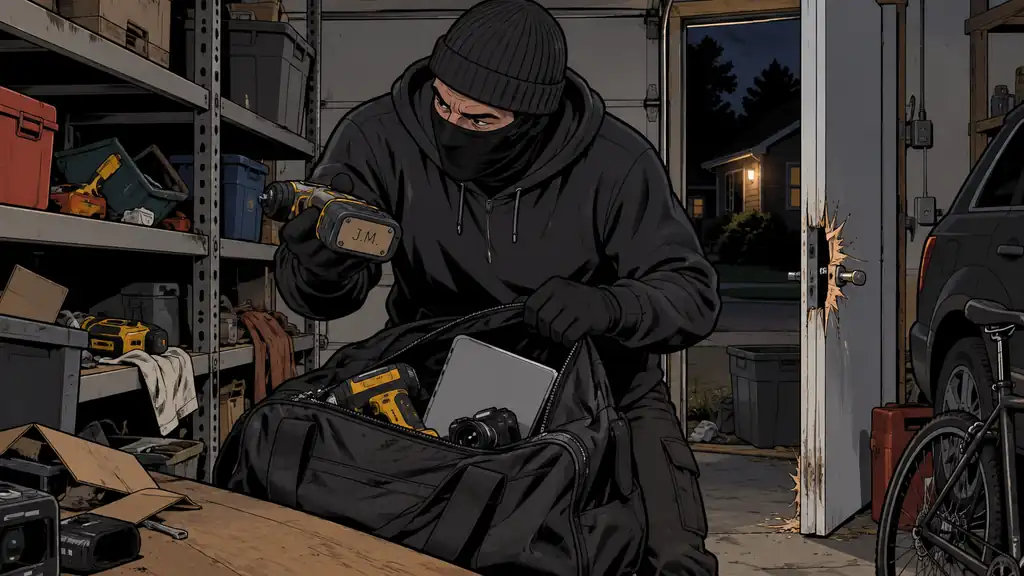
Say “robbery” and most people picture a man with a gun demanding a wallet. That happens, but it’s the rare version, and on this site it’s already covered from both ends — the street confrontation is a mugging, and someone forcing their way in while you’re home is a home invasion. This article is about the third one, the one that actually empties most people out: the theft that happens to your property while nobody’s home or you’re not paying attention. No confrontation, no witnesses, no adrenaline. Just an empty house, a quiet hour, and a truck.
That version is far more common than the one with the gun, and it answers to preparation better than almost any threat on the list — because it runs on a simple economic engine, and you can break the engine.
The target is an empty house — and the shed before the house
A thief who wants to avoid you is really shopping for two things: time and no eyes. An empty house gives him both. That’s why the exposure clusters around the hours and days your absence is predictable — the workday, the weekend away, the week of vacation you announced on social media.
And the first place he looks usually isn’t the house. It’s the outbuildings. The detached garage, the shed, the barn, the shop, the carport. Think about what lives out there: chainsaws, power tools, a generator, a welder, an air compressor, fuel cans, an ATV or mower, fishing and hunting gear, sometimes firearms. High value, easy to carry, easy to sell, and hard to trace. Then look at how it’s secured — often a $6 padlock on a screwed-on hasp, no camera, no light, set back from the road with a tree line for cover. That’s not a vault; that’s a display case. The soft building holds the sellable stuff and gets the least protection. Fix that mismatch and you’ve done half the job.
Everything gets sold — that’s the whole point
Here’s the part that tells you exactly where to push back: the thief doesn’t want your chainsaw. He wants the cash your chainsaw becomes. Property crime is a resale business. The stuff has to move, fast, before you’ve even filed a report — through pawn shops, online marketplaces, flea markets, and buyers who don’t ask questions.
That changes the whole problem. Locks and lights raise the cost of taking it. But you can also attack the other side of his math — the cost of selling it. An item he can’t easily turn into money isn’t worth the risk of grabbing. The best-protected thing you own isn’t the one behind the strongest lock; it’s the one no fence will touch.
Make it hard to sell
Three cheap habits turn your gear from easy money into a liability in a thief’s truck:
- Record the serial numbers. Every tool, appliance, firearm, and piece of equipment with a number, logged with a photo, kept somewhere you can pull it up fast. A recorded serial is what lets police actually return a recovered item to you — without it, they can’t prove it’s yours even when it’s sitting in the evidence room. Many jurisdictions also require pawn shops to log and report the serials of what they take in, which is exactly how flagged serials get a buyer arrested instead of paid.
- Engrave your name on the valuable stuff — visibly, not hidden. An anonymous chainsaw is cash. A chainsaw with someone else’s name cut into the housing is a chainsaw the fence hands back and the pawn shop won’t buy. You’ve stamped “stolen” on it permanently.
- Photograph it all. A phone walk-through of every building, drawer, and rack, once a year, does double duty: it’s your serial-and-condition record for recovery, and it’s what turns an insurance claim from a guessing match into a paid check.
None of this stops the lock from being cut. It makes cutting the lock pointless — which is the deterrent that actually lasts.
Work the number: two identical chainsaws
Picture two neighbors, each with the same $400 chainsaw stolen out of the same kind of shed.
Neighbor A never wrote anything down. His saw is anonymous. It’s at a pawn shop across the county by that afternoon, sold for cash in a day, untraceable — and even if a deputy happens to see it, there’s nothing to connect it to him. It’s gone, and so is the insurance money, because he can’t prove what he owned.
Neighbor B spent ten minutes last year: serial logged with a photo in his binder, his last name engraved on the bar cover. Same theft, completely different ending. The pawn shop that runs serials flags it or refuses it. If it’s recovered, it comes home, because ownership is provable. And the claim pays without an argument. Same lock, same shed, same thief — the only difference is ten minutes of paperwork that made the saw worth stealing to exactly nobody.
That’s the whole game: you can’t guarantee he won’t cut the lock, but you can guarantee he can’t cash out.
The common mistakes
- Treating outbuildings as an afterthought. The house gets the deadbolt and the camera; the shed full of sellable gear gets a hardware-store padlock. The value-to-protection ratio is backwards.
- No inventory, so nothing comes back. Without serials and photos, a recovered item can’t be returned and a claim can’t be proven. You lose it twice.
- Advertising the empty house. Piled-up mail, a dark house every night at the same time, and a vacation countdown posted online all say the same thing: nobody’s here, and won’t be.
- Betting on one deterrent. A single lock, or a single camera, is one problem for him to solve. Layers are several — and he’s looking for the place with none.
What preparedness looks like
Build it from the resale engine outward.
1. Kill the resale value first. Serial log plus photos plus engraving on everything worth stealing. It’s the cheapest, highest-leverage thing here, it protects gear no lock can, and it’s the piece almost nobody does. Keep the list somewhere you can hand it to police in five minutes.
2. Harden the soft buildings. Real hasps and locks (bolted through, not screwed on), motion lighting, a visible camera, and blocked sightlines into windows and open bays. Make the shed at least as much trouble as the house.
3. Make the place look lived-in. Hold the mail, put a couple of lights and a radio on varied timers, ask a neighbor to park in the drive and pull the cans in, and keep the trip off social media until you’re home.
4. Layer the deterrence. Lock and light and camera and signage and a dog or the look of one. Each layer sends the opportunist down the road to an easier target — and easier targets are what he’s shopping for.
5. Plan the after. Know your local numbers going in — see FBI stats for your area in Area Recon — and have the inventory ready so a break-in becomes a report and a claim, not a total loss.
Bottom Line
- The common robbery is a burglary of an empty house — no confrontation, and it usually starts with the outbuildings, not the front door.
- It’s a resale business. He doesn’t want your stuff; he wants the cash it becomes at a pawn shop or online.
- Attack the resale, not just the lock. Serial numbers, engraving, and photos make your gear unsellable and recoverable — the protection no lock provides.
- Protect the soft buildings like they hold what they hold — that’s where the fenceable, high-value, hard-to-trace stuff lives.
- An anonymous tool is cash; a marked, logged tool is a liability — ten minutes of paperwork is the difference.
A thief can cut any lock you own. What he can’t do is sell a chainsaw with your name carved into it — so carve your name into it.
Build the serial-and-photo inventory that makes your gear unsellable and your claims provable in the Home Inventory tool — it’s the small effort that decides how a break-in ends.