


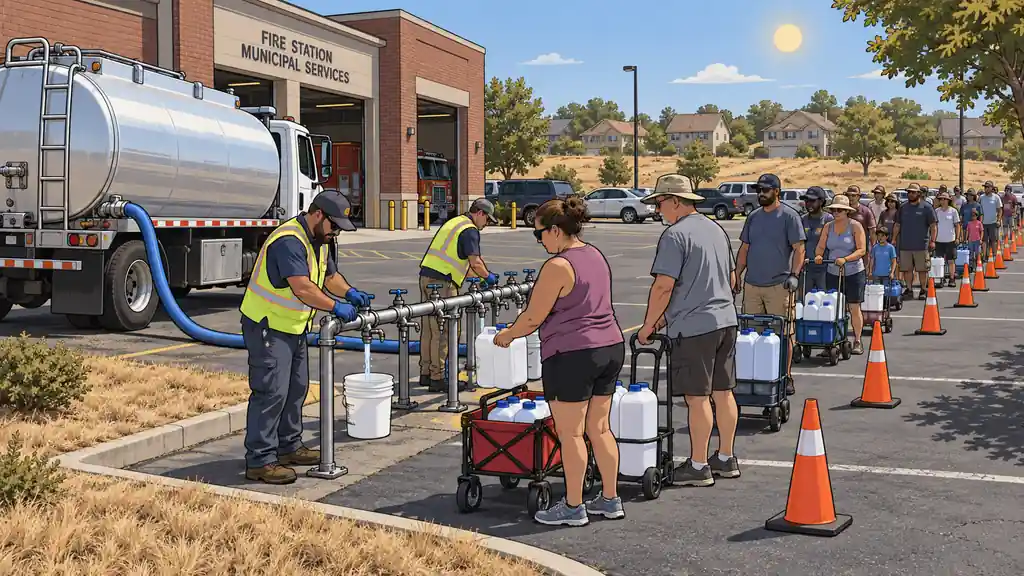
Municipal water is the most invisible thing you depend on, and one of the most fragile at scale. A regional water crisis is not a burst main on your street. It’s a failure that takes out many towns at once — a reservoir drained by drought, a treatment plant knocked offline, a contamination event that puts a whole system under a do-not-drink order. It scores likelihood 4/9, impact 7/9: uncommon, but high-consequence, and slowly getting worse as the pipes age and the droughts deepen.
The one thing that changes everything about planning is how long it lasts. A broken main on your block is fixed in a day. A regional failure takes far longer — you’re refilling a reservoir, recertifying a plant, or re-pressurizing a whole network, all while every town in the region needs the same crews. That’s why the standard 72-hour water supply is quietly sized for the wrong emergency. Three days is fine for the outage that gets fixed in three days. It’s not fine for this one.
Why it’s on the list at all
Preparedness is just weighing how likely something is against how bad it is. Water crises land in the ugly corner: not that likely, but severe when they hit — because water is the one thing you can’t substitute and can’t wait on. You can go weeks without food. You get roughly three days without water before it’s life-threatening. When safe water disappears across a whole region, the shortage is instant, everybody has it at the same time, and every backstop — bottled-water supply chains, emergency distribution points — gets slammed at once. That’s not a nuisance; that’s the exact profile of a threat worth taking seriously even at modest odds.
The system, and the three ways it breaks
Your tap water runs through a chain: source (reservoir, aquifer, river) → treatment (filter and disinfect) → distribution (pumps, mains, pressure). A regional crisis is a break somewhere shared and upstream, which is why it hits everybody at once. Three flavors:
- The source runs dry — drought. Reservoirs and aquifers drawn down over months to years to critical levels. Slow to arrive, usually forecast well ahead, but brutally slow to reverse. A drained reservoir refills on nature’s schedule, not the utility’s — which means it can take decades.
- Treatment fails, or something gets in. A plant goes offline, or a contaminant reaches the finished water — a chemical spill, farm runoff, floodwater, a failed disinfection step, or biological contamination. This triggers one of two very different orders, and the difference is the whole ballgame. A boil-water order means a biological risk, and boiling fixes it. A do-not-use / do-not-drink order usually means a chemical risk — and boiling is useless or worse, because it can concentrate some contaminants. Both have hit real US cities. In August 2014, an algae toxin (microcystin) in Lake Erie forced a do-not-drink, do-not-boil order for roughly 400,000 to 500,000 people around Toledo, Ohio for about three days — boiling would only have made it worse. Seven months earlier, in January 2014, an MCHM chemical spill into West Virginia’s Elk River put about 300,000 people across nine counties under a do-not-use order for days.
- Pressure drops — distribution. A major main break, a pump station down, a power failure that stops the pumps, or a hard freeze rupturing pipes. And here’s the sneaky part: when the pressure drops, contamination gets sucked into the empty pipes, so a pressure failure often turns into a boil-water order on top of everything else.
The thread running through all three: they’re shared failures, so the fix is slow and the affected population is huge — which means outside help is thin, because everyone around you needs the same help at the same time.
What it does — the cascade
- Drinking and cooking stop from the tap immediately. That’s the life-safety layer, and it’s on the three-day clock.
- Sanitation collapses — and this is the part people miss. No water for washing, dishes, and flushing means hygiene falls apart and disease starts moving. In long water crises, the illness that comes from not being able to stay clean has historically done as much harm as the thirst. The crisis isn’t only about the water you drink; it’s about the water that keeps you from getting sick.
- The shelves empty in hours. The moment an advisory posts, bottled water is gone regionally. If you’re not already stocked, you’re racing everyone else for a resource that just vanished. Stocking before the advisory is the entire difference.
- Duration compounds all of it. A multi-week timeline means storage alone eventually runs out — unless you stored an enormous amount — which is exactly why you need a way to make water, not just a way to hold it.
Building it: storage, treatment, sources
Measure your readiness in days of water covered, not dollars spent. Three pieces.
1. Storage — sized in weeks, not days. The planning baseline is about one gallon per person per day for drinking plus minimal hygiene — but understand that’s a survival floor. Real comfort and sanitation run higher, more in heat or with a big household, pets, or medical needs. The math is simple: people × gallons/day × days. A family of four planning two weeks at two gallons a day needs 4 × 2 × 14 = 112 gallons. That’s not a wall of store bottles; that’s a couple of proper containers and a plan. Scale it with what fits: dated commercial bottled water, stackable 5-to-7-gallon jugs, and food-grade 55-gallon drums for bulk — one drum is about 55 person-days at a gallon a day. Store it cool and dark, rotate or treat it, and keep some in grab-and-go sizes. Storage is your zero-effort first line. Its only flaw is that it’s a fixed number that only goes down.
2. Treatment — the part that doesn’t run out. A reserve is a countdown. A filter plus a source is a supply. Own a filter rated for the contaminants that matter — at minimum bacteria and protozoa, which are behind most boil-water orders — and better still one that also handles viruses for the worst cases. But know its limits: most gravity and pump filters pull out microbes but not dissolved chemicals, which need activated carbon, reverse osmosis, or distillation. That’s not a filter problem; that’s a matching problem — you match the tool to the threat. Boiling and a standard filter beat biological contamination. A chemical event needs different treatment or a different source entirely. Keep backups: the ability to boil (which means an off-grid heat source) and chemical treatment (unscented bleach or purification tablets, dosed correctly).
3. Sources — mapped before you need them. Know your alternate water now, not during the crisis: nearby surface water (creek, pond, lake), rainwater off a downspout (a single storm can fill a barrel), the water already sitting in your heater tank and pipes (dozens of gallons), and any local wells. For each one, know what treatment it takes. A mapped source plus the right treatment is what turns a finite reserve into a supply that outlasts the outage.
And watch the advisories. Track your utility’s notifications and learn the two order types cold, because they call for opposite responses. Early warning lets you top off and act before the shelves clear — it turns lead time into gallons.
Bottom Line
- A regional water crisis is uncommon but high-impact (4/9, 7/9) and, crucially, runs for weeks — the standard 72-hour supply is sized for the wrong emergency.
- You get about three days without water, and sanitation collapse is the dangerous second act — plan for drinking and staying clean.
- Store in weeks: run people × gallons/day × days, baseline a gallon per person per day, and target two weeks or more. Four people, two weeks, two gal/day is 112 gallons.
- Add treatment as the part that doesn’t run out — a contaminant-rated filter plus boiling and chemical backups — and match the method to biological versus chemical.
- Map your alternate sources and watch the advisories, so you’re acting on lead time instead of racing an empty shelf.
Storage gets you through the first weeks. A source and a way to treat it gets you through the rest. Build both, and a region-wide water failure is a logistics problem you already solved instead of a race you’re losing at an empty shelf.
Size your household’s water reserve precisely — gallons, days, and containers — with the Food & Water Storage tool.