


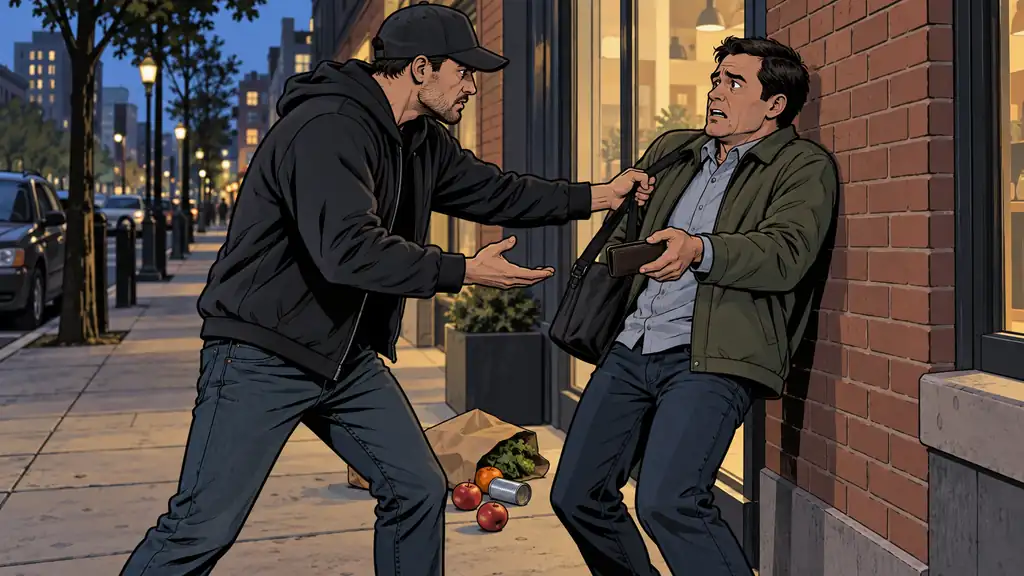
If you already prep, you probably think about mugging in terms of what’s in your pockets — what you carry, whether you carry. That’s the wrong end of it. A mugging is a fast, quiet job the robber has to finish in a few seconds, somewhere help is far off, before you’ve even registered what’s happening. Every choice he makes — who, where, when — serves those few seconds. Understand the seconds, and you know exactly where to get in the way, usually long before anyone’s close enough to demand your wallet. That’s not fighting skill; that’s just seeing the thing clearly.
What a mugging is actually made of
Strip a mugging down and it needs three things: speed, isolation, and surprise. He wants to be on you and gone before you react, somewhere no one’s watching. Knock out any one of the three and the risk stops being worth the reward.
- Speed is why muggings cluster where you’re stopped or slowed — at an ATM, at your car door, in a stairwell, at a checkout where the crowd’s thin.
- Isolation is why they favor the in-between places: parking garages, a transit platform between rushes, the block where the crowd finally thins out.
- Surprise is why he watches your attention before he moves. Head down, earbuds in, arms full — that’s a person who won’t see him coming and won’t react in time.
Your habits aren’t really about winning a fight. They’re about being visibly expensive to any one of those three.
The pattern barely changes
You don’t need a specific case to see the shape — decades of crime data tell the same story. The FBI’s national robbery figures consistently show streets and highways as the single most common place it happens — about a third of all robberies (34.3% in the 2019 data), more than any other setting. That’s why transit corridors, bar districts, and ATM clusters after dark carry the exposure. And robbers pick for ease, not for value. The well-dressed person staring at their phone is a better target than the alert person carrying more cash. Say it plainly: how you get picked is mostly a signal you’re giving off, and you control the signal.
How likely is it, really?
For a typical person, a mugging is an occasional risk — possible in a given year, not frequent. But that flat number hides enormous spread, because the risk is almost entirely about where and how you move. Three dials set your exposure:
- Where. A dense downtown, a transit commute, a nightlife strip — far more exposure than a suburb or a car-to-door life.
- When. After dark and in the empty hours, both his confidence and your isolation go up.
- Pattern. The same walk, same time, same distraction, through the same in-between space, is a standing invitation.
That’s what makes mugging different from a random hazard. Two people in the same city can have wildly different odds based on habits alone. It’s also why it answers so well to a little preparation — you’re turning the exact dials that set the risk.
What it actually costs
Most muggings cost you property and a scare — a phone, a wallet, a ruined afternoon, and a wariness that hangs around a while. That’s the normal outcome, and it’s the whole reason the sane default is to not fight over stuff. But there’s a tail: any robbery can turn into an injury, especially if you resist, freeze, or he’s armed or high. And the after-costs are real — replacing your IDs and cards, dealing with a stolen phone, and the confidence hit that changes how you walk for months.
Here’s the honest version: the typical mugging is manageable, and the bad one is what your habits are really insuring against. You don’t build the habit because the average mugging is dangerous. You build it because the average isn’t the one you’re afraid of.
Where the seconds go — a worked example
Play it out. You’re walking to your car in a parking garage, phone up, reading something. He’s been watching from beside a pillar. He needs maybe five or six seconds to close the gap while you’re not looking. You register him at arm’s length — too late to do anything but hand things over.
Now run it again with your phone in your pocket and your eyes up. You clock the guy loitering by the pillar at thirty feet, not three. That’s several seconds of warning, and several seconds is enough to turn back toward the entrance, ready your hand to uncover your concealed firearm, or just make eye contact that tells him you’ve seen him. Most of the time, that’s the whole encounter — it never starts, because you moved it out of the two things he needed: your surprise and your isolation. Nothing about you got tougher. You just bought back the seconds he was counting on.
The mistakes that get people picked
- Phone out in the in-between spaces. It’s the single loudest “not paying attention” signal there is, and it’s exactly where the risk lives.
- Overriding the gut feeling to be polite. That prickle that something’s off is your brain matching a pattern faster than you can name it. Talking yourself out of it to avoid seeming rude is how people walk into it.
- Everything valuable in one grabbable place. One wallet, one pocket, one bag — hand it over and you’ve lost all of it.
- No decision made in advance. If you haven’t already decided what you’ll do, adrenaline decides for you, and adrenaline freezes.
Building the habit, far to near
Think of it in layers, from far away to right on top of you. Each one that works means the next never gets tested.
- Be a poor target. In the in-between spaces, phone away, head up, moving like you’ve got somewhere to be. Scan as you walk up to your car, an ATM, a stairwell. Thirty seconds of attention where the risk actually is — none wasted where it isn’t. This layer alone sends most opportunists looking for someone easier.
- Buy reaction time. Awareness turns his surprise into your warning. Notice the person loitering with no reason to, the one matching your pace, the one standing near the choke point. This is what turns “it happened” into “I changed my route and nothing happened.”
- Limit the loss. Carry only what you need. Keep a decoy — a small amount of cash separate from your real wallet, something you can produce fast to end it. Don’t consolidate. If you carry a bag, wear it so a snatch doesn’t drag you off your feet.
- Pre-decide. Right now, in the calm, decide that property gets handed over without a fight. Rehearse it in your head: hands visible, comply, make distance, then call for help once you’re clear. The one exception is a threat to you, not your stuff — but you don’t want to be sorting out that difference for the first time with adrenaline running.
Bottom Line
- A mugging needs speed, isolation, and surprise — remove any one and his math falls apart.
- Your risk is set mostly by where and how you move; habits change it far more than gear does.
- Being a poor target and buying reaction time are the layers that matter; if it reaches a demand, the cheap fight is already lost.
- Carry less, keep a decoy, and never put everything valuable in one grab.
- Pre-decide to hand over property. The typical mugging costs a wallet; the bad one is what your calm is insuring against.
Don’t prepare to win a mugging. Prepare so he looks at you, does the math, and picks someone else.
Want to see how personal-crime risk compares to the natural and infrastructure threats in your area? Run your county through the Threat Report.