


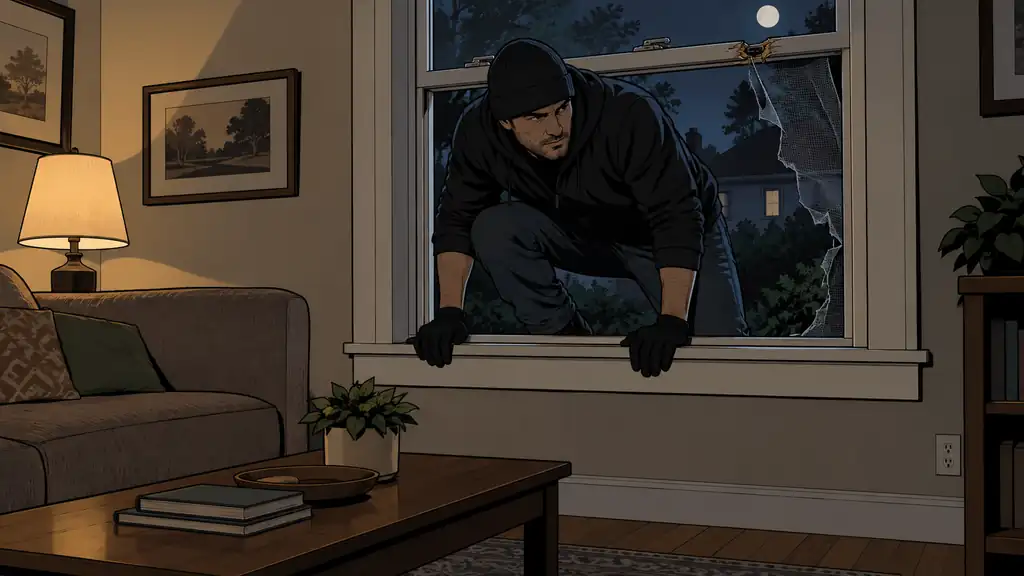
If your whole home-defense plan lives in a nightstand, you’ve prepared for the least likely and most dangerous moment of the whole problem — the one where a stranger is already inside your home. Flip that around. Spend your effort on the layers an intruder hits first — deterrence, detection, delay — so the standoff most people plan for is the one you’re least likely to ever face.
That’s not home defense; that’s a last stand. And a last stand is what you’re trying to design your way out of.
Security people talk about the “Five D’s”: deter, detect, deny, delay, defend. The order is deliberate. Every layer you build on the outside is a layer the last one never has to. A home invasion — a forced entry into an occupied home — is a low-frequency, high-consequence event, and that’s exactly the profile that rewards cheap, layered, upfront work over one expensive point of failure.
Why it’s on the list even though it’s rare
For any single household, a violent break-in is uncommon in a given year — we score its likelihood a 3 out of 9. But the impact is an 8 out of 9, and that gap is the whole point. When it happens, everyone in the home is at direct risk of assault or worse, and the distance between an unprepared household and the threat is nearly zero: no light, no lock that matters, no plan, no fast line to help.
The odds also aren’t the same for everyone. They move with location, visibility, and habits. Burglars are overwhelmingly opportunists who’d rather hit an empty house. Bureau of Justice Statistics data shows most residential burglaries happen in the daytime, when people are out, and more than a third involve no forced entry at all — the intruder just walks through an unlocked door or an open window.
I bring up burglaries because it’s common to lump this threat in with burglaries, and that’s a huge mistake. As we just established, burglars don’t want you home. Home invasions are a different kind of threat — in these, they do, and their goal isn’t stealing things — it’s doing harm to you and your family. This increases the stakes considerably and this becomes a threat that everyone should prepare for as a result.
The pattern is consistent enough to build against
You don’t need a specific headline. You need the recurring shape, and it’s remarkably consistent. Across the vast majority of events, the entry point is the path of least resistance: an unlocked door, a reachable ground-floor window, a side or rear entrance hidden from view, or a house that’s telegraphing it’s empty. Intruders are, overwhelmingly, opportunists looking for low effort and low visibility.
That’s good news, because opportunists are deterrable. You’re not engineering against a determined, resourced adversary who picked you specifically — that’s a different and far rarer problem. You’re up against someone who moves to an easier target the moment yours stops being easy. Security here is comparative. You don’t have to be a fortress. You have to be less inviting than the house next door.
The odds, honestly
Low, but not nothing — and heavily moved by things you can change. Don’t treat it as a fixed number; treat it as a dial. Neighborhood, lighting, whether the house looks occupied, and social-media discipline all turn it. The right answer to a low-odds, high-stakes threat is neither fear nor a shrug. It’s proportionate, one-time hardening that keeps paying off for years.
What’s really at stake
The direct impact is obvious: a violent stranger in an occupied home threatens every person in it. But think past the moment. The psychological toll on a household — especially on kids — can outlast the event by years. And a plan improvised under adrenaline tends to scatter the household instead of pulling it together, turning one emergency into several at once. The impact score of 8 reflects the worst the threat can do, not the average — and you prepare for the worst.
Building the layers
Deter — make the house say “not worth it.” Motion-activated lighting at every entrance and every dark approach is the single highest-return thing you can buy. Darkness is cover; lights take it away. A dog in the yard creates a major hazard that must be gotten past. Trimmed shrubs and trees mean the neighbors and the street can see your doors — that’s surveillance you don’t have to pay for. Visible cameras, even a doorbell cam, change the math before an opportunist ever commits.
Detect — know before they’re inside. Layer your detection so the warning comes at the perimeter, not in the hallway. Exterior cameras with alerts, door and window sensors tied into an alarm system, and a dog in the house all buy you the one thing that matters most here: time. A few seconds of warning is the difference between running your plan and reacting to a person already in the room.
Deny and delay — harden the shell. This is where most homes fail. A hollow-core exterior door, or a deadbolt screwed into a stock strike plate with short screws, is theater — it looks like security and stops nothing. Upgrade to solid-core or steel exterior doors, deadbolts that throw into a reinforced strike plate anchored with 3-inch screws driven into the wall stud behind the frame, and windows with film applied and that actually lock. The goal is to turn a silent five-second entry into a loud, drawn-out, attention-drawing struggle. Opportunists quit when it gets loud and slow.
Defend — the layer you build last and hope to never use. A household lockdown plan and a designated safe room is your gathering point. Pick an interior room — usually a main bedroom — that locks, and stock it simply: a charged phone, a flashlight, and whatever means of defense you’re trained and legally allowed to keep. The plan is to pull the household into that one room, lock it, call for help, and defend that single door only if you have to. You are not clearing your house — that’s a job for people with backup and training. You’re holding one door until help arrives.
The comms layer. A charged phone in the bedroom every night is non-negotiable — it’s your only reliable line to help. Think through how you’d call if the power or the Wi-Fi is out, and make sure at least one other person in the house knows the plan cold. Measure your readiness in time to help and time to get everyone in the room, not in dollars spent on gear.
Information discipline. Don’t post things that make you an inviting target for a predator. This means severely limiting any pictures of your wife and children as they are the primary targets in most events. The key is to manage the free intelligence an opportunist can gather about you before ever setting foot on the property.
Bottom Line
- Flip your priorities. Spend on the outer layers — deter, detect, delay — not just the inner standoff.
- The gap drives the strategy: low likelihood (3/9), severe impact (8/9). One-time hardening is the right answer to that profile.
- You’re deterring opportunists, not defeating specialists. Comparative hardening works — just be the harder target on the street.
- A safe room and a rehearsed lockdown plan turn chaos into one defensible problem: hold a single door.
- Measure readiness in time — time to detect, time to gather everyone, time to help.
Build your security like an engineer, not an action hero — five quiet layers on the outside so the loud one on the inside never has to fire.
Map your home’s approaches, sightlines, and lighting gaps with Area Recon, and log your security plan and safe-room details in the Digital Binder.