


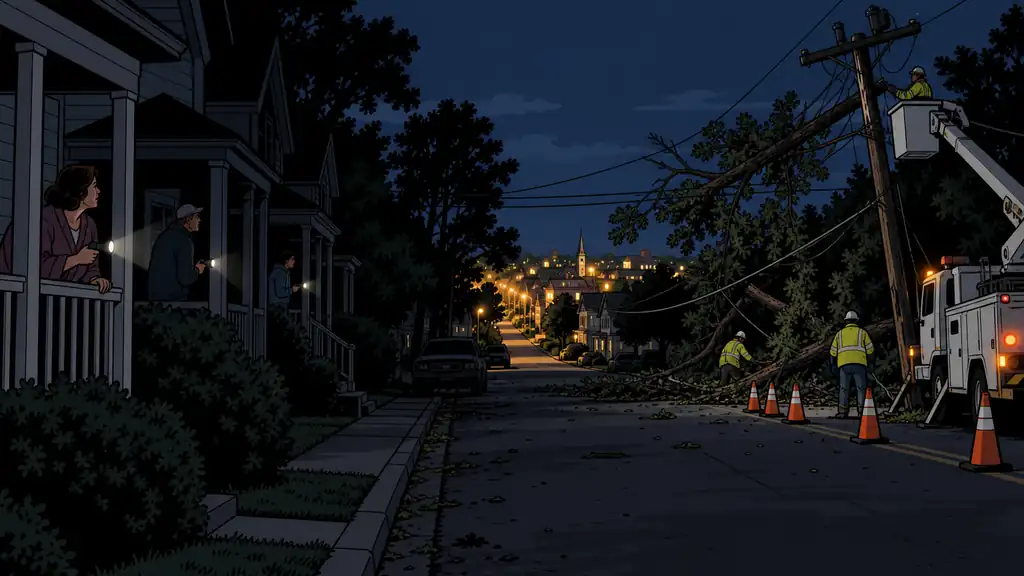
If you keep a flashlight and a charged battery bank, you’ve already solved the four-hour outage. Good — that’s most of them. But the outages that actually cost people money and misery are the ones that cross from hours into days, and those ask a different set of questions. How long does my food stay safe? How do I hold heat in the house? Does my water keep running? Can I still reach anyone? A four-hour plan doesn’t answer any of those. That’s not the same threat scaled up; that’s a different threat.
The frame that makes this easy: an outage isn’t an event, it’s a clock. At hour one it’s nothing. By hour six your fridge is warming up. By hour twenty-four your phone’s dead if you didn’t manage it. By day two a cold house in a hard freeze is an actual health problem. You don’t prep for “the outage.” You prep for the clock.
Likelihood: basically certain, occasionally serious
On our scale this threat sits near the top for likelihood and low for impact — and that’s exactly right. Nearly every household loses power at least briefly every year, so the base rate is about 100%. What swings wildly is duration. Routine outages clear in minutes to a couple of hours. The long ones cluster around big weather — ice storms, hurricanes, derechos, heat waves that overload the grid — where restoration drags out to days because crews are fixing thousands of broken points at once, not because any one break is hard.
The national numbers show the split cleanly. The EIA found the average US customer lost about 5.5 hours of power in 2022 — but only around 2 hours of that came outside the major weather events. So the big storms roughly triple your expected outage time, and they’re where nearly all your real exposure lives.
The practical read: prep for the common short outage as a reflex, and prep for the multi-day outage as a separate, deliberate case tied to whatever severe weather your area actually gets. If you’re in ice country, the long one arrives with a hard freeze. On the Gulf, it comes with heat and humidity. The outage plan and the weather plan are the same plan.
Impact: low on its own, dangerous through the workarounds
A short outage is a disruption, not a danger, once you’ve got light, a way to manage temperature, and a charged phone. That’s why its baseline impact is low. The harm almost always comes from three places instead:
- Unsafe improvising. This is the one that kills people. A generator or a grill run in a garage or near a window fills a house with carbon monoxide — the CPSC pins roughly 85 deaths a year on portable-generator CO alone, and they spike right after storms when everyone’s in the dark at once. Candles start fires. The fix isn’t willpower; it’s having a safe option already staged so you’re never tempted to improvise a deadly one at 2 a.m.
- Spoiled food. Per USDA guidance, a closed fridge holds a safe temperature for about 4 hours. A full freezer holds for roughly 48 hours — about 24 if it’s only half full — as long as you keep the door shut. Cross those lines and you’re throwing out a fridge’s worth of groceries and a freezer full of meat. Every time you open the door “just to check,” you spend that clock faster.
- Temperature in the house. In a hard freeze or a heat wave, a house with no power drifts toward the outdoor temperature over hours to a day. For most people that’s misery. For the very young, the elderly, and anyone medically fragile, it’s a real health threat.
A worked example: the two-day ice storm
Run the clock for a family of four, freezer half full, an ice storm that takes the power for 40 hours in a cold snap.
- Hour 0–4: nothing. Lights on, dinner’s already cooked, phones full.
- Hour 4: the fridge is now at its safe limit. Time to move the milk, meat, and leftovers into a cooler with the ice you froze ahead of time. Do it once, then leave both closed.
- Hour 6–12: house is cooling. Everyone’s in warm layers, and you’ve closed off one room to hold heat. Phones are on low-power mode, pulling from the reserve battery bank, not the wall.
- Hour 24: the half-full freezer is at its limit — but you already emptied the must-save items into the cooler, so it doesn’t matter. Phone at 60% because you managed it instead of streaming.
- Hour 40: power’s back. You lost nothing but a little comfort. The unprepared house down the street lost a freezer of food, ran a generator in the garage and got lucky, and spent two cold nights improvising.
Same 40 hours. The only difference was staging a cooler, some frozen jugs, a reserve battery, and warm layers — call it a hundred dollars and one afternoon.
What a solid outage plan covers
Build it in two tiers, because the two problems really are separate.
Tier 1 — the short outage (reflex):
- Staged lighting with spare batteries right beside each light, and at least one headlamp per adult so hands stay free.
- A charged battery bank big enough to refill every phone in the house at least once. A 20,000 mAh bank does that several times over.
- A wind-up or battery weather radio so you’re getting news without draining the phone you need for light and contact.
Tier 2 — the multi-day outage (deliberate):
- Keeping food cold: keep the fridge and freezer shut, have a cooler and a plan to move the essentials into it, and freeze a few water jugs now so they double as ice and as drinking water later. Know your “when in doubt, throw it out” line before you’re staring at questionable chicken.
- Heat without the grid: warm layers and good sleeping bags carry a cold-weather outage on zero fuel. If you use a fuel heater, it has to be one rated for indoor use, with the ventilation the manufacturer specifies — never a patio heater or a stove you talked yourself into.
- Cool without the grid: find the coolest part of the house, block the afternoon sun, hydrate, and slow down. A wet cloth in front of a little airflow cools you in dry heat.
- Water: city water usually keeps flowing short-term, but pumps and treatment can lean on the grid, and a well pump stops the instant the power does. Keep a few days of drinking water set aside, and know whether your water depends on electricity — because if you’re on a well, it does.
- Comms: one battery bank held in reserve that you don’t touch until Tier 2, and a household rule to flip phones to low-power mode the moment an outage looks long.
Where a generator fits (and where it doesn’t)
A generator is a Tier-2 comfort multiplier, not a Tier-1 necessity. If you buy one, buy the safety with it. Run it outside, well away from every window and door, keep the house on CO alarms, and size it honestly to the few things you actually need — the fridge, a couple of lights, phone charging, a medical device. An oversized generator you never learned to run safely is worse than a good battery bank you understand cold. (For sizing, the generator calculator walks the loads.)
Bottom Line
- Treat the outage as a clock: nothing at hour one, a real problem by day two. Plan for both, separately.
- The true danger is the unsafe workaround — stage safe light, heat, and power so you never improvise a deadly one.
- Know your cold-chain times — about 4 hours for the fridge, 24–48 hours for the freezer — and know your home’s best hot-weather and cold-weather room.
- Keep a reserve battery bank and water you don’t touch until an outage goes long, and if you’re on a well, remember the pump dies with the power.
The outage you’re ready for is a non-event. The one that hurts is the one where you’re improvising heat, light, or power in the dark — so remove every reason to improvise before the lights ever go out.
Track your outage tier list, batteries, and water alongside the rest of your supplies in Food & Water Storage, and size backup power with the energy calculators.