


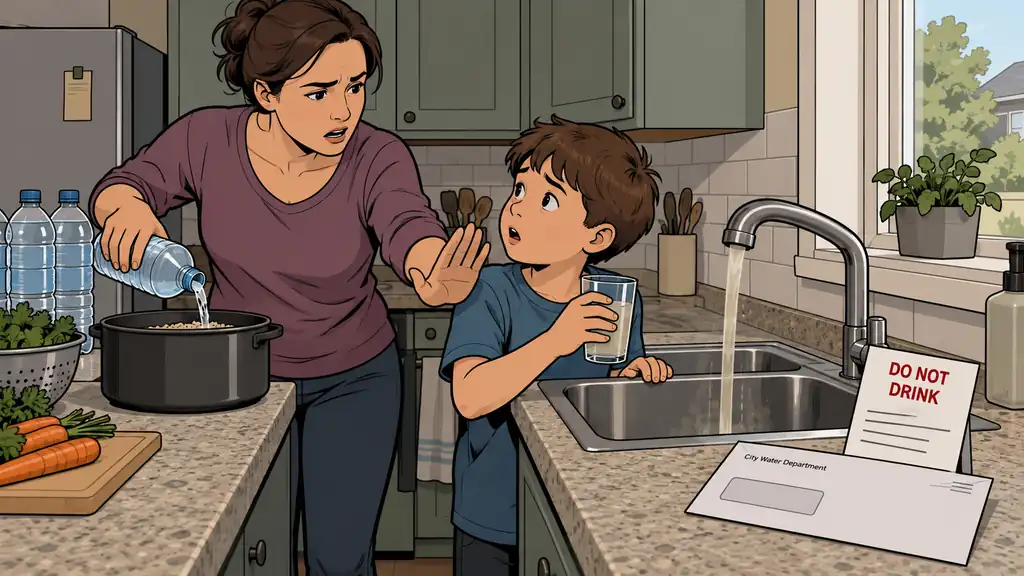
Most preppers have “water” on the list and a few cases of bottled stashed in the garage. That’s a start, but it treats every water problem as the same problem. It isn’t. A precautionary boil advisory and a real, lasting contamination are two different events that need two different responses — and the second kind, the one that actually threatens your household, often can’t be fixed by boiling at all. Getting this right means knowing what’s in the water, matching the treatment to it, and storing enough to bridge the gap while the store shelves are empty.
The reframe: “unsafe water” isn’t one thing
When a utility puts out a boil-water notice, it’s usually a germ precaution — a pressure drop or a main break that might have let bacteria in, so they tell everyone to boil until the tests come back clean. Boiling handles that completely. Heat kills bacteria, viruses, and protozoa. Boil for a minute, you’re safe, and the advisory lifts in a day or two.
The events that actually hurt households are a different animal:
- Confirmed germ contamination — a treatment failure or a fouled source that puts real pathogens in the supply for a sustained stretch, not just a maybe.
- Chemical contamination — an industrial spill, farm runoff, a treatment-chemical failure, or metal leaching out of the pipes themselves. Lead is the famous one. Boiling does nothing for most chemicals — and for the ones that evaporate, boiling concentrates them as the water steams off, leaving what’s left more poisonous than what you started with.
That one distinction drives everything. Your treatment has to match the contaminant, and for the worst cases, stored and bottled water is the only safe answer until the utility fixes it. This is the whole ballgame: boiling a chemical problem doesn’t just fail, it can make things worse.
The record: scares, and then the real ones
Main breaks and pressure losses set off short precautionary advisories constantly — that’s background noise. The serious cases are the ones worth studying, and they teach the same lesson three times:
- Flint, Michigan (2014 onward): a switch in water source destabilized the pipe scale and leached lead into the supply for years, affecting roughly 100,000 residents. You cannot boil lead out of water. Bottled and properly filtered water was the only safe supply for an extended period.
- The Elk River spill near Charleston, West Virginia (2014): an industrial chemical called MCHM got into the supply and put about 300,000 people across nine counties under a “do-not-use” order — not even “boil,” don’t use it.
- Milwaukee, 1993: a filtration failure let Cryptosporidium through and sickened an estimated 403,000 people, killing dozens — still the largest documented waterborne outbreak in US history.
The thread running through the serious ones: they lasted (days to much longer), they blew past the local bottled-water supply almost immediately, and the households that coped were the ones with their own storage and treatment. The ones caught flat had to stand in line, ration, or haul.
How likely: mid-low, but the base is getting worse
On our scale this sits on the higher side — more common than most people assume. A serious, sustained contamination is rarer than a quick precautionary advisory, and in any single year your town’s odds are modest; but these recur often enough that plenty of households will meet one within a few years. It’s not worth losing sleep over — it is worth being quietly ready for.
But the trend line matters. A lot of US water infrastructure is aging past its design life — pipes, mains, and treatment plants under real financial and physical stress. The American Society of Civil Engineers graded US drinking water a “C-” in its 2025 Infrastructure Report Card and estimates a water main break somewhere in the country every two minutes — on the order of 240,000 a year. Stressed systems fail more often and in more ways. So while your household’s odds in any given year are modest, it’s a recurring — arguably rising — risk across the system, concentrated wherever the pipe is oldest. That’s a solid case for cheap, standing readiness instead of reacting after the fact.
What it actually does
The damage scales with how long it lasts and what kind it is. A one-day advisory is a nuisance. A multi-day loss of safe water is a real problem, because a household burns through more water than people expect, and most of it isn’t optional.
Run the math for a family of four. At the common planning floor of one gallon per person per day, that’s 4 gallons a day — just for drinking and modest cooking and cleaning. A week of that is 28 gallons. And that gallon-a-day floor is lean; it doesn’t cover a normal day’s dishes, laundry, and full hygiene. The point isn’t the exact figure — it’s that “we’ve got a case of bottled” is a day, maybe two, not a week.
Then the knock-on effects ripple out:
- The bottled-water aisle empties within hours of the announcement, because everyone in town does the math at the same moment. Reacting isn’t a plan.
- Restaurants and some businesses close under health rules.
- The vulnerable are in real danger — infants on formula, the immunocompromised, dialysis patients — on much narrower margins than the rest of us.
- People poison themselves trying to fix it — drinking untreated water, or boiling a chemically contaminated supply and trusting it. That last mistake is the trap worth naming twice: treating a chemical event like a germ event. Matching the response to the contaminant is the entire skill.
What being ready looks like
Build water readiness in layers, not as a single trick.
Layer 1 — stored water (your no-think reserve).
- Aim for one gallon per person per day as the planning floor, and be honest that it covers drinking and light hygiene, not a normal day. Store at least a week — for a family of four that’s 28 gallons — and more if you have the space.
- Keep part of it as sealed, commercial bottled water that needs zero treatment. That’s your simplest, safest first draw, and it’s the right answer during a chemical event when treatment may not help at all.
- Rotate stored tap water periodically, and use food-grade containers.
Layer 2 — treatment for germs (to stretch your supply).
- A real filter rated to remove pathogens — not a taste-improving pitcher. Look for one that takes out bacteria and protozoa like Giardia and Cryptosporidium; many gravity and pump filters qualify. Know its limits: most filters don’t remove viruses or dissolved chemicals unless they specifically say so.
- Boiling: a rolling boil for one minute (longer at altitude). The gold standard for germs, no equipment needed, as long as you’ve got fuel.
- Chemical disinfection: unscented household bleach at the correct tiny dose, or purification tablets, kept with printed instructions. This is your backup when fuel or filters run short.
Layer 3 — knowing your other sources.
- Your water heater holds many gallons of drinkable water you can drain — most homes have 30 to 50 sitting right there. Toilet tanks (not bowls) hold clean water too. Know these before you need them, and know to kill the power to the heater first.
- Identify nearby natural sources, and understand you’d have to treat them — and that in a chemical event, even nearby sources may share the same contamination.
The judgment layer — match the method to the threat.
- Germs or precautionary → boil or filter, and stored water covers the gap.
- Chemical → do not rely on boiling or a standard filter. Use your stored and bottled water and wait for the official all-clear. That single decision is the line between being prepared and poisoning yourself efficiently.
Measured in what you can actually do: a week of stored water, one good filter, two treatment methods you can execute without looking anything up, and the judgment to tell the two contamination types apart. That’s robust water readiness for very little money.
Bottom Line
- Separate the two events — precautionary or germ (boiling works) versus chemical (it doesn’t). Your whole response depends on which one you’re facing.
- Store at least a week at one gallon per person per day — 28 gallons for a family of four — including sealed bottled water that needs no treatment.
- Own a real filter and know boiling and bleach dosing, because the local shelves empty within hours and reacting fails.
- Boiling doesn’t remove chemicals and can concentrate some — stored and bottled water is your only safe move in a chemical event.
- Know your hidden sources — the water heater and toilet tank hold gallons of drinkable water most people never think of.
The contamination that hurts you is the one you can’t boil away. Match your treatment to the threat, and keep enough water stored that you’re never the one standing in the empty water aisle.
Set your gallons-per-person target and track your reserve and rotation with the Food & Water Storage worksheet.