


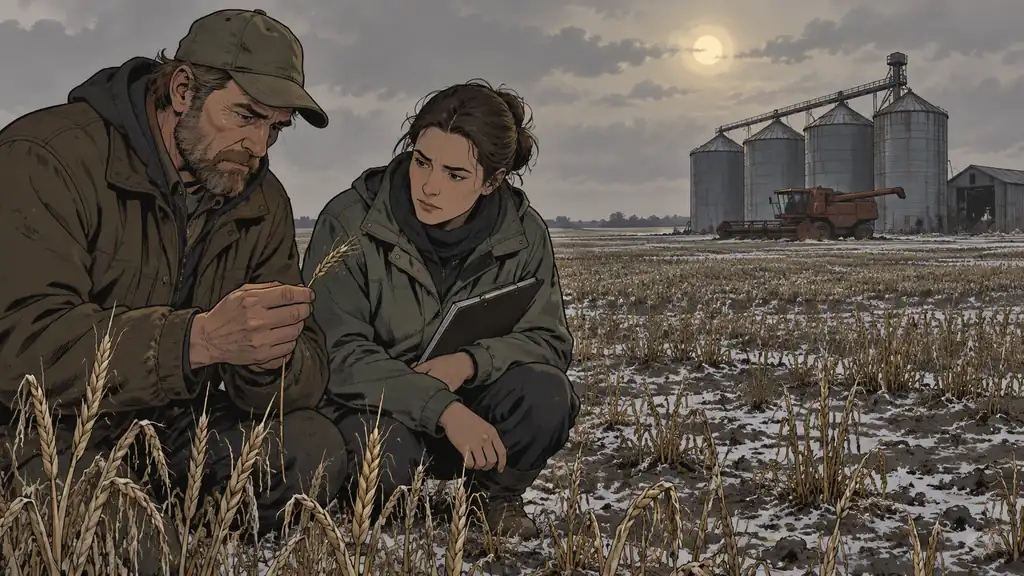
Nuclear winter is the threat preppers most often get wrong in both directions — written off as unsurvivable and ignored, or obsessed over far past what its odds deserve. The measured view is neither. It’s a real tail risk with the lowest probability on the board (1) and the highest consequence (9): the multi-year climate aftermath of a large nuclear exchange, one that would break agriculture worldwide.
The key to preparing for it sanely is to see clearly what it actually is. It’s not a blast. It’s not fallout. Those belong to the nuclear war threat — local, acute, with their own answers. Nuclear winter is the global, delayed, food-system collapse that could follow. You could be nowhere near any detonation and still face it, because the mechanism is climate, and climate is planet-wide.
The mechanism: what could happen
It’s a second-order effect — a consequence of a consequence. Following the chain is what makes the preparation rational instead of fearful:
- A large nuclear exchange sets off massive fires in cities and industrial areas.
- Those firestorms loft enormous amounts of soot — black carbon — high into the stratosphere, above the weather that would otherwise rain it back down within days.
- The soot spreads around the globe and absorbs incoming sunlight, cooling the surface and dimming the light for years. Climate modeling by Alan Robock, Brian Toon, and colleagues finds a full US–Russia exchange could loft roughly 150 teragrams — about 165 million tons — of soot, which heats the surrounding air, lifts itself higher, and can linger in the stratosphere for a decade or more, producing surface cooling their models compare to an ice age.
- Colder temperatures, shorter frost-free seasons, and less sunlight cause crop failures across many food-producing regions at the same time.
That last word is the whole problem: at the same time. The world’s food system handles a bad year in one region by shipping surplus from another. It has no answer for a bad year everywhere at once, for several years running.
Precedent: the mechanism is real, the scale is modeled
There’s no historical nuclear winter to point at, and it’s important to say that plainly — this is a modeled scenario, not one anyone has watched happen. But the underlying physics has a clear real-world track record.
Big volcanic eruptions have thrown aerosols into the stratosphere and cooled the whole planet enough to wreck growing seasons. The cleanest case is the 1815 eruption of Mount Tambora — the largest in recorded history — which dimmed the globe enough to make 1816 the “Year Without a Summer.” Killing summer frosts, crop failures across Europe and North America, and famine that contributed to well over 100,000 deaths. That’s a real event, and it’s the same class of mechanism: aerosols in the stratosphere, less sun, failed harvests.
But there’s a problem with the comparison…
Yes, we have the precedent of the Tambora eruption, but I don’t know that it means a nuclear exchange would create a nuclear winter. The reason I say this is the scale.
Earlier, I stated the value of 165 million tons of soot would be injected into the atmosphere during a full-scale nuclear exchange - this is the number that Alan Robock, Brian Toon, and colleagues arrived at. The problem is that the Tambora eruption projected about 154 billion tons of material into the atmosphere - 1000x more. This makes me skeptical that an event with 1/1000 the impact would have the same net effect. Scientists say that the Tambora eruption only lowered global temperatures by 1.8 maximum. I would suspect that at 1/1000 the material, the temperature impact would be minimal.
Additionally, based on my research, it’s likely that most nuclear targets would not be ground-bursts, they’ll be air-bursts. Ground-bursts are only required to penetrate hardened targets, etc. so they would have limited use. This is good because air-bursts generate almost no fallout. The explosions at Hiroshima and Nagasaki were both air-bursts, and for this reason rebuilding began almost immediately.
It’s because of these factors, I’m genuinely skeptical about whether a nuclear winter is even realistic. But, this site is about making informed decisions, so I’m including all the information here so you can make a decision for yourself.
The odds, and why it still makes the list
On the 1–9 scale this is a 1, the lowest, and it earns that without hedging. Nuclear winter can only happen if a large nuclear exchange happens first, and that prerequisite is itself unlikely. Think of it as two unlikely things stacked: the chance of a large exchange, times the chance it produces a severe winter. The first term alone is small. You should not reorganize your life or your prepping around this.
What the low odds don’t do is justify ignoring it, for two reasons. The consequence is extreme enough that even a tiny probability carries some weight in a complete risk picture. And — this is the practical part — almost everything you’d do for it, you’re already doing for likelier threats. That’s the combination that puts it on the list but dead last in the queue: negligible odds, catastrophic impact, and mitigation you get as a byproduct of ordinary deep resilience.
The impact: a caloric shortfall that runs for years
Impact is a 9 because there’s the possibility I’m wrong and this hazard exists as it’s been modeled. If true, this is a prolonged, worldwide breakdown of the systems that feed and warm people. The core hazard is caloric — simply not enough food, everywhere, for a long time.
- Global food scarcity. Simultaneous multi-region crop failure over consecutive years would blow through food reserves and trade, which are built for normal ups and downs, not a global multi-year shortfall. A 2022 study in Nature Food estimated a full US–Russia nuclear war could put more than 5 billion people at risk of death from famine.
- Cold that compounds it. A colder world raises heating demand exactly when energy and supply systems are broken — and cold itself burns more calories.
- Cascading collapse. Food and energy scarcity at global scale rolls into economic collapse, broken trade and governance, conflict over what’s left, and mass displacement — a downward spiral, not a discrete event with a clean end.
- Duration is the difference. Most threats are measured in days or weeks. This one is measured in years. That’s what makes it a different animal and why the reserves it asks for are so deep.
Here’s the math that makes “deep” concrete. Survival is people × calories/day × days. Say a person needs about 2,000 calories a day — and remember cold pushes that up. Four people for a single year is 4 × 2,000 × 365 ≈ 2.9 million calories. No pantry holds that in ready-to-eat form for a household of four, let alone the several years this scenario can run. That single line is why nuclear winter can’t be solved by storing your way out — it has to become producing your way through.
Honest planning admits its limits: against a threat this large and this long, no individual prep guarantees an outcome. The goal is to maximize your household’s and community’s odds and self-reliance — not to promise a result.
Building the posture — deep, general, and last
The preparation is the deepest extension of ordinary resilience, built after you’re solid on likely threats, because every piece also serves those.
Deep food reserves — the bridge. The core challenge is prolonged scarcity, so the core prep is long-term food storage taken to its deepest practical horizon: shelf-stable staples with multi-year life — grains, legumes, fats, salt — properly packed, rotated, and maintained. This is just the far end of the same food-storage continuum you build for any long disruption. Dual-use, not exotic. But be honest about its role: reserves bridge you toward production. Over years, they run out.
Sun-independent food production and preservation. Because the limiting factor is cold and dim light: skills and infrastructure for controlled-environment growing — greenhouses, cold frames, season extension — that buffer bad conditions. Preservation capability — canning, drying, root-cellaring, fermentation — to make harvests and reserves last. Seed saving, and knowledge of cold-tolerant, short-season crops. All of it is high-value for any long crisis and for ordinary self-sufficiency.
Grid-independent warmth. A colder world with broken systems needs reliable heat: a wood stove or equivalent with a sustainable fuel supply, plus deep insulation and efficiency. The same heating resilience that serves an energy crisis or a winter grid failure.
Durable skills and community — the deepest layer. Over a multi-year horizon, no cache lasts; capability and cooperation do. Hands-on skills — food production, preservation, repair, medical, mechanical — that let you produce rather than only consume. And a trustworthy, capable community, the single most important factor in surviving any prolonged scenario, because no household is self-sufficient over years alone.
Bottom Line
- It’s a food-system collapse, not a blast. Global, delayed, agricultural — the aftermath of large-scale nuclear war, not the war itself.
- Lowest odds on the board, highest impact. Contingent on a large exchange that’s itself unlikely — so understand it, don’t fear it, and keep it last in the queue.
- The mechanism is real (volcanic analogs); the scale is modeled and uncertain — prepare for the direction, colder and darker and longer, not a specific number.
- You can’t store your way out — you produce your way through. Multi-year reserves bridge you to sun-independent growing, preservation, and warmth.
- Build it last, and lean on community. Every element also serves far likelier threats, so you earn nuclear-winter readiness at near-zero extra cost — and the people around you are the reserve that doesn’t run out.
You don’t build a nuclear-winter plan. You build the deepest general resilience there is — and this scenario is just the furthest edge it happens to reach.
The multi-year food reserve at the heart of this is the same continuum you build for every lesser threat — start with the Food & Water Storage tool.