


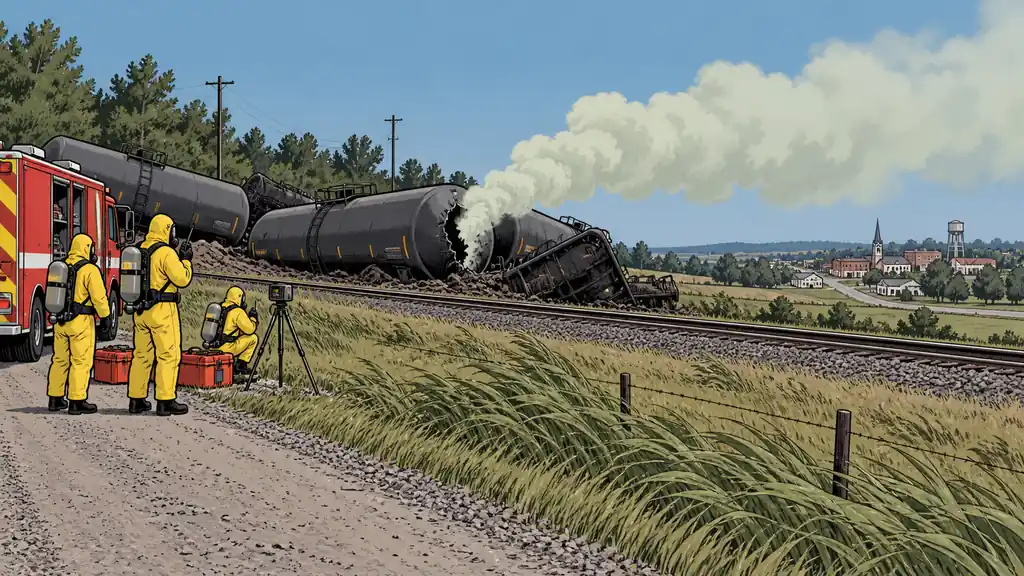
Most emergencies have one right response you can prepare for one way. A hazmat derailment has two, and they’re opposites. You either evacuate or shelter in place — and picking the wrong one can be worse than doing nothing. Leave through a drifting toxic cloud and you walk straight into the danger. Shelter in place when you should have run from a growing fire, or from a heavy gas pooling at ground level, and you seal yourself in with it.
So the thing that matters here isn’t a stockpile. It’s being able to do either move correctly, fast, when the release, the wind, and the responders make the call for you — and they make it in minutes. That’s not a supply problem; that’s a readiness-and-judgment problem.
A hazardous-materials train derailment is a rail accident that spills, ignites, or vents dangerous cargo — flammable liquids, toxic gases, corrosives. It rates impact 7 of 9, concentrated near the line, and likelihood 3 of 9 — uncommon, but a live risk for the very large number of people who live near active rail. If that’s you, this is one of the best trades in prepping: a little cheap readiness moves your odds a lot.
Why the risk is real even though it’s rare
Freight rail moves an enormous volume of hazardous material across the country every day, and the tracks thread right through the middle of countless towns — usually lines laid a century before the houses grew up around them. So the odds for any one household in any one year are genuinely low, but the number of exposed households is huge and the consequence, when it lands, is severe and immediate.
The volume tells the story. U.S. railroads move more than 2 million carloads of hazardous materials every year, including roughly 105,000 carloads of toxic-inhalation-hazard materials like chlorine and anhydrous ammonia — chlorine alone about 35,000 of them, per the Association of American Railroads. And the risk isn’t spread evenly: how close you are to the line, what kind of traffic it carries (busy freight versus a light passenger run), and the local geography (grades, curves, river crossings) all move it up or down.
The one that made the news: in February 2023 a Norfolk Southern train came off the tracks in East Palestine, Ohio — 38 cars, several carrying vinyl chloride — forcing a roughly one-mile evacuation of about 2,000 residents and a deliberate controlled burn of the leaking chemical. That’s the shape of it: a normal evening turns into a mandatory evacuation in a matter of hours.
What actually threatens you — and why the response splits in two
The hazard type is what decides whether you run or seal up:
- Toxic inhalation hazards. Certain gases and volatile liquids — chlorine and anhydrous ammonia are the classic rail cargoes — form a cloud that’s dangerous or lethal to breathe and drifts downwind. Some are heavier than air and flow downhill into low ground, ditches, and basements. For these, the cloud’s path is the threat, and getting crosswind then upwind is survival. This is the case where evacuating in the right direction saves you — and where sheltering can be right instead, if the cloud will pass quickly and you can seal the house.
- Flammables and explosives. Crude oil, ethanol, LPG. These burn hard and can escalate. A heated pressurized tank car can throw a boiling-liquid expanding-vapor explosion (a BLEVE) — a large blast and fireball. For these, distance is safety, and a wide, fast evacuation is usually the order.
- Corrosives and reactive chemicals. Contact hazards, and sometimes toxic byproducts when they mix or burn.
Here’s the hard part: the chemical dictates the response, and you usually won’t know the chemical. Responders read it off the placards and shipping papers and set the zones from there. That’s exactly why enrolling in official alerts and following responder instructions isn’t optional politeness — it’s the core of the plan.
How likely, calibrated to you
Treat it as a low base rate with high local variance. Living a mile from a quiet branch line is a different risk than living 200 yards from a mainline that runs unit trains of crude or chlorine. The right response isn’t fear. It’s a one-time, honest look at your actual exposure, then cheap standing readiness sized to what you found.
Work the clock
The danger in a derailment is the compression. A hurricane gives you days; a derailment can force an evacuation order in hours or less. So put it in time.
Say the order comes and you have 30 minutes before the plume reaches your block. A household with a packed bag by the door, two routes already picked, and documents already handled is out and moving in under 5 minutes — 25 minutes of margin. A household starting cold spends that half hour hunting for medications, the passport, the pet carrier, and a route, and pulls out with the plume already on them, into roads clogged by everyone else who waited. Same 30 minutes. Completely different outcome.
The shelter side has its own clock. Sealing a room right — everyone in, windows and doors shut, HVAC and fans off, dampers closed, gaps taped — is a 2-minute job if the tape and plastic are already staged, and a frantic ten-minute scramble if they’re in a drawer somewhere. You’re buying those minutes now, in a quiet moment, so you don’t have to find them later.
What to actually do
The goal is to be able to run or stay, correctly, within minutes.
Assess your exposure first. Find out whether active rail runs near you, how close, and what it carries. This one check sets how much of the rest applies to you. Map it, including the low ground where a heavy gas would settle.
Build the go-bag — and keep it actually packed. The universal failure isn’t owning supplies; it’s owning supplies that aren’t ready to grab. A bag staged by the door should cover a multi-day displacement: medications and a written list of them, critical documents (or secured digital copies), water, food, a change of clothes, cash, phone charger and battery bank, an N95 or better, and whatever your kids, pets, or medical needs require. The test is whether you can be out the door in under 5 minutes.
Plan wind-aware routes — more than one. Pick at least two ways out in different directions, because the right one depends on where the cloud is going. Burn the rule into your head: crosswind, then upwind — away from the smoke, not just toward the nearest highway. Have a specific place to go outside the immediate area.
Rehearse shelter-in-place. Know how to do it fast: everyone inside, all windows and doors shut and locked, HVAC and fans and anything pulling in outside air switched off, fireplace dampers closed, gaps sealed with the tape and plastic sheeting you staged ahead of time. Pick an interior room, and for a heavier-than-air gas, higher up beats a basement. Keep a battery radio in there so you hear the all-clear.
Wire in the alerts. Enroll in every local notification system — Wireless Emergency Alerts, county reverse-911, any community-specific system. In a fast event this is your warning, and the seconds it buys are the whole margin. Measure your readiness in time to decide and time to move, not in dollars spent.
Bottom Line
- Two opposite moves, chosen in minutes — evacuate or shelter, and the wrong one can kill you. Be ready for both.
- Wind and chemistry decide. Crosswind then upwind for a toxic cloud; seal up when told; you usually won’t know the chemical, so follow official alerts.
- The risk is low but concentrated on the huge population near active corridors — assess your real exposure once, then stay ready in proportion.
- A go-bag that’s actually packed and two wind-aware routes turn “evacuate now” into a five-minute grab-and-go.
- Enroll in local alerts today. The warning is measured in minutes, and the alert is how you get them.
A derailment doesn’t ask whether you’re ready. It hands you a two-minute decision between two opposite moves — and only the household that already chose how to get the order gets to choose right.
Map your rail exposure, low-ground pooling zones, and wind-aware evacuation routes with Area Recon, and keep your go-bag list and documents in the Digital Binder.