


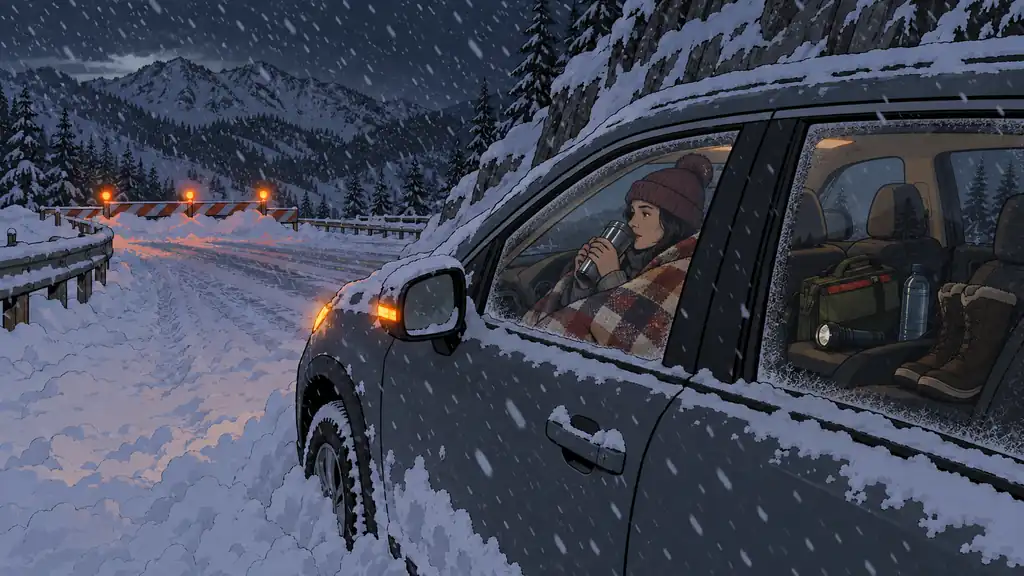
Most people treat a stranding as bad luck you wait out. That’s a fine way to think about a ten-minute delay and a terrible way to think about a cold night. When you’re actually stuck — road closed, car dead, no signal — you get exactly what you brought with you and nothing that’s sitting at home. That’s the whole thing to understand. Being stranded isn’t a supply problem; it’s a self-rescue problem. Help might be an hour away or it might be the next morning, and in between, the only resources in play are the ones inside your vehicle.
If you already keep a bug-out bag and think about the house, good — but that’s the stationary version of you. The gap for most preppers is the version that’s forty minutes from home when the interstate shuts. That version needs its own plan.
What actually strands people
The word covers three very different situations, and the difference matters because it sets what you’re preparing for:
- Weather — a storm closes a pass, flooding cuts a road, a whiteout drops you to zero visibility. This is the category that kills, because it pins you in place and piles cold on top.
- Traffic — a crash or a chemical spill shuts the highway for hours. You’re not in danger, but you’re not moving, and you didn’t pack for hours.
- Logistical — a missed connection, a canceled flight, an unfamiliar city overnight with no plan.
Note: Car breakdowns or crashes also can leave you stranded and are covered by a separate threat category: Vehicle Accident or Breakdown.
Notice the pattern. The situation itself rarely kills anyone. What kills is the second thing that lands on top of it: cold, distance, or a medical need you can’t meet from where you’re stuck. Your kit isn’t aimed at “getting unstuck.” It’s aimed at those three.
The mistake that turns a delay into a body count
The clearest case is the 2006 death of James Kim. His family missed a turn in Oregon and got stranded on a remote road that’s normally gated in winter. They ran the car for heat until the fuel ran out. After several days, he set out on foot believing help was about 4 miles away — it was closer to 15. He died of hypothermia roughly a mile from the car. His wife and two young children, who stayed with the vehicle, were found alive.
Read that for the lessons, not the horror. People underestimate winter. They over-trust their phone’s coverage. And they treat the car as a way to travel instead of what it actually is once you stop: a shelter. The ones who come through easily had layers, water, and a full tank, and they told someone their route. That’s not luck; that’s preparedness.
The thermal clock, and the fuel that runs it
Here’s the number that decides a winter stranding. Turn the engine off and the cabin doesn’t hold heat — it slides toward the outside temperature over tens of minutes to a couple of hours, depending on sun, wind, and how well the car’s sealed. After that, the inside of your car is the same temperature as the ditch you’re in.
And hypothermia doesn’t need arctic cold. A wet, breezy 40°F night is enough if you’re underdressed and sitting still.
So the engine looks like the answer — run it for heat. It is, until it isn’t, for two reasons:
- Heat costs fuel, and fuel is finite. Every hour of idling draws the tank down. The tank you started with sets the ceiling on how long you stay warm. Start a cold trip below a quarter and you’ve capped your heat at a couple of hours. Start it full and intermittent idling — a few minutes an hour, not continuous — can carry you most of the night, with phone-charging and light on top.
- A running engine in the snow can kill you a different way. If snow packs around the tailpipe, carbon monoxide backs up into the cabin. That’s why the discipline is: clear the tailpipe, crack a downwind window, and run the engine in short bursts, not steadily.
The clean fix that removes the whole bind is to not depend on the engine at all. A real sleeping bag or a couple of wool blankets, rated below the coldest night your route could throw at you, means the car staying dead is a comfort problem, not a survival one. Idling becomes a nice-to-have.
What it costs you, honestly
Most of the time, a stranding costs you a few hours — you wait, you get a tow, you’re late for dinner. A small kit absorbs that completely. The seriousness lives in the tail:
- Cold. The main way a stranding turns fatal, and the whole reason warmth is the center of a winter kit.
- A medical need on a clock. Stranded with a condition that needs medication — diabetes, heart trouble, anything time-sensitive — and a delay becomes an emergency you didn’t schedule.
- Dependents. Stuck with kids, elderly passengers, or pets multiplies every need and shortens every timeline. Everyone in the car needs water, warmth, and calm, and the little ones or elderly need it first.
Impact is duration times exposure. Your kit works on both ends: it stretches how long you can wait, and it blunts the danger that’s otherwise climbing the whole time.
Building the kit — three jobs
Think in three jobs: stay warm and fed, get found, get unstuck. Build once, leave it in the car, forget about it until you need it.
Stay warm and fed — the box in the trunk.
- Water — a few liters per person, rotated so it’s fresh. An overnight isn’t a hydration crisis, but thirst shouldn’t be part of your night.
- Food — calorie-dense, no-prep, and freeze-tolerant. Bars, nuts, jerky. Not chocolate that turns to a brick and cans that split when they freeze.
- Warmth — the heart of the whole kit in winter: a real blanket or sleeping bag per person, spare hat, gloves, and socks, and layers beyond what the drive seems to need. Hand warmers are a dollar of cheap insurance.
- Light — a headlamp with spare batteries. Keep the phone for the phone’s job.
- Power — a charged power bank that’ll hold a phone for a day or more, plus the right cable.
- Meds and first aid — a basic kit, plus a few days of any essential prescription living in the car or your bag.
- Cash — a small reserve. A tow truck, a tank of gas, or a motel room shouldn’t depend on a card reader and a signal both working.
Get found — the check-in. A kit keeps you alive; a check-in ends the situation.
- Tell one person your route and your arrival time before you leave. A missed check-in is what starts a search, and it works even if you’re unconscious. This is the single cheapest, highest-value thing on the list.
- Nurse the phone battery the moment you’re stuck: brightness down, low-power mode, a text instead of scrolling.
- In a true dead zone, know that a text will often send where a call won’t, and that walking to higher ground can catch a bar.
Get unstuck — cut the odds and the wait.
- Keep the tank above half. Make it a standing rule, not a decision. Fuel is heat, light, and a charged phone while you wait. Running low is the most avoidable way to make a bad night worse.
- Know one alternate route before you need it, and don’t take an unfamiliar “shortcut” in bad conditions — that’s a classic way people get truly stuck.
- A little recovery gear if you drive rural or in winter: a small shovel, some traction (sand, kitty litter, or mats), a jump pack, a tow strap. Any one of them can turn a stranding into a five-minute fix.
The extreme
It’s not likely, but I do need to mention the extreme version of this threat - EMP. While it’s likely that all vehicles won’t be irreparably damaged in such an event, the possibility does exist. As a result, if you’re preparing for an EMP, you need to consider this potential side-effect of it. Specifically, what would you do if your vehicle is disabled and help isn’t coming?
Bottom Line
- Stranded is a self-rescue problem — you get what you brought, and the well-stocked pantry at home counts for nothing on the shoulder of a highway.
- The situation rarely kills; the second thing does — cold, distance, or a medical need landing on top of an ordinary delay.
- Warmth is the winter core, and the smart version doesn’t depend on the engine — a bag rated below your route’s coldest night beats a tank of gas you’ll burn through by 2 a.m.
- Keep the tank above half and send one text before you leave — fuel and a check-in are the two cheapest saves on the list.
- Measure it in time, not dollars — could your car keep everyone in it safe until morning? Build the kit until the answer is yes.
Your car is a shelter you already carry everywhere you go. Stock it like one, and a closed road stops being a threat and goes back to being a story.
Sizing water, food, and meds for a vehicle kit is the same math as your home stores — the Food & Water Storage tool works it out.