


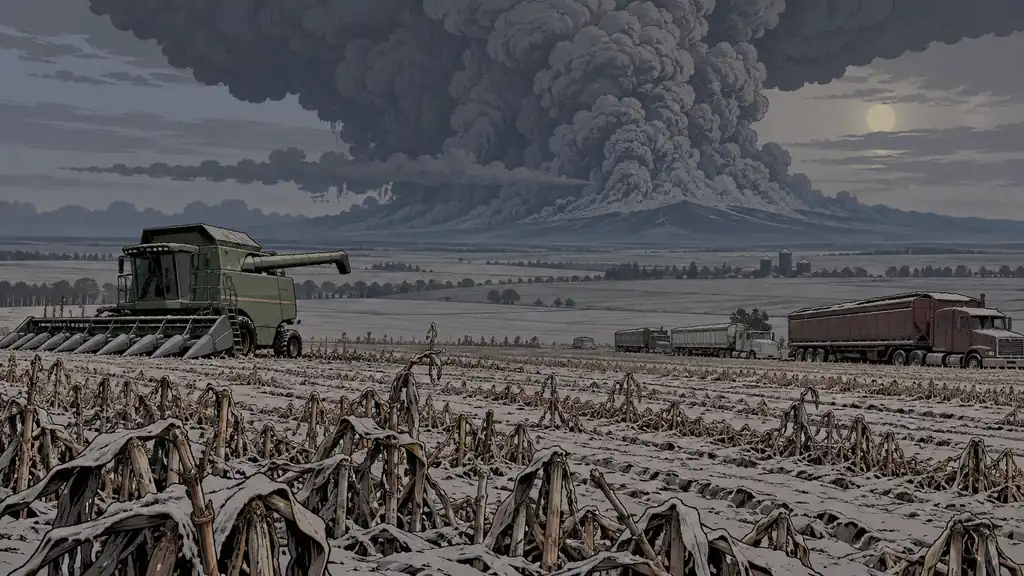
The supervolcano is the clearest example on the whole threat list of a huge impact stapled to almost no chance of happening. It’s worth understanding not because you should prepare for it specifically — you shouldn’t — but because getting it right forces you to hold two facts at once: a super-eruption could disrupt human civilization worldwide, and you will almost certainly never live through one. Most people can’t hold both. They either wave it off or they spiral. The disciplined version is calm: understand the real mechanism, price the odds honestly, and notice that the only reasonable hedge is the same deep, general resilience you’re already building for things far likelier to reach you.
The danger is climate, not lava
Picture a volcano and you picture lava and a burning town. For why a supervolcano threatens the world, that image is almost entirely wrong. The thing that reaches everyone else isn’t the blast — that’s regional. It’s what the eruption throws into the sky.
A super-eruption injects enormous amounts of ash and, more importantly, sulfur dioxide high into the stratosphere. That sulfur forms a haze of fine particles that spreads around the globe and reflects sunlight back into space. Less sunlight reaching the ground means a cooler planet — for years, because up in the stratosphere that haze doesn’t rain out the way weather does down low. That’s the mechanism, and it has a name: volcanic winter.
Note, this is a sister-threat to Nuclear Winter. You can find that threat here.
We’ve watched a small version of it. When Mount Pinatubo erupted in 1991, it put roughly 17 to 20 million tons of sulfur dioxide into the stratosphere and cooled the whole planet’s surface by about 0.5°C for a year or two — from one ordinary-sized eruption. Scale that mechanism up to a super-eruption and the cooling is deeper and lasts longer.
So the thing that would actually threaten people far from the volcano isn’t fire. It’s cooler temperatures, shorter frost-free seasons, and dimmer sunlight knocking down crop yields across major farming regions at the same time. That’s not a volcano problem; that’s a food problem, stretched across years and the entire planet. Get that one reframe and the rest of this makes sense.
The record is in the rocks
Super-eruptions are geology, not history. Scientists say that Yellowstone’s last one — a VEI 8, the largest class on the scale — was about 640,000 years ago. The Toba eruption in Indonesia, the biggest of the last two million years, was roughly 74,000 years ago. Both were long before recorded history.
But we don’t have to guess at the mechanism, because “merely large” eruptions inside recorded history show it plainly. Tambora erupted in 1815 — a VEI 7, a step below a true super-eruption — and cooled the globe by roughly 0.4 to 0.7°C. The next year, 1816, became the “Year Without a Summer”: frosts in the growing season, failed harvests, and famine across the Northern Hemisphere. That’s the whole chain in a single documented case — sulfur up, sunlight down, crops fail.
Two things follow for a prepper:
- The gap between these events is enormous. There has been no super-eruption in all of recorded human history. That tells you directly how rare this is against the length of one life.
- The big ones are watched. Yellowstone and the other known caldera systems are instrumented and studied. A real super-eruption would build up over an extended stretch of detectable unrest — swarms of quakes, ground swelling, gas changes. It wouldn’t drop out of a clear sky overnight. That doesn’t make it easy to survive, but it means it isn’t a random overnight surprise.
The odds — the lowest on the list
State this flat, with no hedging: on any honest scale, a super-eruption is at the very bottom for likelihood. The chance in any given year is tiny, and even stretched across a full lifetime it stays vanishingly small. The gaps between these eruptions run to tens of thousands of years and more.
Being blunt about that is the point of including it. Refusing to hype an extraordinarily rare event isn’t a gap in your preparedness — it’s what accurate threat assessment looks like. The right amount of worry here is zero. The right amount of understanding is enough to keep it in proportion. A prepper who can price a supervolcano correctly has a working yardstick for every other dramatic-but-unlikely thing on the list.
What it would actually do
If it happened, the damage would come in two very different circles:
- Near the volcano: direct devastation — ash burying whole areas, and hazards that would be locally unsurvivable. That’s a limited geography.
- Everywhere else: the volcanic-winter chain, playing out over years — sustained cooling and dimmer sun, growing seasons cut short in major breadbaskets at the same time, food shortages as production drops and stored reserves draw down, and the economic and social strain that always follows severe, prolonged food scarcity. Where the ash travels, air quality suffers too.
The defining feature is how long and how wide it runs. This isn’t a bad week. It’s potentially bad years, everywhere at once. That’s what makes it different in kind from the local disasters most prepping targets — and it’s also the honest reason no household pantry “solves” it. Deep reserves and real skills improve your odds at the margins. They don’t make a multi-year global crop failure comfortable, and anyone who tells you otherwise is selling something.
What preparedness looks like
The correct move is the deepest version of ordinary preparedness.
1. Go deep on the reserves you’d want anyway. Build the deepest practical food and water reserves you reasonably can. Depth is the one lever that’s actually relevant here, because the core problem is a long food-supply disruption. And here’s the worked version of why this isn’t wasted: most households’ food reserve is measured in days to a couple of weeks. A serious prepper’s is measured in months. The gap between those two — a pantry that lasts weeks versus one that lasts months — is exactly the depth that also carries you through job loss, a bad recession, a pandemic, or a long supply-chain snarl. You build it once and it covers the entire long-duration tail. The supervolcano is just the most extreme thing on that list.
2. Keep water and air filtration. Good water filtration and quality respiratory protection — solid dust masks and filters — are cheap, broadly useful, and directly relevant if ash ever fouled the air and water. Dual-use across a dozen scenarios.
3. Build low-tech skills — probably the highest-value thing you can do. This scenario is long and grinds down infrastructure, which means what you can do outlasts what you stored. Growing food, saving seed, preserving a harvest, cooking from raw staples, staying warm on little power, fixing what breaks. Skills don’t expire, and they serve every threat. For a multi-year event, the ability to produce matters more than any stack of buckets — with the honest caveat that a real volcanic winter would degrade the very growing conditions those skills lean on, which is exactly why no prep fully closes this gap.
4. Keep it in proportion. Do not spend money or worry on this scenario beyond what broad preparedness already gives you. There’s no cost-effective supervolcano purchase to make. Prepare broadly, cap the attention this gets to match its near-zero odds, and put your real effort into likelier threats. That’s the whole lesson: a giant impact number doesn’t justify big spending when the probability is on the floor.
Bottom Line
- Top of the impact scale, bottom of the odds scale — a civilization-level event you’ll almost certainly never see.
- The mechanism is volcanic winter, not lava — years of global cooling and failed growing seasons, worldwide at once.
- There’s no special kit — the deepest general reserves, some filtration, and real low-tech skills are the only sane hedge, and every bit of it is dual-use.
- Skills outlast supplies — for a years-long event, being able to grow and preserve food beats any stockpile.
- Proportion is the whole point — a huge impact number doesn’t earn a dollar of spending or a minute of worry against near-zero odds.
A supervolcano is the ultimate test of proportion: catastrophic if it ever came, and almost certain never to. Build the deepest broad resilience you can for the threats that are actually likely, and this one’s already covered — no fear required.
Build the deepest practical reserve — the only real hedge for this and most long-duration disruptions — with Food & Water Storage.