


Ask anyone who studies great-power conflict where a war between the United States and China is most likely to ignite, and you’ll get the same one-word answer: Taiwan. It’s the consensus flashpoint, and for once the consensus is right. But most of the coverage misses why, and the real reason changes how you should think about the risk — because the fight isn’t really about an island. It’s about a single company on that island, and about a technology so fragile that winning the war could destroy the very thing the war is being fought over.
For Beijing, this isn’t negotiable — and they keep saying so
Start with the thing Western analysts chronically underweight: to the Chinese Communist Party, “reunification” with Taiwan is not a foreign-policy preference. It is framed as a regime-defining mission, a matter of national identity and Party legitimacy, and the language leaves no daylight.
“Resolving the Taiwan question and realizing China’s complete reunification is a historic mission and an unshakable commitment of the Communist Party of China,” Xi Jinping said in 2021. By his 2023 year-end address it had hardened into prophecy: “The reunification of the motherland is a historical inevitability. China will surely be reunified.” By September 2024: “It is an irreversible trend… No one can stop the march of history.” And the military half of the message has been just as explicit — then-Defense Minister Wei Fenghe, face to face with the US Secretary of Defense in 2022, promised China would “not hesitate to fight… and crush any ‘Taiwan independence’ plot at all costs.”
When a government says the same thing, at the highest level, for years running, the mistake is to treat it as bluster. It’s stated policy. The only open questions are timing and cost.
The US side: the “2027 window” — and what it does and doesn’t mean
On the American side, the number you’ll hear is 2027. In congressional testimony, successive heads of US Indo-Pacific Command have warned that China is working to field the military capability to take Taiwan by then — Admiral John Aquilino told the House Armed Services Committee in March 2024 that the PLA is on track to be ready by 2027.
Read that carefully, because it gets mangled constantly. 2027 is an estimate of when China could be capable, reportedly the year Xi has directed his military to be ready. It is not a prediction that an invasion will happen in 2027. Capability is not intent, and intent is not a date on a calendar. But a rival building a specific capability against a specific deadline is telling you how seriously to take the threat — and 2027 is close enough that the usual “someday, maybe” shrug no longer fits.
I will say that on the flip side, 2027 has been set within the U.S. military as a timeline for them to be ready for a conflict with China. Back in 2021 I was told by an officer about a briefing they had just received setting this same timeline for readiness. Again
Why Taiwan, and not somewhere else: the silicon
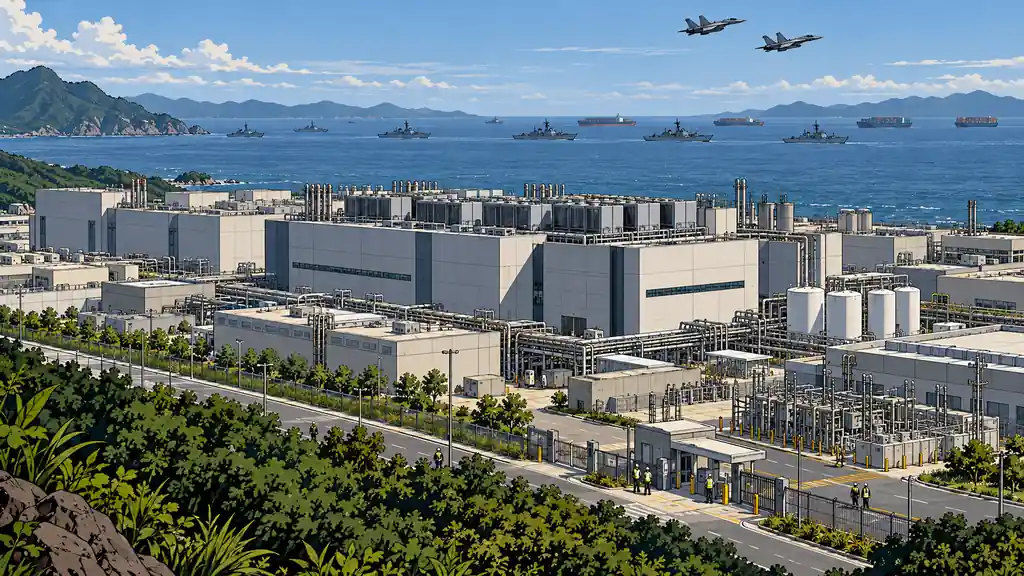
Here’s the part the geopolitics coverage skips, and it’s the whole story. Taiwan produces the overwhelming majority — on the order of 90% — of the world’s most advanced computer chips, almost all of it from one firm, TSMC. Not the chips in general; the leading-edge ones, the few-nanometer processors that run phones, data centers, cars, guided weapons, and every bit of the AI boom. Modern civilization, military and civilian alike, is built on a supply that comes almost entirely from a handful of buildings inside the first-strike range of the PLA.
That concentration is why Taiwan is sometimes called the “silicon shield” — the theory being that the island is too economically indispensable to invade and too indispensable for the US to abandon. The shield is real. But a shield this valuable is also a bullseye, and the comfort people take from it rests on a misunderstanding of how these chips actually get made.
Because you cannot simply seize this capability. Anyone who has spent time close to how advanced semiconductors are manufactured knows that a fab is not a factory you can capture and switch back on. A single leading-edge fab costs tens of billions of dollars and years to build. The most critical tool inside it — the extreme-ultraviolet lithography machine that prints the finest features — is made by exactly one company on Earth (ASML, in the Netherlands), costs hundreds of millions of dollars, and does not run without continuous support, spare parts, and software from its maker. And none of that is even the hard part.
The hard part isn’t the building or the machines. It’s the thousands of tuned process steps and the yield knowledge that only exists in the heads of the people who run the line — and in contamination control so extreme that a stray particle, a vibration, or a power blip ruins the wafers mid-process.
A fab is one of the most delicately balanced industrial systems humans have ever built. Tear it out of its ecosystem — the materials supply, the service engineers, the trained workforce, the software that can be remotely cut off — and even an intact building is close to worthless. A new fab somewhere else takes years to ramp to the yields of a mature one, and that’s with full cooperation from everyone involved. In a war, you get the opposite of cooperation.
Which leads to the paradox at the heart of this flashpoint: the thing that makes Taiwan worth fighting over is the thing a fight would almost certainly destroy. Analysts have openly discussed a “broken nest” logic — that Taiwan and the US could render the fabs inoperable rather than let them fall intact into Beijing’s hands. Whether or not anyone ever executes that, the physics alone guarantees it: shells, sabotage, a cut power grid, or just the flight of the irreplaceable engineers would leave a conqueror holding rubble, not a chip supply. Nobody “wins” TSMC in a hot war. They only lose it more or less slowly.
Why that makes it more dangerous, not less
You’d think the broken-nest paradox would be stabilizing — if everyone loses, nobody starts. Sometimes. But it also makes the situation more combustible in two ways.
First, the asymmetry of stakes. For Beijing, Taiwan is existential to the regime’s self-image; for Washington, it’s strategic and economic. When one side treats something as a matter of survival and the other as a matter of interest, deterrence gets wobbly, because the two sides are not even playing for the same pot.
Second, it doesn’t take an invasion. A blockade, a “quarantine,” a mining of the strait, or a coercion campaign well short of a D-Day landing could choke the chip supply and drag in the US Navy without a single beach being stormed — and each of those is far easier to start, and far harder to cleanly end, than a full invasion. The most likely spark isn’t a sudden amphibious assault. It’s a squeeze that someone misjudges.
What it means if you’re preparing
Of every scenario on the war-with-China shelf, a Taiwan crisis is the one most likely to move from “geopolitics” to “your life” fast — because it hits the global economy at its single most concentrated chokepoint. You don’t need an invasion for the effects to reach your household; even a blockade or a damaged TSMC would mean a worldwide shortage of the chips inside nearly everything you buy, a supply-chain shock, and a sharp risk of US–China escalation on top of it.
So rate it accordingly. This is the highest-consequence trigger in the entire war-with-China threat, and the 2027 capability window means it isn’t comfortably far off. The preparations are the ones you already know — a resilient supply buffer, financial cushion, and a plan for a stretched grid and economy — but this is the scenario that most justifies having them in place before the headlines, because a chip shock arrives at the speed of a shipping manifest, not a mobilization.
Bottom Line
- Taiwan is the consensus flashpoint for a reason — and it’s the chips. The island produces ~90% of the world’s most advanced semiconductors from essentially one company, making it the most concentrated chokepoint in the modern economy.
- For Beijing it’s non-negotiable, and stated openly. Years of top-level “historical inevitability” language, plus a 2027 capability window, mean this is policy, not posturing — though capability is not the same as a date-certain invasion.
- You can’t capture a fab. Advanced chipmaking is too fragile and too dependent on an outside ecosystem to seize intact — so a war over Taiwan likely destroys the prize, which both deters a move and raises the danger of a miscalculated squeeze short of invasion.
- It’s the fastest path from headline to household. A blockade or a broken TSMC means a global chip shock and a US–China escalation at once. Treat it as the highest-consequence war-with-China trigger and have your supply, financial, and grid preparations in place ahead of it.
Weigh it for yourself on the war with China threat page.