


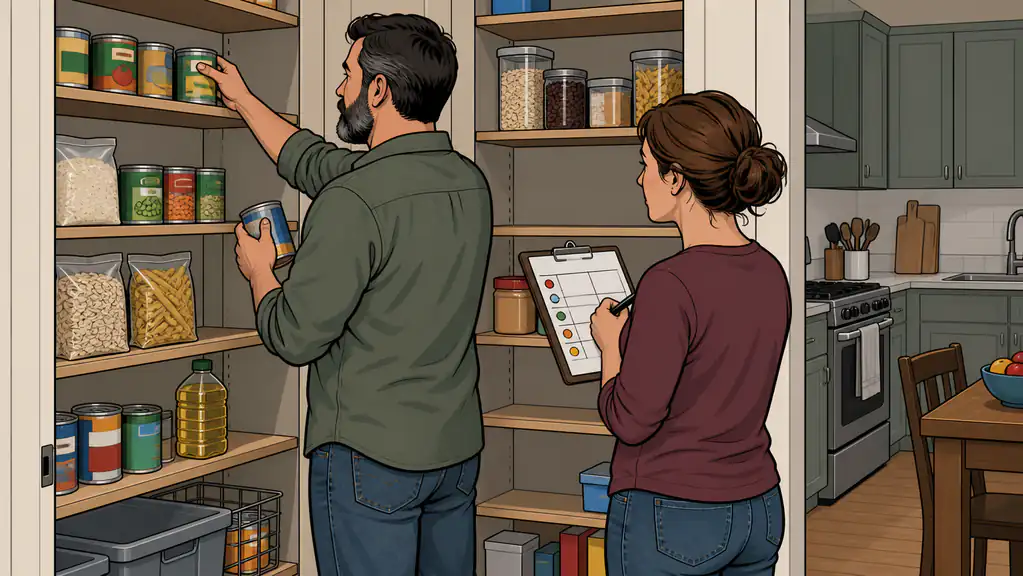
The modern food supply is efficient and fragile, and those are the same fact. Food moves nonstop from farm to warehouse to store to your kitchen, with almost nothing sitting still along the way. That keeps it cheap and fresh. It also means the buffer between a disruption and empty shelves is measured in days, not weeks. A national food shortage or famine rates 3 of 9 for likelihood — rare in a developed country — and 8 of 9 for impact, because sustained hunger is life-threatening at scale. The right response isn’t panic and it isn’t a shrug. It’s depth in your own kitchen, so a disruption anywhere upstream doesn’t reach your table.
Why “the shelves are full” fools people
A full grocery store looks like abundance. It isn’t. It’s a river, not a reservoir. The store carries only a few days of stock and refills constantly, and that refill leans on fuel, trucks, drivers, working card readers, and the farms and plants upstream. Any one of those can hiccup. When the resupply stops, the food on the shelf is all there is — and it goes in the time it takes for people to notice.
That’s why the same pantry covers so many different causes. Your larder doesn’t care why the trucks stopped. A hurricane, a fuel crisis, a strike, a pandemic, a war that chokes imports, a genuine bad harvest — from your kitchen they all look identical. The store can’t restock, and you eat what you have.
Two kinds of shortage, and only one is rare
Keep these separate, because people argue past each other by mixing them up.
Temporary, local shortages are common. Shelves stripped before a storm. The 2020–2021 disruptions — empty toilet-paper and cleaning aisles, no flour or yeast, thin meat cases after COVID outbreaks idled packing plants. None of that was true scarcity. It was a chain that couldn’t flex. These are the disruptions you will actually meet, more than once in your life.
True national famine is rare in a modern developed country, and it almost never comes from one bad harvest. It comes from several things failing together — conflict, bad policy, economic collapse, and crop loss stacked on top of each other. The economist Amartya Sen, studying modern famines, argued they’re usually a failure of access as much as production — people losing the means to buy food that still exists (“Poverty and Famines”—1981).
The lesson from both: a big harvest doesn’t guarantee food reaches you. Getting it to you is the weak link. Depth at home is your hedge against that link breaking.
The odds, honestly
The 3 is for a sustained, national shortage. That’s genuinely uncommon, and I won’t pretend otherwise. But don’t treat this as one event — treat it as a range. At the severe end, national famine, it’s rare. At the mild end, a two-week gap in certain goods after a regional disaster, most households will hit it more than once. Build for the middle of that range — a few weeks to a couple of months of eating from your own shelves — and you cover the common cases easily while buying real margin against the rare one. You’re not betting on famine. You’re buying your way out of the scramble that comes with any disruption.
What a shortage actually does
Impact rates 8 because sustained scarcity is both deadly and corrosive, and it arrives in order:
- Hunger, then worse. A prolonged shortage means going without, and at the extreme, starvation — with kids, the elderly, and the sick hit first and hardest.
- Prices jump. Scarcity drives prices up, which turns a supply problem into a money problem. Families on tight budgets get priced out before the shelves are literally bare.
- The scramble. Panic buying and hoarding. The rush itself empties shelves faster than the underlying problem would — a wound the crowd inflicts on itself.
- Everything downstream. Long scarcity strains health, tempers, and households. Not knowing where the next meal comes from is one of the hardest things a family can carry.
The through-line: depth at home turns a crisis into a non-event for your household, and it means you’re not one more person clearing the shelf.
A worked example — count it in days, not dollars
Here’s the only question that matters: how many days can we eat with the store closed? Answer it in real food for your real household, not in dollars spent or buckets owned.
Say four people, and figure roughly 2,000 calories each a day as a starting point. That’s 8,000 calories a day for the household, about 56,000 a week. A two-week target is 112,000 calories you need sitting on your shelves. Now translate that into groceries you actually buy: a pound of dry rice or beans is roughly 1,500–1,600 calories, so the staple base of two weeks is on the order of 70 pounds of rice and beans, plus the canned goods, oil, and pantry items that turn it into meals people will eat.
Do that math once and two things happen. The target stops being a vibe and becomes a number, and you find out fast whether your “well-stocked” pantry is two weeks deep or two days.
What preparedness looks like
Build depth, build the ability to use it, then build a little ability to grow it — in that order.
1. The deep larder, built from what you eat
This is the move that separates real prepping from wasted money.
- Store what you already eat. Shelf-stable staples your household actually goes through — rice, dried beans and lentils, pasta, oats, canned vegetables, fruit, and meat, cooking oil, peanut butter, shelf-stable milk, coffee, salt, sugar. That’s the difference between a larder and a graveyard of survival buckets nobody opens.
- Rotate: oldest first. Eat the oldest, replace it on your normal shopping trips. The larder becomes a working part of the kitchen, not a museum. Nothing expires unused.
- Measure in time. Start at two weeks, then one month, then push toward three months as space and budget allow — always in days of full eating for the household you actually have.
- Don’t skip the multipliers. Calorie density (fats and grains carry the weight), variety (for morale and nutrition), and the small stuff that makes plain food edible — salt, spices, oil.
2. A way to cook without power
Stored food you can’t cook is half a plan. Shortages love to show up alongside a power or gas outage, so keep a grid-independent way to cook — a propane or butane burner, a camp stove, a grill, a rocket stove — with fuel to match the days you’re planning for. Combustion goes outdoors or with real ventilation, never in a closed room. And keep a manual can opener. More improvised plans have died on that one missing tool than on anything else.
3. Skills: cook, preserve, stretch
A larder plus skill goes far further than a larder alone.
- Cook from basics. Turning flour, beans, rice, and cans into real meals is the floor.
- Preserve. Canning, drying, or freezing so a garden surplus or a bulk buy extends your reserve instead of rotting.
- Stretch. Soups, stews, one-pot meals — they turn a little protein into a full meal, and learning to cook lean multiplies your days.
4. A little production: seeds and a garden habit
This is the long game — the piece that matters if a disruption outlasts your shelves.
- Keep viable seed — open-pollinated or heirloom, so you can save seed from your own harvest — for vegetables your climate supports.
- Start the garden now, at whatever scale you can. Growing food has a long learning curve and a slow clock: one season is one lesson. That’s exactly why you can’t wait until you need it. A garden won’t feed you overnight, but the knowledge and the beds are only there if you started early.
Bottom Line
- The food system is thin on purpose — national famine is rare (3/9), but the just-in-time chain empties shelves fast in any disruption.
- Build a deep larder from food you already eat, rotated oldest-first so nothing is wasted.
- Count it in days — target two weeks, then a month, then three-plus — in days of real eating for your household.
- Store a way to cook and the fuel to match — stored food you can’t cook is half a plan.
- Add skills and a little growing — cook, preserve, stretch, and keep seeds and a garden habit for anything that outlasts storage.
You don’t build a larder because you expect famine. You build it because a few weeks of food you already eat turns every disruption — storm, layoff, shortage, illness — into a non-event, and takes your family out of the scramble.
Size your larder in real days for your household — and generate the shopping list — with the Food & Water Storage tool; plan a garden with the Garden Planner.