


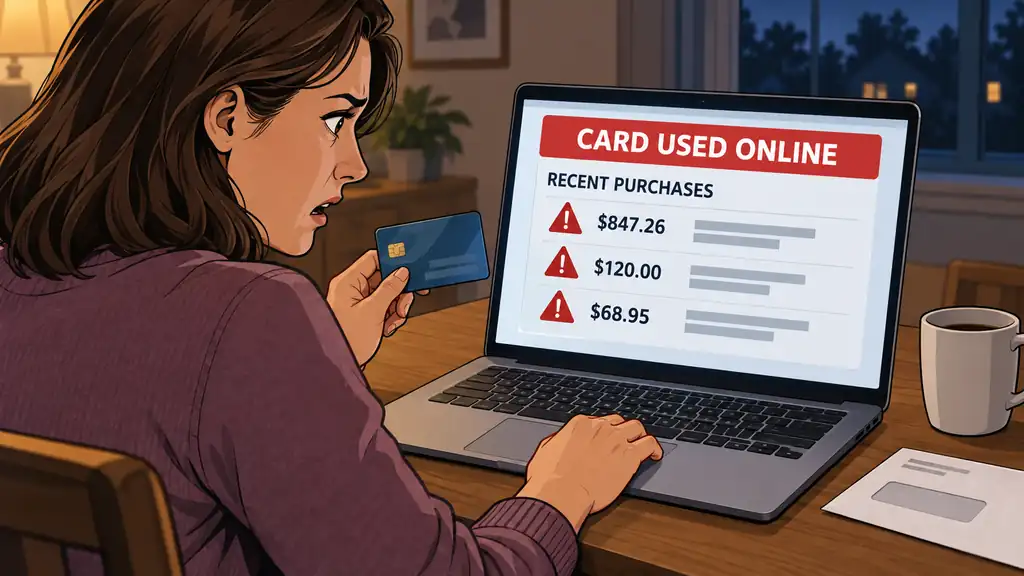
Most advice about card fraud is built on a false hope: keep your number secret and you’ll be fine. But you can’t keep it secret. You hand those 16 digits to every gas pump, restaurant, and online checkout you use. Any one of them can leak it, and you’ll never know which one did. So the whole strategy has to flip. Stop trying to keep the number private, and make a leaked number worthless instead. That’s the reframe the rest of this rests on.
The good news is that this threat rates a likelihood of 7 out of 9 but an impact of just 2 out of 9 — very common, rarely serious. The system is designed to eat the loss for you. Your job isn’t to survive a financial hit; it’s to catch fraud fast and shrink the fallout when a number inevitably escapes.
How the number actually leaks
A card number gets stolen in a handful of well-worn ways, and knowing them tells you where to spend your effort:
- Skimmers. A thief attaches a reader over a real card slot — gas pumps and standalone ATMs are the classic spots — or a tiny overlay on the keypad. Swipe your card and the skimmer copies the magnetic stripe, which contains everything needed to clone it. This is why the swipe is the weak point: the stripe hands over a full, reusable copy of the card.
- Data breaches. A store, hotel chain, or online service gets hacked and their customer database — including saved card numbers — gets dumped and sold. You did nothing wrong; a company you trusted just lost your data along with a million other people’s. This is the big one, because it leaks numbers in bulk.
- Sketchy or spoofed checkouts. A fake storefront, a compromised payment form, or a phishing page harvests the number as you type it. The site looks normal; the form quietly ships your details to a thief.
- Card-not-present testing. Once a number is on the market, criminals run automated “card testing” — tiny charges to see which stolen numbers are still live before selling or using the good ones. That small mystery charge is often the tell.
Notice what all four have in common: the leak happens somewhere you don’t control, long after the card left your hand. That’s why “be careful with your card” isn’t a real defense. The defense has to assume the number is already out.
A worked example: how a leak becomes charges
Walk through a normal case so the timeline is concrete.
You buy gas on a Tuesday at a pump with a skimmer you couldn’t see. The skimmer copies your stripe. Over the next week your number gets bundled with a few thousand others and sold. A buyer runs a $1.20 card-test charge at some random online merchant — it clears, so your number is confirmed live. Two days later they run a $740 electronics order shipping to a reshipping address.
If you have transaction alerts on, here’s how it goes: your phone buzzes on the $1.20 charge you don’t recognize. You call the bank, they freeze the card, the $740 charge never even clears. Total cost to you: a five-minute phone call and four days waiting on a new card.
If you don’t have alerts on, you find both charges three weeks later on your statement. You still get the money back — that’s the zero-liability policy at work — but now you’re disputing two charges, proving you didn’t make them, and untangling anything that auto-paid against the card in the meantime. Same protection, ten times the hassle. The difference between a non-event and a bad afternoon is entirely in how fast you catch it.
The strongest fix for online purchases: virtual card numbers
Here’s the move that actually breaks the whole cycle, and it’s the one I switched to after getting hit more than once. A virtual card service issues a separate card number for each merchant, locked to that merchant and often capped at a spending limit you set. It bills back to your real card or bank behind the scenes, but the store never sees your real number.
Now play the breach forward. The online store you shop at gets hacked and their card database leaks — the single most common way numbers escape in bulk. Your number is in that dump. But it’s a merchant-locked virtual number that only works at that one store. A thief who tries it anywhere else gets declined instantly. And you kill just that one card in the app without reissuing your real card or touching any of your other merchants. The leak is real; the damage is zero.
I have used Privacy.com for this for several years. You can spin up a card locked to one store, set a per-month cap, and pause or close it in a tap. It turns “my number leaked” from a fire drill into a shrug — the leaked number simply doesn’t work anywhere it wasn’t meant to. This is the closest thing to a permanent fix in the whole category, and it’s free for personal use.
This also works great for “trial” services. There is no risk in trying to get them to cancel the trial - just turn off the card… Or you can set a spending limit so that there’s no way they can increase charges without you realizing it.
Common mistakes people make
- Waiting for the statement. Monthly statement review is how people used to catch fraud, and it’s why it used to take weeks. Alerts on every transaction are the modern version. Turn them on for every card.
- Treating debit like credit. With a credit card, fraud spends the bank’s money until it’s reversed. With a debit card, fraud drains your checking account until the reversal clears — which can bounce your real bills in the meantime. For online and everyday spending, a credit card (or a virtual card) keeps the fight off your actual cash.
- Reusing the real number everywhere. Every place you save your real card is another database that can leak it. Virtual numbers or your phone’s tap-to-pay wallet break that — the merchant stores a token, not your real digits.
- Still swiping. The magnetic stripe is the one part of your card that hands over a full, cloneable copy. Chip and tap don’t. If a terminal lets you insert or tap, never swipe.
- Panicking. The first fraud charge feels like a break-in. It isn’t. The money is protected. Freeze the card, dispute the charge, move on. Save your worry budget for the rarer, uglier threat — full identity theft — not this.
What preparedness looks like
1. Alerts on every card, right now. Push or text on every transaction. This is the highest-value five minutes you’ll spend.
2. Virtual card numbers for online spending. Merchant-locked numbers so a breach leaks a dead card, not your real one.
3. Credit over debit for exposed spending. Keep fraud fighting the bank’s balance, not your checking account.
4. Chip or tap, never swipe. Starve the skimmers of the reusable stripe data.
5. A record of what’s on auto-pay. When a card does get reissued, you’ll need to update every recurring charge tied to it. Knowing that list ahead of time turns a reissue from a scavenger hunt into a checklist.
Bottom Line
- You can’t keep the number secret — so make a leaked one useless instead of trying to guard it.
- Leaks happen where you don’t control them — breaches, skimmers, and spoofed checkouts, not carelessness on your end.
- Speed is everything — alerts turn fraud from a weeks-late statement surprise into a five-minute phone call.
- Virtual card numbers are the strongest fix — a merchant-locked number can’t be reused when it leaks.
- It’s common but minor — very likely to happen, rarely a real loss; keep it in proportion to its 2-out-of-9 impact.
You will not win the game of keeping a number you share with a hundred businesses secret. You win by making the leak pointless — merchant-locked numbers, instant alerts, and the chip instead of the stripe.
When a card gets reissued you’ll be updating every auto-pay tied to it — keep that list in the encrypted Digital Binder so a reissue is a checklist, not a scramble.