


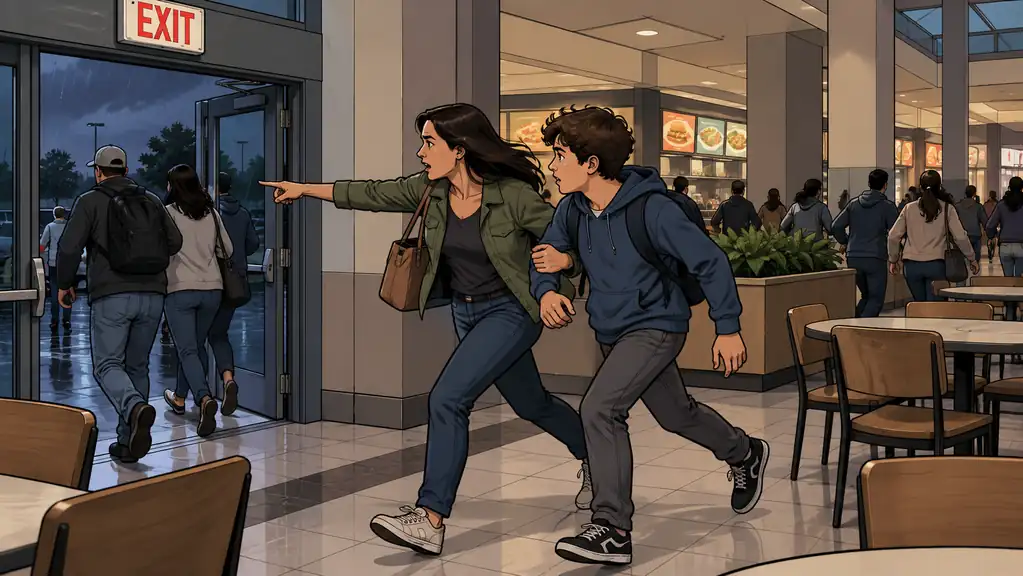
An active shooter is one of the rarest things on any prepper’s list and one of the hardest to think about calmly. For any single person, the odds of ever being in one are very low. But when it happens, it happens fast and it’s deadly, and there’s no time to figure out a plan from scratch. That’s the whole reason it’s worth a few minutes now: not to make you afraid of every crowd, but to load a simple plan into your head so that if the worst ever unfolds, you move instead of freeze. Preparation here isn’t gear. It’s a decision made in advance.
What we’re really talking about
An active shooter is someone attacking people in a public place — a store, a school, a venue, a workplace. The defining features are speed and surprise: the FBI has found that most of these events are over in five minutes or less, often before police can arrive. That’s a hard fact, and it’s exactly why your own first actions matter so much. In those first moments, the person most able to help you is you.
Why it’s on the list despite being rare
Honestly, the odds for any one person are near the bottom of the scale. You are far more likely to face a car accident, a house fire, or a bad storm. So why cover it at all? Because the consequences are so severe for the people who are there, and because the right response is so simple to learn and so useless to learn in the moment. This is a case where a tiny investment now buys a lot of protection against a small-but-terrible possibility. That’s a good trade.
The plan that fits in your head: Run, Hide, Fight
Emergency experts boil the response down to three words, in order of preference. Learn them and you’ve done most of the work.
Run. If there’s a safe way out, take it — immediately, and leave your things. Getting away from the danger is always the best option. Don’t wait to see what’s happening or to gather your stuff. Just go, and help others go if you can, but don’t let anyone slow your decision to leave.
Hide. If you can’t get out, get out of sight. Find a room, lock or barricade the door, turn off the lights, silence your phone, and stay quiet. Put solid walls and locked doors between you and the threat. Most attackers move on from a door they can’t open.
Fight. Only as a last resort, only if your life is in immediate danger and there’s no other option — commit fully. This is for the moment there’s nothing left to try. It’s the last item on the list for a reason, but knowing it’s on the list matters.
The order is the point: Run if you can, Hide if you can’t, Fight only if you must.
What preparedness looks like here
You can’t stockpile your way out of this one. Readiness is mental, and it’s mostly two habits.
Know your exits. When you walk into a public space — a restaurant, a theater, a store — take one second to notice where the doors are. Not just the one you came in. This tiny habit means that if you ever need an exit fast, you already know where it is instead of running toward the crowd.
Have the plan pre-loaded. Run through Run-Hide-Fight in your mind once in a while. Picture it in the places your family goes. That mental rehearsal is what lets you act in the first seconds instead of standing still, which is what most untrained people do under sudden shock.
And for families: teach kids age-appropriate plans. Schools drill this now; reinforce it simply at home — where to go, to listen to adults, to be quiet, to move to an exit. Keep it calm, not scary. The goal is a child who knows what to do, not a child who’s afraid to leave the house.
Bottom Line
- Active shooter events are rare for any one person but fast and deadly where they occur — your first actions matter most.
- Learn Run-Hide-Fight: get out if you can, hide and barricade if you can’t, fight only as a last resort.
- Notice the exits every time you enter a public place — it’s a one-second habit that pays off in a crisis.
- Rehearse the plan in your head so you move instead of freeze.
- Teach children simple, calm plans for school and public places.
You can’t control whether it happens. You can decide, right now, that you’ll move — and know where the door is before you ever need it.