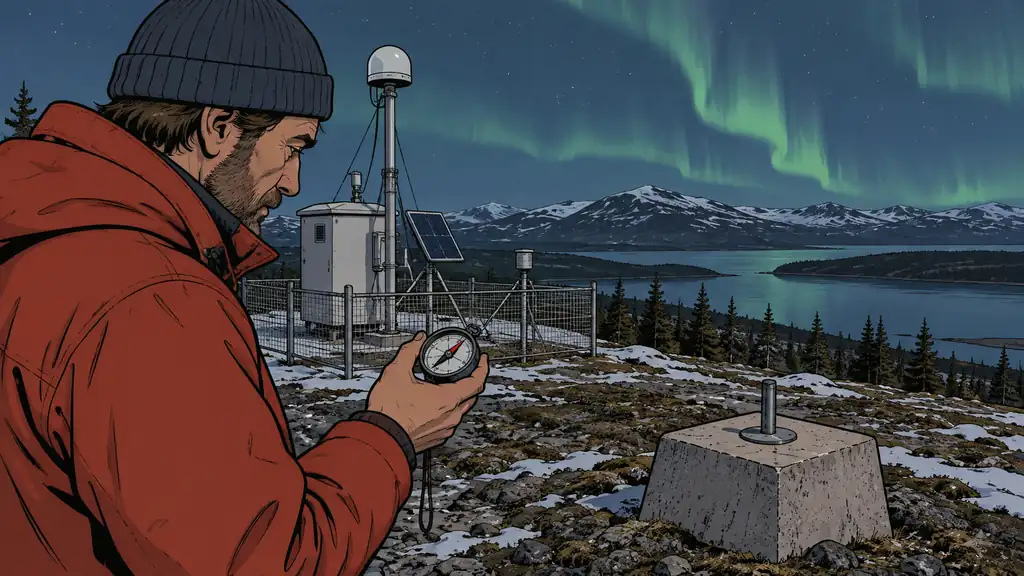
Say “pole shift” and most people picture the Hollywood version: the crust breaks loose, the earth tips over in an afternoon, oceans slosh across continents, and everything that survives starts over from zero. It’s the kind of thing that gets filed under tin foil hat and dismissed on sight. That reaction is understandable — and it throws out something real along with the nonsense.
Here’s the problem: two completely different ideas share that one name. One of them is boring, measured, and published in peer-reviewed journals. The other is a cataclysm story with thin evidence and a lot of confident YouTube narration. If you can’t tell them apart, you’ll either panic over the wrong thing or laugh off the whole subject — and both are mistakes. So let’s sort them.
What’s actually being measured: the poles drift
Start with the part nobody disputes. The earth’s magnetic poles — the dip poles, the spots your compass actually points toward — are not fixed, and they aren’t perfectly opposite each other. The North Magnetic Pole was first pinned down in 1831, and scientists have tracked it ever since. It moves.
For the last century it’s been drifting out of the Canadian Arctic toward Russia. That drift started around 6 miles per year and increased to about 31 miles per year in the early 2000s, where it remains today.
This is real, it’s tracked, and it’s the reason the World Magnetic Model — the thing your phone’s compass and every aviation chart quietly depend on — has to be updated on a schedule. That’s the measured core. Everything else in this subject is built on top of it, and it gets shakier as you climb.
The people who fear an imminent catastrophe point at the acceleration — the jump from 6 to 31 miles a year — as a warning sign. That’s a fair thing to notice. It is not, by itself, evidence that the planet is about to flip. A pole that speeds up and then slows down is doing what a wandering pole does.
Check out the pole movement map yourself here.
Why the field matters at all
The poles are one visible feature of a much bigger thing: the magnetosphere, the magnetic field that wraps the entire planet. Its job is genuinely important. It deflects the solar wind — the constant stream of charged particles the sun throws at us — and shields the surface from the worst of it. Without it, the atmosphere erodes over geologic time and the surface radiation environment gets far harsher.
This is the honest reason the subject deserves a prepper’s attention at all, and it’s the same reason a CME/solar storm belongs on your list. A weaker field is a leakier shield. You don’t need a planet-flipping cataclysm for a degraded magnetosphere to matter — you just need a big solar storm to arrive while the shield is thinner than it used to be. That’s a difference of degree, not a science-fiction plot.
Geomagnetic reversal: the real version
Now the part that surprises people: the magnetic field has flipped before, and it will flip again. North becomes south and south becomes north. This isn’t fringe — it’s written into the rock. As new seafloor cools, it locks in the magnetic orientation of the moment, leaving a striped record of past reversals. NASA’s own material acknowledges it plainly, describing a field in “continual flux” whose poles “completely flip locations” on long timescales. I’ve seen official NASA stats that cite between 300,000 and 780,000 years between events. The last full reversal (Brunhes–Matuyama) was ~780,000 years ago.
Here’s the key point the calm version and the scary version disagree on: how fast, and how dangerous.
The mainstream position is that a reversal is slow — it plays out over thousands of years, not a weekend. The last one is estimated to have taken on the order of 7,000 years, with other reversals running anywhere from 2,000 to 12,000 years. And critically, the mainstream view holds that the earth is never left unprotected during the transition. The field gets messier and weaker and may sprout multiple poles, but it doesn’t switch off. This is NASA’s stated position.
The contested version — and where it goes off the rails
Some researchers argue the transition is much faster and far more dangerous. The claim runs like this: as the poles reverse, field strength drops toward zero, the shield effectively fails, and for some window we’re sitting in what could be considered a planetary-scale microwave oven. The logic offered is that it must be fast, because a multi-thousand-year gap with no shield would sterilize the surface — so anything alive today is proof it happens quickly.
That’s the fork in the road. The reversal itself is settled science. The “sudden, shield-off, mass-casualty” mechanism is not. Treat the first as fact and the second as an open question worth watching — not as a countdown.
Earth Crustal Displacement: the fringe branch
The wildest branch of the family deserves its own label, because it isn’t a magnetic story at all. Earth Crustal Displacement claims the planet’s solid outer crust can slide as a single shell over the interior — that the poles aren’t really moving, we are. The proposed trigger is polar ice building up until its accumulated mass “tips” the whole crust, supposedly by as much as 90 degrees, in under 48 hours. The advertised consequences are total: former equator at the poles and vice versa, oceans sloshing into globe-spanning tsunamis, earthquakes and volcanoes everywhere at once.
I’m laying this out so you recognize it, not so you bank on it. There’s no accepted physical mechanism for a 48-hour crustal flip, and the timing tables that circulate with it — reversals every few thousand years, poles hopping from Sudan to Hudson Bay to Wisconsin — sit far outside what the rock record supports. This is the branch that earns the tin foil hat. File it as a story, watch it if you’re curious, and don’t let it drive a single dollar of your preparations.
The one number that isn’t reassuring
Here’s what keeps this off the “pure nonsense” pile: the field really is weakening, and that part is measurable.
The global-average decline at roughly 10% between 1850 and 2000, and another ~5% from 2000 to 2010 — call it 15% over that span — with the loss concentrated in a region over the South Atlantic and stretching toward South America known as the South Atlantic Anomaly, where field strength runs below 60% of the global average. Satellite operators already treat that zone as a real hazard, powering down sensitive electronics as they pass through it.
Where it moves from data to speculation is the extrapolation. If you plot the few data points we have, it does fit an exponential-decay trendline, and projects the field dropping below 50% around 2030 and toward zero around 2039.
I must note that fitting a few points to sparse data is not a forecast, it’s a guess. And it’s a guess that’s likely wrong.
So hold two things at once. A real, measured, multi-century decline in field strength: yes. A firm date by which it hits zero and the sky falls: no — that’s a line drawn through too few dots.
So what does a prepper actually do with this?
Almost nothing exotic, and that’s the point. You cannot store your way out of a magnetic reversal, and you certainly can’t prep for a 48-hour crustal flip that has no mechanism. What you can do is notice where this subject touches threats that are concrete:
- A weakening field raises your exposure to solar storms. The prep for that is the same grid-down, electronics-hardening, communications-resilience work you’d do anyway. That’s where the effort belongs.
- Watch the indicators, don’t chase the prophecies. Pole-drift rate and field strength are published and trackable. Countdown dates from advocacy channels are not the same thing.
- Keep the categories straight. Reversal — real but slow. Field weakening — real and measured. Sudden crustal cataclysm — speculative. Never let the third borrow credibility from the first two.
The magnetic field flipping is settled science. The field weakening is measured fact. A planet that tips over in two days is a movie. The skill isn’t believing all three or none — it’s telling them apart.
Bottom Line
- “Pole shift” is two stories in one name. Geomagnetic reversal and field weakening are real and documented; sudden Earth Crustal Displacement is fringe with no accepted mechanism. Judge them separately.
- Reversals are real but slow — thousands of years by the mainstream account, with the field weakened but not switched off. The “shield drops to zero and everything cooks” version is a contested minority claim, not established fact.
- The measurable worry is a weakening field, not a flipping planet. A leakier magnetosphere makes a bad solar storm worse — and that’s a threat you can actually prepare for.
- Don’t prep for the cataclysm; prep for the overlap. Grid-down resilience, electronics protection, and communications cover the realistic edge of this threat. Everything past that is watching, not building.
See how this connects to the threat you can actually plan around in the solar-storm simulator, and read the full pole shift brief for where it sits in your threat ratings.