


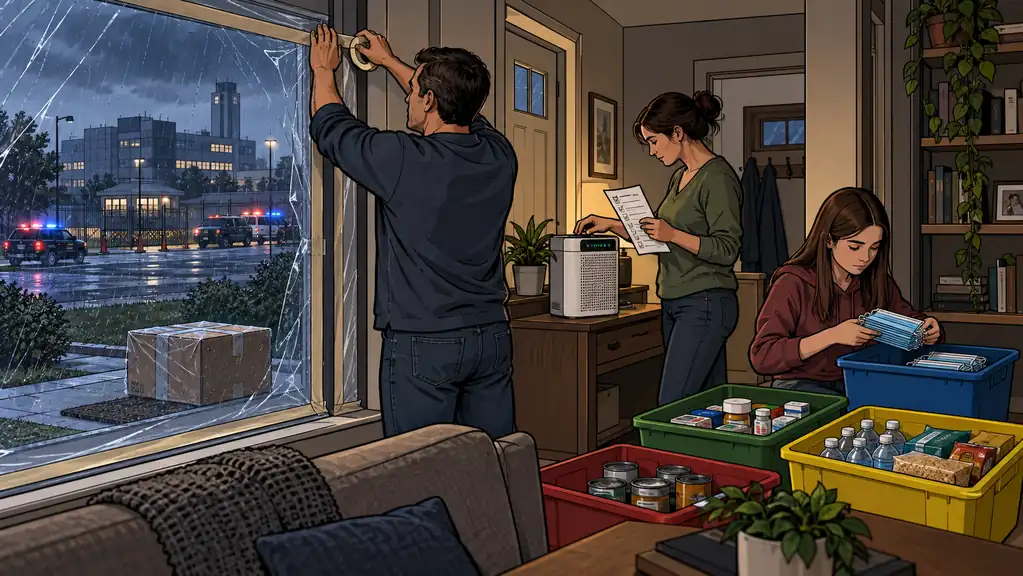
A bioweapon release sounds like a whole category of nightmare unto itself. Here’s the reassuring truth that cuts it down to size: for your household, the plan is the same one you’d make for a bad natural pandemic. The difference is that a deliberately engineered disease is designed to be worse — so you size the same plan for a worse case. You don’t need a new skill set or a new kind of gear. You need a deeper version of preparations you’d already want: the ability to seal yourself off from other people, and to sustain your household while you do.
That’s the whole idea. A bioweapon is the deliberate, worse-case tail of the pandemic threat, and the household defense against any pandemic — natural or engineered — is the same: isolation plus supplies to outlast it.
What history shows
Disease has been weaponized across history — state programs like the Soviet Biopreparat effort, whose accidental anthrax release at Sverdlovsk in 1979 killed dozens. The 2001 anthrax letters mailed after 9/11 infected 22 people and killed 5 (per the FBI).
In recent history, we have the Covid-19 pandemic. While the origins are debated by some, I firmly believe that the Covid-19 pandemic was a release of a contagion from a lab (the Wuhan Institute of Virology to be specific). Whether it was accidental or purposeful is debatable, but regardless I believe the evidence clearly shows that Wuhan was the origin. Diving into why I believe that is outside the scope of this article, but I wanted to mention this so you understand the mindset that I have while writing this article…
What is the opportunity?
To really understand how likely this event could be again, we need to look at what the opportunity is, and to know this we need to know how many labs there are in the world doing this work.
Officially, there are no bioweapon laboratories in the world today. They are strictly banned under the Biological Weapons Convention.
There are labs that do research on dangerous pathogens, commonly using “gain of function” research to make them even more dangerous so that vaccines or treatments could be developed. Currently, there are 69 High-Containment Research Labs (BSL-4) across 27 countries worldwide. 8 of these exist within the United States and one is just over the border into Canada.
How likely is it?
While all these facilities have safety precautions to prevent the escape of one of these pathogens, humans make mistakes. As a result, there’s a possibility that humans could make another mistake and allow one of these pathogens to escape.
Even though it happened 7 years ago, we can’t let recency bias artificially inflate the likelihood. There wasn’t a previous case of a large-scale bioweapons release in all of recorded history prior to this point, so we must temper the likelihood with this fact.
As a result of the combination of these factors, I’ve rated it at a 2 (unlikely).
What it actually does
Like any serious outbreak, a release would spread illness through a population, and the effects cascade beyond the illness itself:
- You have to avoid other people. The core danger is catching it, so the core defense is distance — staying away from crowds and, in a bad case, sealing your household off entirely for a while.
- Normal life shuts down. Stores, services, work, and healthcare get strained or unavailable. Supply chains falter. You may not be able to safely go out for what you need.
- It lasts. Outbreaks aren’t over in a day. The household that can sustain itself for weeks without leaving is the one that rides it out safely.
Because it’s engineered to be severe, the responsible move is to size your plan for a worse case — more time, more supplies, more caution — than you’d assume for an ordinary bug.
What preparedness looks like here
Four moves, all of which double as pandemic prep:
- Keep deep isolation supplies. Weeks of food, water, and essentials, so your household can stay home and not go out during the dangerous stretch. This is the foundation — everything else supports it. Measure it in time: how many weeks could you not leave the house?
- Stock medical, sanitation, and protective gear. Basic protective equipment (masks, gloves), sanitation and cleaning supplies, and a solid first-aid and medication stock. The goal is to reduce your chance of catching or spreading illness, and to handle ordinary health needs when clinics are overwhelmed.
- Have a plan to seal and shelter at home. Know how your household would actually isolate: who’s inside, how you limit contact with the outside, how deliveries or necessary trips are handled safely. A plan made calmly in advance beats improvising in fear.
- Follow credible guidance fast. In an engineered or fast-moving outbreak, acting early matters. Know which sources you trust for real information, and be willing to move quickly — isolating a day early is far better than a day late.
Bottom Line
- A bioweapon release is the deliberate, worse-case tail of the pandemic threat — and the household plan is your pandemic plan, sized up.
- It’s unlikely, but preparing for it also covers the far more probable natural pandemic — that shared plan is why it’s worth doing.
- The core defense is isolation plus supplies to outlast it — measured in weeks you can stay home, not dollars.
- Stock food, water, medical, sanitation, and protective gear, and have a plan to seal and shelter before you need it.
- Act early on credible guidance — a day early beats a day late.
You don’t need a special plan for a bioweapon. You need your pandemic plan, deeper — the ability to close the door, and enough on the shelf to keep it closed.
Size your household’s weeks-at-home supply with the Food & Water Storage worksheet.