


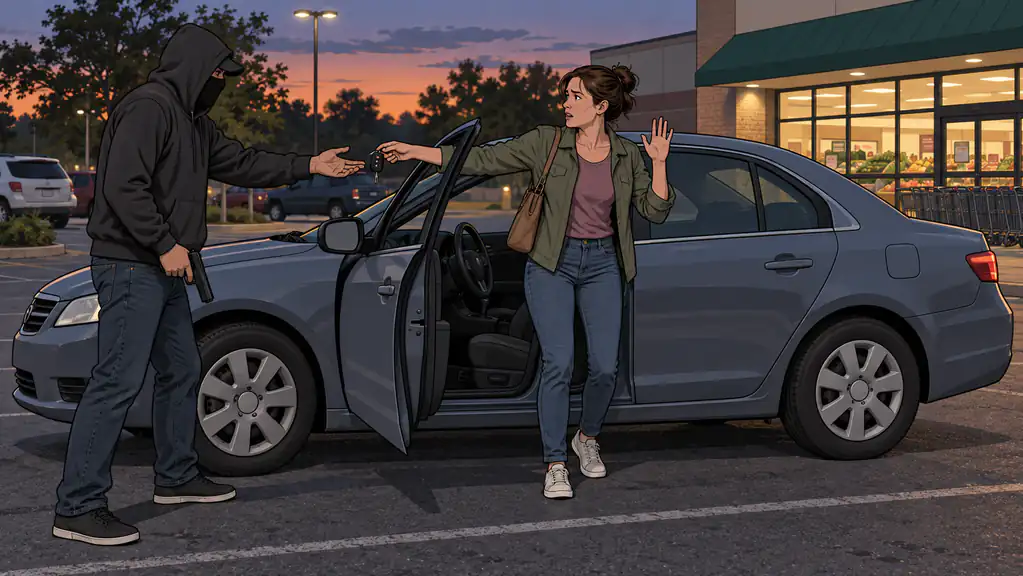
Carjacking gets treated as either a big-city inevitability you can’t do anything about or a reason to turn every drive into a tactical operation. Both are wrong, and the mechanics tell you why. A carjacking is an armed robbery with one hard requirement the robber can’t skip: he needs your car stopped and you unable to leave. That’s the constraint the whole event is built on. Take the constraint seriously and the threat stops being a fog of dread and becomes a short list of specific moments you can engineer against — most of them without touching the brake pedal of your normal life.
The whole argument in one line: a carjacker can only work the stationary moment, so your entire job is to enter those moments alert, leave yourself a way out, and have already decided — in the calm, not the adrenaline — that the car goes. Everything below is detail on those three things, plus the one genuinely hard trade-off underneath them, which is worth walking through slowly because most people get it exactly backwards under stress.
Keep the scale honest while you read: this is a likelihood of 3 out of 9 and an impact of 6 out of 9. Uncommon for most, concentrated in hotspots, recoverable in the typical case, serious in the tail because a weapon is usually present. That rating is the point of proportion — real habits, not a reorganized life.
The stationary moment, engineered
A moving car is a bad target: he can’t reach the door, can’t control you, and can’t stop you leaving. So every carjacking is built on removing your motion. Break the moment into its parts and you can see each one you can attack:
- You’re stopped. Red lights, stop signs, gridlock, driveways, pumps, parking lots. Unavoidable — you have to stop sometimes. But how you stop is yours.
- You’re boxed in. Bumper ahead, cars beside, curb to the right. When your motion is already gone, his job is done for him.
- You’re distracted. Phone, radio, kids, groceries, the relief of finally heading home. Your attention is the alarm, and it’s usually switched off in exactly the wrong places.
- The door is the interface. Locked door and closed window turn a two-second grab into a barrier he has to defeat in the open, where time works against him.
Notice that of the four, only the first is truly forced on you. The other three — boxed in, distracted, door open — are choices, and each one you deny him raises the cost of the whole thing. You don’t need to win all four. Denying any one of them often ends it before it’s an event.
Positional and driving habits that cost you nothing
These aren’t tactical-driving-course moves. They’re small defaults that, once habitual, run on their own:
- Leave the escape gap. At every stop in traffic, keep enough room to the car ahead that you could steer out and go — the old rule of thumb is being able to see its rear tires meet the pavement. That gap is your exit.
- Pick the outside lane and the open line. Where you can, sit where you’re not walled in on both sides. In lots, back into the space or pull through so you’re facing out — you leave forward, fast, without a three-point turn while someone’s approaching.
- Treat the approach to the car as its own moment. Most people are alert while driving and oblivious in the fifty feet before they reach the door — which is exactly when you’re on foot, hands full, keys out, and slow. Scan the lot as you walk up, not after you’re seated.
- Doors locked, windows up, by default. Not just in “bad” areas — as the normal state in unfamiliar places and stopped traffic. It’s free and automatic, and it converts the easiest version of the attack into one he’d rather skip.
- Don’t lead a follower home. If the same car has been behind you since the store or the ATM, your driveway is the worst place to find out whether it’s nothing. Take an extra turn or two. If it stays, drive somewhere lit and public and let it reveal itself there. Better yet, drive to the nearest police station — the odds of a bad guy following are nil.
- Don’t get out for the bump. A light tap from behind in a lonely spot is the setup, not the accident. You’re allowed to signal, keep rolling to a gas station or a police station, and handle the exchange there. A real fender-bender survives a two-minute drive to somewhere safe.
None of this asks you to drive scared. It asks you to remove, as a habit, the specific gifts a carjacker needs.
The hard trade-off: give up the car vs. an armed response
Here’s the part that deserves real honesty, because it’s where training and instinct pull against each other.
If the above fails and you’re faced with a decision: give up the car. It’s replaceable and insured; you are not. The overwhelming majority of carjackings end with a lost vehicle and a scare precisely because people comply, and compliance is what makes the typical outcome the recoverable one. Hands visible, no sudden reaches, out of the car if that’s what he wants, and distance — the car driving off with your stuff in it is the win condition. This is the whole game most of the time.
Now the complication, for those who carry. Some will say a firearm changes the math. Sometimes it can — but the burden it puts on you in that instant is enormous, and most people badly underestimate it. Consider what an armed response actually demands, all at once, in under two seconds, with adrenaline dumping:
- Target identification under stress. Who exactly is the threat? Is there one person or two? Is the second person a lookout, an accomplice, or a bystander? You have to know before you act, and tunnel vision and auditory exclusion are actively working against you.
- Backdrop and bystanders. You are in a car, in traffic, in a lot, surrounded by other people and other vehicles. Anything you miss goes somewhere. That backdrop doesn’t clear just because you’re afraid.
- The car itself. You’re often belted in, behind a wheel, in a terrible position to do anything but drive. The single best weapon you have in a car is usually the car — driving out of the situation, if you kept the gap that lets you.
- The legal burden, decided later, judged slowly. What felt like life-or-death in the moment gets examined for months afterward against a standard of reasonable, immediate threat to life. Losing property is not that standard. A weapon shown to take your car does not automatically make lethal force lawful or wise, and the line between the two is not one you want to be drawing for the first time with your heart at 170.
So the disciplined position is narrow and clear: your stuff is never worth a gunfight; your life might be, and those are different facts. If it’s the car he wants, the car goes. The only thing that changes the calculus is a credible, immediate threat to you or your passengers after the car is no longer the point — an attempted abduction, an attack that continues once you’ve complied. That’s a real and separate scenario, and the mistake is blurring it into “he threatened me for my car, so.” Pre-deciding this — in the calm — is the actual preparation. You do not want your first attempt at sorting property-loss from threat-to-life to happen while it’s happening.
Kids and passengers change the answer
Everything above gets sharper with people in the car, and one scenario matters more than any other: the car taken with a child still in it. This is the nightmare version, and it flips the default. If a carjacker is taking the vehicle and your kid is in the back seat, this is no longer a property crime you comply with and let drive away — the priority becomes getting that child out. Never get out while the child is still seatbelted in. The child gets out with you or you don’t get out - PERIOD.
The preparation is upstream:
- Never leave a child in a running, unlocked car — not for the “quick” gas-station or convenience-store stop. That’s the exact stationary-plus-distracted moment, with the worst possible stakes.
- Do the loading and unloading alert. Buckling a kid is heads-down, hands-full, slow — engineer that moment: doors locked on the other side, scan first, park where you’re not walled in.
- Brief passengers simply. Adults ride knowing the plan is comply and get clear; kids old enough ride knowing to follow your voice and move where you say. You don’t want to be improvising crowd control in the middle of it.
The rule “the car is replaceable, you aren’t” holds — but you now includes everyone in the car, and that can turn a comply-and-let-it-go into a get-them-out-first.
Second-order effects worth planning for
The car leaving is rarely the end of the ledger:
- Everything in the car goes with it — registration and insurance card with your home address, a garage remote, a phone, sometimes a wallet or house keys. That’s a stranger with your address and a way into your house. Plan for it: don’t keep the garage remote and the home address together in the car, and know how you’d kill a stolen phone and rekey a door.
- The scare has a tail. Getting back behind the wheel, especially at the same intersection or lot, carries weight for a while. That’s normal, and worth expecting rather than being blindsided by it.
- Identity and access cleanup. Cards, IDs, the phone, the accounts on it — the aftermath is a paperwork day you can shorten by knowing in advance what’s in the car and how you’d shut it down.
None of these are catastrophic. They’re the ordinary long tail of the event, and thinking about them once now makes the bad afternoon shorter.
How you know you’re ready
- The escape gap at stops and the eyes-up scan approaching your car are automatic — you do them without deciding to.
- Doors locked and windows up is your default state in unfamiliar places, not a thing you remember in bad ones.
- You’ve pre-decided — genuinely, not vaguely — that the car goes, and you can state the one narrow case that changes it: an immediate threat to you or your passengers, not to the property.
- You’ve thought through the armed-response trade-off honestly enough to know why the car isn’t worth it, and you’re not carrying the fantasy that a gun makes the stationary moment simple.
- If you carry passengers or kids, you have a simple, rehearsed plan and you never leave a child in a running, unlocked car.
- You know what’s in your car that a thief would inherit — address, remote, keys, phone — and how you’d shut that down fast.
- And you’re keeping it in proportion: a couple of habits in a few predictable moments, sized to a 3-out-of-9 threat, not a life rebuilt around it.
Bottom Line
- The stationary moment is the whole threat — stopped, boxed in, distracted, door open. Deny any one and the setup usually collapses.
- The habits cost nothing — leave the escape gap, park to leave, scan on approach, lock the doors, don’t lead a follower home, don’t get out for the bump.
- Give up the car, every time it’s about the car. It’s replaceable and insured; you aren’t. Compliance is why the typical outcome is recoverable.
- The armed-response trade-off is real and mostly one-way — your property is never worth a gunfight, and the target-ID, backdrop, and legal burden under stress are heavier than they feel. Only an immediate threat to you or your passengers changes the calculus, and that’s a different fact you pre-decide.
- Passengers change the answer, the aftermath has a tail, and proportion is the discipline — plan for kids and stolen-car access, then keep the whole thing sized to a low-likelihood threat.
A carjacker can only work the moment you’re stopped and stuck. Engineer that moment — space, attention, a locked door, a decision already made — and you’ve handled the threat long before anyone reaches your window.
Deep personal-safety readiness is transferable: see how carjacking and the other personal-crime threats compare to the natural and infrastructure risks where you live with Threat Planning.