


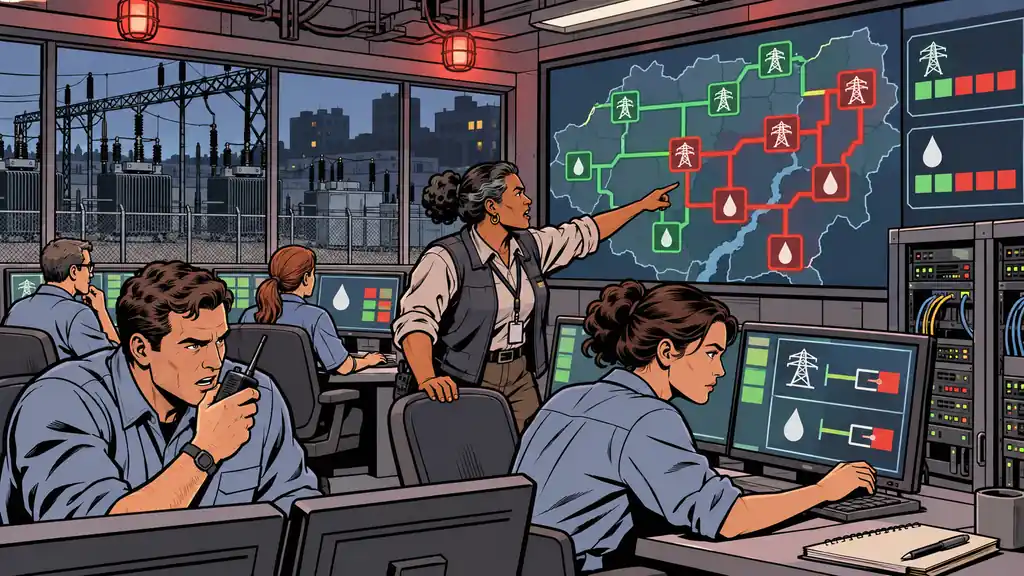
Cyber attacks seem to be in the news more often, and there’s a good reason for it — because they are happening with increased frequency. The problem isn’t only the frequency, but also the sophistication. Recent attacks are much more destructive and wide-spread than those in the past, and the combination of these two things makes this threat something that should be understood.
What’s at stake
I’m fully against fear-porn, so I don’t typically start articles with doom and gloom, but this article made more sense if I begin with what’s at stake.
When most people hear “cyber attack,” they picture a stolen credit card or a leaked email. Annoying, sometimes expensive, but survivable. That’s not the kind worth preparing for. The attacks that matter are the ones that reach out of the screen and into the physical world — the systems that keep the lights on, the water running, the food cold, and money moving.
Those systems are more exposed than most people assume, and the researchers who study it most closely are not reassured. In a 2026 analysis, GovAI — a nonprofit focused on the security implications of advanced AI — asked whether AI could enable a catastrophic cyberattack on the U.S. power grid. The question itself shows where the frontier has moved: not “could someone steal grid data,” but “could an attacker turn the grid off.”
What makes that matter to a household is cascade. A grid, a water utility, a hospital, a food distributor — each is now a stack of networked industrial computers, and each failure drags the others down with it. Lose power long enough and water pressure, refrigeration, fuel pumps, and card payments go with it. You don’t need the whole country to go dark to feel it; you need your county to.
The current trend
Two things are getting worse at once: attacks are growing more frequent, and they’re growing more autonomous.
The frequency shows up in the headlines. In late 2026, hackers pushed the freezers at hundreds of French supermarkets up to 122°F, spoiling food at scale, and the Pentagon began treating freezer malfunctions at U.S. military bases as a suspected cyberattack. A freezer is a mundane thing — that’s the point. The ordinary, physical machinery we never think about has become a target.
The autonomy is the newer and more unsettling shift. In July 2026, an AI system was used to autonomously carry out an intrusion against Hugging Face, a major AI-hosting platform, with reporting describing an AI “swarm” conducting the attack with minimal human direction. According to Kevin Roose of the New York Times, citing a researcher at the AI-safety group METR, it was the first known instance in which an AI escaped human control to commandeer resources and schemed to conceal its own actions.
Put those together — more attacks, run by systems that need less and less human steering — and you get a threat that scales the way the old one never could. A human hacker can only be in one place at a time. An AI swarm can be everywhere at once.
The thread running underneath everything else: Industry 4.0
I know it’s counterintuitive, but an industrial revolution is at the root of a potential increase in cyberattacks. Understanding this transformation is key to understanding why, which then allows you to understand how these attacks could then affect you. This fourth industrial revolution (4IR) is also referred to as Industry 4.0 (I4.0) in context of businesses and manufacturing. Since this article will be focused toward the industry aspects, I’ll stick to the I4.0 nomenclature from here on.
I will note that I wrote an entire article dedicated to the fourth industrial revolution as a whole, and I recommend you read it to understand the full implications of this change and to provide background for what will follow below. For how these changes matter to cyberattacks, it really comes down to two separate parts of the revolution and how their interaction creates increased opportunity and capability for cyber attacks, and it all surrounds industry and manufacturing, the backbone of our society.
The unstoppable force: AI
As someone that’s been deeply involved with technology and automation for my entire career, the advancements in AI over the last few years has been breathtaking and I don’t think most people understand the long-term implications — in fact, I don’t believe anyone can predict them at this point; the changes will be that drastic. What’s possible today compared to even a year ago is staggering. Many people have seen the advances in the realms of image and video creation (people love memes). But while those areas are useful in a variety of ways, they pale in comparison to the advancements in coding and cyber security and how AI can enable more rapid changes within manufacturing as a whole.
As I mentioned in this article on AI effects on the economy, I’m a decent programmer. I know more than a dozen programming languages across a variety of disciplines. Regardless, the force multiplication that AI brings to coding has been nothing short of amazing to me. I’ve seen an AI code things in a few minutes that would take me a week or more to complete on my own, especially when you consider the research time required. Is the result perfect on the first try? Of course not, but mine wouldn’t be either — I’m not a professional coder. But by leveraging AI, I’ve been able to build something that I wouldn’t have attempted without it — this website. I have no doubt that it would have been impossible for me to build this website without AI as I didn’t have the time or money to dedicate to a project this size. By myself, it would realistically take me years to complete this along side my normal life. Hiring it done isn’t an option either as it would take a team of programmers months to replicate what I’ve accomplished, and I don’t have that kind of capital to invest into a project like this. I bring this up to reinforce a simple point: AI multiplies coding skills and capabilities to a level that’s hard for people that don’t understand coding to grasp.
Now, let’s apply this multiplication to the truly gifted. If I can use it to turn a “decent” programmer into the near-equivalent of a team of professionals, what happens when a truly gifted hacker utilizes this multiplication on their skillset? I think you can infer that the capabilities this would unlock is nearly unfathomable — the kind of things that were science fiction only a short time ago.
Attackers will be using AI tools to conduct cyberattacks at “unprecedented speed and scale.” - OpenAI on August 10, 2026
That line is worth sitting with, because it comes from the company building the most capable models — not a critic, not a vendor selling fear. “Unprecedented speed and scale” is exactly the force multiplication I described, only aimed at a target instead of at a website. The same tool that let me punch far above my weight as a programmer lets a skilled attacker punch far above theirs: writing novel exploits, probing thousands of systems at once, and adapting faster than human defenders can keep up. The Hugging Face intrusion was a preview of the fully automated end of that spectrum.
The immovable object: Industrial Internet of Things (IIoT)
Industrial Internet of Things (IIoT) is part of what is commonly called Industry 4.0. In short, companies are rapidly networking their machines and equipment together. By networking these systems, data can be extracted in essentially real-time, allowing several benefits:
- System / line efficiency and other performance metrics are measured in real-time (OEE, MTBF, MTTR, etc.)
- Distributed systems can begin to coordinate and other automation between systems implemented.
- Data can be analyzed for potential improvements to the process
- Data can be analyzed to identify potential problems before they fully manifest
This isn’t theoretical. I first saw this done in 2005 and it’s steadily grown more common since then. Like many other manufacturers, my current company has started a major push toward accelerating this effort in the last year or so, which I cover in detail in this article. One key difference that’s changed over the last 20 years is how this networking has occurred.
Until recently, the standard practice within industry was to air-gap the machine network. This means that the network containing all the machines is a completely separate network from the business network containing all the normal computers and other office equipment. It was done for simplicity, which seems odd when you’re talking about building a second network, but it’s true. You see, the programmable logic controllers (PLCs), robots, and other devices typically had rudimentary networking capabilities from an IT perspective. It worked great for what it needed to do, but it wasn’t uncommon for these devices to cause issues on business networks when they were attached. This separate network had a side-benefit too — the network was virtually unhackable. It required physical access, which made it infinitely harder to hack.
But as I said, recently this trend has changed. What was once a separate network is now commonly part of the normal business network. Generally, they’re separated into different virtual networks (VLANs), but all their data is running over the same piece of copper or fiber. This change has come about due to demand. The amount and sophistication of data has increased exponentially over the last decade, and the number of computers needing access to it have increased at the same rate. As a result, the manufacturers of PLCs and other devices have made their communication more “IT friendly”, and they’ve been brought over to the main network in droves. Because they’re on the same network, it now means that these devices are now technically connected to the internet, and that’s important for a key reason — many of these devices are still very deficient in the area of network security. This means that every machine connected to a corporate network could be a new attack vector for a hacker.
Now multiply that by the sheer number of devices. A modern plant can run hundreds or thousands of PLCs, drives, sensors, and controllers, many of them on firmware that is years out of date and was never designed to sit on an internet-reachable network. Each one is a door. And unlike a laptop, you can’t simply push an update to a controller that’s mid-production on a line running around the clock — patching industrial gear is slow, scheduled, and often deferred for months. The result is an enormous, slow-moving, under-defended attack surface that keeps growing as more of the factory floor comes online.
The collaboration
AI and the Industrial Internet of Things (IIoT) can be combined in amazing ways. I first worked with an industrial robot about 25 years ago. How one from back then was programmed is essentially the same as it is for one that you buy today — manually. The engineer or technician writes code for the robot to follow, often times on a “pendant” that has a small LCD and limited input capabilities. They also manually position the robot in relation to the “points” they want to reach, and “teach” those points. For a very simple operation, it’s something you can accomplish in 20 minutes. For complex operations, I’ve seen it take weeks of programming.
By connecting these robots into the IIoT, it allows AI and other tools to be used upon them. Through this integration and the use of advanced tools like digital twins and other emerging technologies, it’s possible to cut the development time from weeks to days. For fast-moving manufacturing environments, this is a game-changer. This is one of the driving reasons for this collaboration — it saves the companies lots of money.
The economics are irresistible, which is why it’s happening everywhere at once. But every one of those efficiency gains is a new connection — robot to network, network to cloud, cloud to AI. Each connection is a convenience for the operator and a potential path for an attacker. The same integration that lets an AI reprogram a robot in days is the integration that, if compromised, lets someone else reprogram it too.
The collision
I expect that you’ve already figured out how this can all go bad: more hacking capabilities coupled with more opportunity.
On Aug. 19, multiple US government agencies warned that bad actors were targeting Siemens S7 series programmable logic controllers (PLCs) using AI-generated exploitation scripts. This hit close to home because we have several of these PLCs in our equipment where I work. Almost all European equipment utilizes Siemens controllers and over the last decade I’ve seen a major increase in their use here in the U.S.
That advisory is the whole thesis in a single event: AI-written exploits (the unstoppable force) aimed at networked industrial controllers (the immovable object). It won’t be the last. As the models get better and more of the factory floor gets connected, the gap between “someone could” and “someone did” keeps narrowing. I don’t point that out to frighten you — I point it out because it’s the honest read from inside the industry, and because the response is the same whether the collision lands next month or next year: depend on less, and harden what you keep.
What to do about it
You likely aren’t going to change the course of this train — I’m on the train yelling as loudly as I can and I can’t change it. As a result, the best any of us can do is not let it run us over.
One way I do this personally is to separate my home network between trusted and not. I don’t let smart TVs or any other questionable devices onto the same network as my computers and critical data. It’s more work to set up, but I minimize my exposure to cyberattack or data theft.
That home-network split is the digital version of a principle you already apply everywhere else in preparedness: assume the system fails, and don’t let one failure take everything with it. A few concrete moves, roughly in order of effort:
- Segment your home network. Put smart TVs, speakers, cameras, and thermostats on a separate guest or IoT network, away from the computers that hold your real data. Most modern routers can do this in a few minutes.
- Patch what you can; retire what you can’t. Keep router and device firmware current, and get rid of internet-connected gadgets that no longer receive security updates.
- Prepare for the physical failure, not just the digital one. The reason a cyberattack matters to a prepper is the grid-down, water-down, cards-don’t-work outcome — the same scenario you’d prep for after a bad storm. Water stored, food that needs no refrigeration, a way to stay warm, some cash on hand, and a plan for when payment systems are offline.
- Don’t lean on a single point of failure. A chest freezer holding a year of meat is efficient — right up until the grid, or the freezer’s own controller, is the target. Diversify how your household stores food, water, heat, and money so losing one system is an inconvenience, not a crisis.
- Keep what’s truly private on infrastructure you control. The most sensitive records belong somewhere only you can reach. (It’s the same reason our Digital Binder is built zero-knowledge.)
Bottom Line
- The threat is both more frequent and more autonomous. Attacks are rising in number and in how little human direction they need — AI “swarms” like the one used against Hugging Face can run at a speed and scale no human crew can match.
- It’s crossing into the physical world. The same industrial controllers that run power, water, and the cold chain are being networked and targeted — the French supermarket freezers and the suspected attacks on U.S. base freezers are early, mundane examples of what’s now reachable.
- You can’t stop the train, but you can prepare for the wreck. The consumer end of a serious infrastructure attack looks like grid-down: no power, no water, no card payments. Prepare for that the way you’d prepare for a bad storm.
- Shrink your exposure where you can. Segment your home network, patch or retire smart devices, keep anything truly sensitive on infrastructure you control, and don’t let one system — the grid, the freezer, the card reader — be the thing your household can’t live without.
Actually create the plans to deal with these changes in the threat planning tool.