


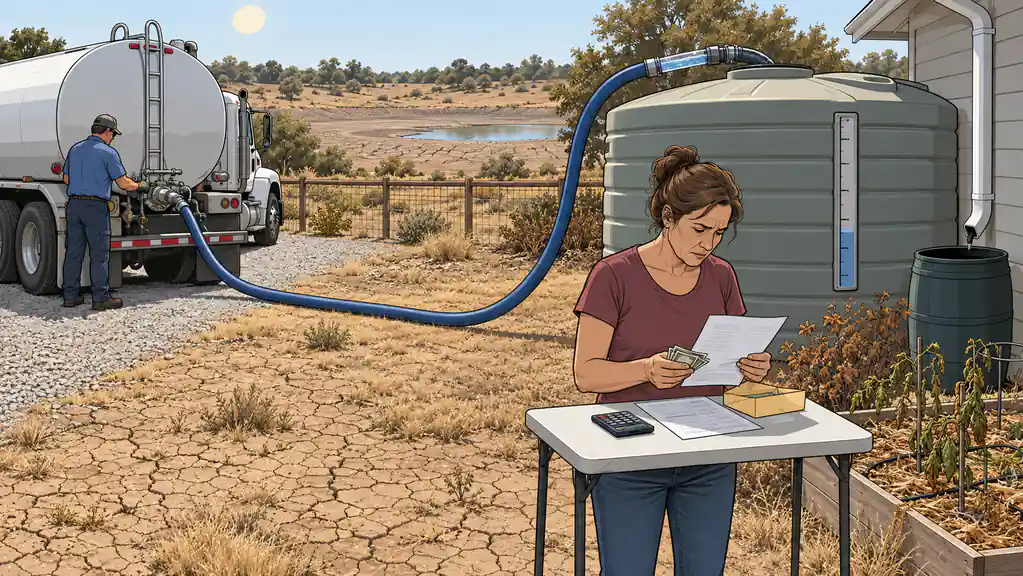
Drought breaks the usual prepper frame because it isn’t an event with a start and a clock. It’s a slow drain on two budgets at once: your water budget — supply falling against demand across a whole basin — and your cost budget — food and water prices climbing as farms and utilities eat the shortfall. Neither one fails on a given day. Both tighten over months to years. So the serious planner isn’t sizing a 72-hour kit. You’re sizing buffers against a multi-year squeeze. The impact per household is genuinely low and the physical danger is small — but the length of it and the size of the area it covers make it a real, repeating load that rewards planning ahead and punishes waiting.
The three droughts, and which one hurts you
“Drought” is really three different shortfalls, and your exposure depends on which one dominates where you live and how you get your water:
- Meteorological drought — not enough rain versus normal. It’s the early warning, but it’s not what actually hurts you.
- Hydrological drought — drained surface water (reservoirs, streams) and, more importantly, groundwater. This is what drives the restrictions and the well failures. And it lags the rainfall shortfall, which means it sticks around long after the rain comes back.
- Agricultural drought — dry soil that cuts crop yields. This is the channel that turns a distant region’s dry year into your grocery bill.
Here’s the planning consequence of that lag: groundwater and reservoirs refill seasons to years behind the rain. The impact window is longer than the drought window. One wet year does not refill an over-drafted aquifer. So size your plan to how long recovery takes, not to how long it stays dry — those are two different, longer numbers.
For groundwater, know your own aquifer. Does it recharge fast (shallow, permeable) or is it effectively fossil water being mined (deep, slow-recharge)? A private well in a slow-recharge or heavily-pumped basin is the sharpest exposure in this entire threat. A falling regional table can drop your well’s yield or pull the water below your pump intake — a hard mechanical failure that needs deepening, a lowered pump, or hauling, none of it fast or cheap, and all of it competing with every other well owner in the basin at the same moment. Know your static water level, your pump setting depth, and your well’s yield trend. That data is your early-warning system, and it’s free to write down today.
Trace the cascade — the real cost isn’t the brown lawn
The first-order effects (higher water bill, dead grass) aren’t where the money sits. Follow it further:
- Water supply. Utilities climb from voluntary restrictions to mandatory ones and, in severe cases, to allocation limits and drought pricing. Agriculture — the biggest water user in most dry basins — gets cut first, which feeds the food-price channel. Well owners lose yield independent of any restriction at all.
- The food system, in two phases. Reduced yields, expensive or short feed, and herds sold off. Herd culling has a trap in it worth understanding: it can lower meat prices briefly as animals flood the market, then raise them durably for years as the smaller herd constrains supply. The 2012 drought is the textbook case — USDA’s Economic Research Service documented ranchers liquidating herds in record numbers, which held beef-price rises down in 2012 even as it set up higher meat prices into 2013, and the drawn-down US cattle herd went on to drive beef and cattle prices to record levels in the years that followed. Your pantry hedge should account for both phases — the brief dip and the long climb behind it. And because food markets are national, your food-cost exposure tracks drought in the major growing and grazing regions, not your local rainfall. That decoupling is what makes drought a broader household threat than the water-table framing alone suggests.
- Wildfire, coupled in. A long drought dries the fuel and lengthens the fire season. A drought-prone household is very often a fire-prone one at the same time — and the water storage you build for drought also serves fire defense, so plan them as one system, not two.
- The slow drag. Gardens and landscaping fail without irrigation; livestock operations eat water-hauling costs and destocking decisions; farm-dependent local economies contract. For the self-reliant household running gardens or animals, this is where drought actually bites — the production systems, not personal survival.
Likelihood: think in recurrence, not annual odds
Drought is a geography-and-cycle risk, concentrated in arid and semi-arid regions on multi-year cycles. Don’t reason about it as a percent-per-year. Think about how often the dry cycles return and how deep they run, because they will return to dry regions. The real questions are: how deep, how long, and do your buffers survive back-to-back dry years without a full recharge in between? Pull your region’s actual drought history and your basin and aquifer conditions rather than reasoning from a national average — the spread between one basin and the next is enormous.
Engineering the buffers
Drought hands you lead time, so the whole objective is capability installed before the cycle, measured in months of water autonomy and months of price insulation.
Water — sources and storage. Build redundancy: a primary (utility or well), a resilient secondary (stored volume, rainwater catchment where it’s legal and sensible, a haul plan with the gear to actually execute it), and enough stored water to bridge restriction periods and short well interruptions. Work a real number: four people at two gallons a day is eight gallons a day, ~240 a month — so a modest six-week reserve for that household is roughly 340 gallons, and that’s before you’ve replenished a drop. Size storage to a realistic dry-cycle restriction, not a weekend. Two cautions: rainwater catchment yields least exactly when you need it most, so it’s a supplement, never the anchor; and for well owners, pre-plan the failure response — pump-lowering feasibility, a deepening contractor, hauling logistics — before the yield drops, because the whole basin will be calling the same contractors the same week.
Demand reduction as installed infrastructure. Conservation is worth most when it’s already habitual and built into the hardware before restrictions — efficient fixtures, leaks eliminated, greywater reuse where appropriate, and xeriscaping that removes the biggest discretionary demand (ornamental irrigation) outright. Demand you cut in advance is water you don’t have to store or haul. Know your household’s baseline gallons a day and which slice of it you can cut on demand — it’s the drought version of knowing your monthly burn rate.
Pantry as a price hedge. A deep, first-in-first-out pantry directly hedges the food-inflation channel: buy ahead of the durable post-liquidation price climb, draw down at the peak. It’s the same storage that serves general resilience, doing double duty as an inflation instrument — measure it in weeks of groceries insulated, not dollars.
Production systems built for the dry year. Native and drought-tolerant landscaping, drought-hardy varieties, soil-moisture practices (mulch, drip, timing), and — the biggest lever for anyone with animals — livestock right-sized to a dry-year water and feed budget, not a wet-year one. The forced destocking that wrecks unprepared operations is avoidable by simply never scaling past what a dry cycle can carry. Design the production system’s water demand to survive the drought, and the good years are just surplus.
The failure modes to design against
- Procrastination. The signature failure. The lead time is the trap — infinite time to prepare produces zero preparation until the options narrow and the contractors are booked.
- Recovery-lag blindness. Assuming one wet year ends it. Over-drafted aquifers and drained reservoirs recover on a multi-year delay.
- Leaning on catchment. Anchoring the water plan on rainwater capture, which yields least precisely when the drought is worst.
- Well-failure surprise. Ignoring the water-table trend until the yield drops, then racing the whole basin for the same drilling and pump crews.
- Wet-year design. Landscaping and especially livestock scaled to good years, which guarantees a crisis in the dry ones.
How you know you’re ready
- You can name your water sources in order — primary, secondary, and a haul plan you’ve actually priced — and you hold enough stored volume to bridge a realistic restriction, not just a weekend.
- If you’re on a well, you know your static level, pump depth, and yield trend, and you’ve already lined up who you’d call before the basin does.
- Your conservation is installed and lived-in, not a plan for later — you know your baseline gallons a day and what’s trimmable on demand.
- Your pantry is deep and rotating, sized in weeks of groceries, ready to buy ahead of the price climb.
- Your yard and your animals are sized to a dry year, so a dry cycle is a nuisance, not a forced sell-off.
- You’ve looked up your own basin’s history and conditions instead of trusting a national average.
Readiness here is measured in months of water autonomy and weeks of price insulation — capability installed before the cycle, not spend logged during it.
Bottom Line
- Drought is a multi-year drain on two budgets — water and price — not an event; size buffers to the recovery timescale, not the rainfall timescale.
- Groundwater lags rainfall, so the impact outlasts the drought; a well in a slow-recharge basin is the sharpest, hardest-to-fix exposure on the list.
- Your food-cost exposure tracks distant growing regions, not your local rain — hedge it with a deep, rotated pantry across both phases of the herd-liquidation cycle.
- Preparedness is capability installed before the cycle — source redundancy, habitual conservation, and production systems sized for the dry year.
- The failure mode is procrastination and wet-year design — the lead time is a trap, so build while the reservoir is still full.
Drought never fails on a single day, which is exactly why it wins. Build your water and price buffers for the multi-year squeeze before the cycle starts — the reservoir being full today is the reason to act, not the reason to wait.
Model your household’s water storage and demand with the Food & Water Storage tool, and review basin and drought exposure for your area with the Area Recon tool.