


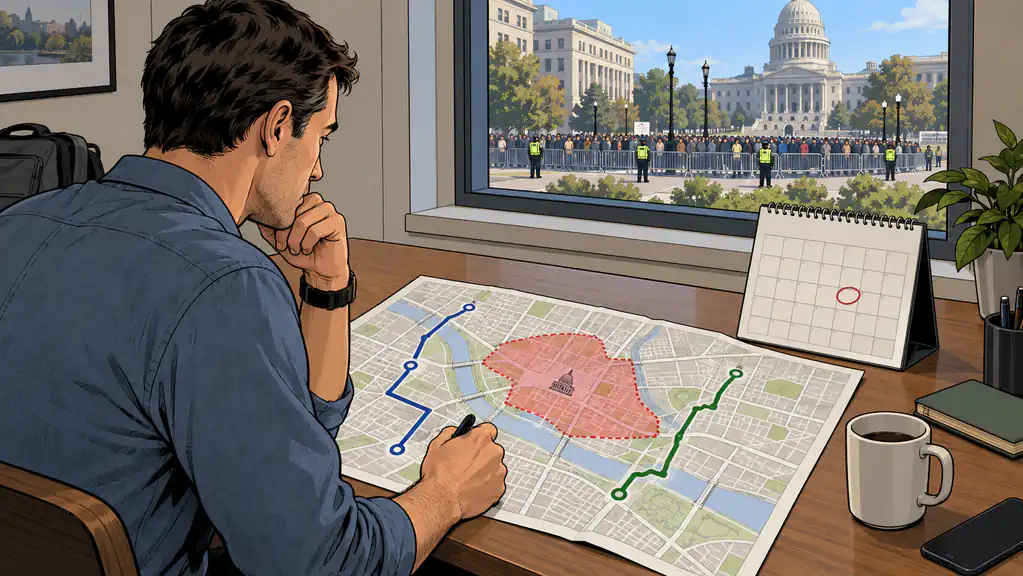
Most threats you prepare for because you can’t see them coming. This one’s the opposite. Political violence is one of the most predictable things on the whole list — and that predictability is the entire plan. It runs on a schedule (elections, big verdicts, charged anniversaries, announced demonstrations) and it happens on a map (capitols, courthouses, downtown squares, symbolic sites). When you can call both the when and the where, prepping stops being about facing anything down. It becomes about routing — reading the calendar and the geography well enough that you’re just never in the wrong place at the wrong time.
To be clear up front: this isn’t about anyone’s politics, and the prep doesn’t take a side. It’s about crowds and flashpoints. A dense, angry crowd is dangerous to a bystander no matter what it’s angry about, and the moves here work the same regardless of who’s in the street or why.
Where this threat sits
Election or political violence rates impact 5, likelihood 4. Both numbers come from how avoidable it is. The bite stays low-to-moderate because the danger clusters at spots most people can simply not go — it’s not a wide-area hazard like a storm or a pandemic that reaches you at home. The odds are moderate, and — this is the key part — they come in windows. The risk spikes around specific events and drops back down between them. It doesn’t run at a steady background level. Understanding it as a windowed thing is what makes the whole see-it-coming approach work.
Reading the schedule
The “when” follows patterns you can watch for:
- Election windows — the run-up to and the immediate aftermath of contested elections, including the certification and transition stretch.
- Court flashpoints — high-profile verdicts and rulings, where both the decision date and the reaction that follows are roughly foreseeable.
- Charged anniversaries and symbolic dates that come around every year.
- Announced events — planned marches, demonstrations, and counter-demonstrations, which are usually publicized ahead of time.
The takeaway: most of the risk arrives on dates you can see coming. US unrest has clustered hard around contested elections and major verdicts — the 2020 election window and its aftermath; the widespread unrest in 2020 following George Floyd’s death is another. Keeping light awareness of the civic calendar — what’s scheduled, and when tension is likely to peak — is most of the intelligence work right there.
Reading the map
The “where” is just as legible. Trouble concentrates at symbolic, high-density spots: government buildings (capitols, city halls, courthouses), central plazas and downtown cores, university areas, and the exact locations named in announced events. Residential neighborhoods, suburbs, and anywhere away from a symbolic target carry far lower exposure.
Knowing your own ground — which specific blocks and buildings pull crowds, and what the routes around them are — turns a vague “downtown might be bad” into a precise “avoid these three intersections, take this street instead.” That precision is the difference between anxious avoidance and confident routing. You’re not hiding; you’re just taking the other road.
The odds, honestly
Moderate, but concentrated. On the overwhelming majority of days, in the overwhelming majority of places, this is not a concern at all. It rises for a window of a few days around a major event, and even then only in specific spots. The honest framing is: low baseline, sharp but predictable spikes in known places. Under-hyping the everyday risk is correct. So is taking the windowed spikes seriously enough to adjust where you go while they’re open.
What it does, and the cascade
For someone who ends up in the middle of it, the hazards are real: crowd-crush in a packed space, clashes between opposing groups, property destruction and fire, tear gas and other crowd-control measures, and the fast, unpredictable way a crowd can turn. But because the whole thing is avoidable, the part that matters for most households is the indirect disruption:
- Getting around — road closures, transit changes, and no-go zones that scramble your normal movement for a few days.
- Stores and services — closures, cut hours, and supply gaps in affected areas.
- Escalation — a peaceful demonstration can turn, and being next to one when it does is the trap. Proximity, not participation, is what usually catches bystanders.
- Comms strain — dense crowds and events can bog down local cell service, which is exactly why a family check-in plan earns its place.
Do the math on staying home
Here’s the reassuring arithmetic. A charged window is short — usually a few days, sometimes a week. The supplies it takes to sit one out are trivial next to what you’d stock for a storm or a grid-down. Two weeks of food and water — a baseline that serves half your other threats anyway — covers any political-violence window with enormous room to spare. You will almost never have to make a hard choice here. You just don’t go out for the couple of tense days, and you barely touch your stores doing it.
Now the routing math, which is even simpler. If your commute passes one known flashpoint, you need one alternate route to erase the risk entirely. Map it once, in the calm. When a window opens, you already have the answer.
What preparedness looks like
1. Watch the calendar and the map — this is the core skill. Keep light, ongoing awareness of the civic calendar (elections, big rulings, announced events) and of your local hotspots (which buildings and areas draw crowds, and the routes around them). Low effort, high payoff — it turns the threat from a surprise into a scheduling item. When a charged window’s open, just check whether anything’s planned near where you need to be.
2. Avoid and route. When tension is high, treat demonstrations and contested sites as places you don’t go — including out of curiosity, which is a common way bystanders get hurt. Plan routes that skirt the flashpoints, run errands somewhere else or on another day, and if you commute through a hotspot, have that alternate ready. The rule is one line: proximity is the risk, so cut the proximity.
3. Keep enough at home to skip the store. A basic stock of food, water, and essentials — the same baseline that serves many threats — means you can just not go out for a few tense days. That’s the whole value: you never have to choose between an empty fridge and a risky trip. You wait it out, comfortable.
4. Set a family check-in plan. Agree ahead of time how the household checks in, what happens if roads are closed or phones are spotty, and where you’d meet if you got separated. In an event that clogs the local network, a simple pre-set plan — a check-in time, an out-of-area contact, a meeting point — keeps everyone coordinated without needing to reach each other live.
Measured right, readiness for this threat is awareness plus the ability to stay put — knowing what’s coming, and a few days of home autonomy. Not gear, not confrontation. The prepared household here isn’t equipped to face unrest. It’s set up to never run into it.
Bottom Line
- It’s a windowed, located threat — predictable in time (the calendar) and in place (symbolic, high-density spots).
- Awareness is the core skill — light tracking of the civic calendar and your local hotspots does most of the work.
- Proximity is the risk — avoid flashpoints entirely when tension is high, curiosity included.
- A couple weeks of supplies turns staying home into a comfortable choice, not a sacrifice.
- A family check-in plan keeps everyone coordinated through closures and local network strain.
Political violence keeps a schedule and a map. Read both, and you don’t face it down — you route around it.
Map your local flashpoints and the routes that avoid them with Area Recon, and set your household check-in plan with the PACE Plan builder.