


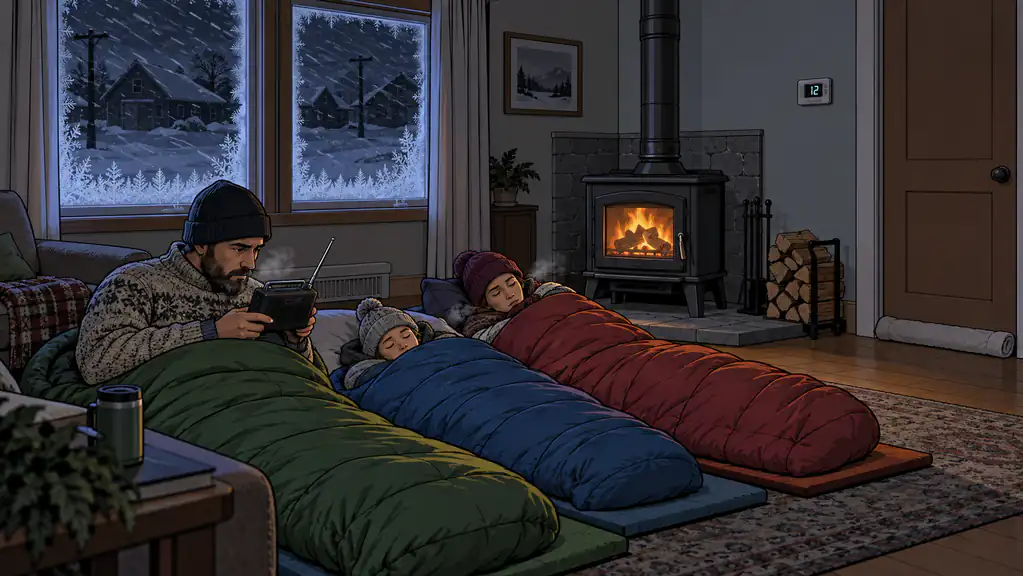
Of every threat on this site, extreme cold is one you’re likely to actually live through — and one of the easiest to take off the table. It rates 6 out of 9 for likelihood and 7 for impact, and that 7 is doing something worth understanding: it’s not fixed. With safe heat, water, and food staged, a deep cold snap is an annoying week. Without them, the exact same cold can kill you. Prepping doesn’t just soften the impact here. It changes what kind of event you’re having.
So the snow isn’t the enemy. The ice isn’t the enemy — those are separate threats. The cold itself is the threat, and what hurts people is losing heat while the temperature outside sits far below freezing, for a few days, with nothing staged to bridge the gap. Fix that once in the fall and you’ve handled almost every cold snap that will ever come at you.
What actually goes wrong
Walk the failure through an unprepared house, step by step, because the order tells you exactly what to prepare for.
- The power drops — often because of the cold. An Arctic outbreak spikes heating demand right as it stresses generation and freezes equipment, and the grid sheds load. Your furnace stops — and here’s the part people miss: a gas or propane furnace still needs electricity for its blower and controls, so “I have gas heat” is not the safety net you think it is.
- The house starts cooling toward the outdoor temperature. How fast depends on your insulation, but in a hard freeze even a tight house loses its usable warmth in a matter of hours to a day — and then keeps falling, toward and past freezing, right where you’re sitting.
- Water fails. On a well, no power means no water the instant the grid drops. On city water, the pipes in a cooling house freeze — and then burst when they thaw, turning a two-day outage into thousands of dollars of flooding after the cold is already over.
- The cold keeps its own schedule. It doesn’t warm up overnight; wind chill makes any exposure dangerous fast; and outside help may be a day or more away. Whatever’s in the house is what you have.
- Somebody improvises. This is the step that kills. Cold, stressed, and out of options, an unprepared household drags a generator into the garage or a charcoal grill into the kitchen to fight the freeze.
Notice that the cold never touched anyone directly in that chain — but it set every deadline. The improvised heat source is what actually kills, and the freeze is what drove someone to it. Break the cascade at step one with a safe way to make heat and a few days of supplies already on the shelf, and the whole thing collapses into a bad week.
The precedent, and the pattern inside it
You don’t have to reach far for the example. The 2021 Texas freeze (Winter Storm Uri) is the textbook case: a severe, prolonged cold snap overwhelmed a grid that wasn’t built for it. More than 4.5 million customers lost power, many for the better part of four days, and Texas ultimately counted 246 deaths — the largest share from cold exposure and the loss of heat and water. The grid strained because of the cold, and then the cold did the killing once the heat was gone. That’s the shape of the threat: the temperature drives the grid failure, and the grid failure hands the temperature its victims.
Two other patterns show up in nearly every deadly cold snap, and each one maps to a prep move below:
- Carbon monoxide. People lose heat, bring the wrong thing indoors, and are poisoned. The CDC counts more than 400 unintentional, non-fire CO deaths in the U.S. every year, and the Consumer Product Safety Commission ties about 100 of them to portable generators — a toll that spikes in the days right after big storms. In plenty of cold snaps, CO kills people the temperature never would have touched.
- Exposure and stranding. A large share of cold-weather deaths are people caught without heat — outdoors, in stranded vehicles, or in a house that’s dropped below freezing — where wind chill and time do the rest. Hypothermia doesn’t need a blizzard; it needs cold and no shelter of warmth.
Plan for “when,” not “if”
A 6 means a dangerous cold snap is effectively an every-winter possibility across most of the cold-weather U.S. That has one practical consequence: stage for winter like you’d stage for a season, not a forecast. The cold that catches people out is almost never the one they didn’t see coming — it’s the one they saw coming and hadn’t set up for, because the heater was still in the box and the pipes weren’t protected. Because it’s this likely, the payoff on preparing is high and immediate. This isn’t insurance against a long-shot. It’s gear you will almost certainly use.
What preparedness looks like
The target is concrete: stay warm, hydrated, and fed for about a week with no grid and no store run — and make zero desperation moves. Four layers get you there.
1. Safe non-electric heat — and the discipline that makes it safe
Pick a heat source that doesn’t need the grid: a wood or pellet stove, an indoor-rated propane heater with an oxygen-depletion sensor, or a fireplace insert. Two rules keep it from killing you:
- Anything that burns makes carbon monoxide. It has to be rated and vented for indoor use. Never a generator, camp stove, charcoal, or running vehicle inside the house or an attached garage — ever. Put in battery-backed CO alarms. This isn’t optional.
- Heat one room, not the house. Pick a small, interior, well-insulated room where everyone gathers and sleeps. Heating 150 square feet instead of a 1,500-square-foot house is a fraction of the fuel — call it a tenth of the load — and that’s the difference between a heat source that lasts one night and one that lasts a week. Then stage the fuel before the season and size it to your days. Don’t own the heater and three hours of fuel; count your cords or cylinders against the full week you’re planning for.
2. Water and no-cook food for a week
Store at least one gallon of water per person per day for the week — both the well and the pipes are failure points in a freeze, so you can’t count on the tap. Four people for seven days is 28 gallons just to drink and cook, and closer to 50 if you want to wash and flush too. Keep a week of food that needs no cooking, because the stove and microwave are dead: canned goods, nut butters, crackers, dried fruit, shelf-stable ready meals. A single burner to melt snow or heat water is a nice bonus — but run it only with ventilation, and never as your main plan.
While you’re at it, protect the pipes from the freeze: know where your main water shutoff is, drip the faucets in a hard freeze, and open cabinet doors so warm air reaches the plumbing. Preventing a burst pipe costs nothing; repairing one costs a small fortune.
3. Bedding and layers, out early
Staying alive in a cold house is mostly about insulating the body, not heating the air — which matters most exactly when the heat has failed and the room is falling toward freezing. Stage it before winter: extra blankets, cold-rated sleeping bags, wool hats and socks, gloves, thermal base layers for everyone. Dressed in layers and sleeping in a good bag, a household stays perfectly safe in a house sitting at 45 to 50°F. Set it out in the fall; don’t go hunting for it during the cold snap.
4. The vehicle, treated as a cold shelter
Because so much cold-weather harm happens to people stranded away from heat, treat each vehicle as its own little warm shelter all season:
- A real blanket or sleeping bag per seat, plus warm layers, hats, and gloves.
- Water and calorie-dense snacks, a flashlight, a phone power bank, a small first-aid kit.
- Keep the tank at least half full. Fuel is both mobility and, in short bursts, heat. Run the engine about 10 minutes an hour to warm up — and clear snow off the exhaust pipe first, or CO backs into the cabin and the car becomes the thing that kills you.
Bottom Line
- It’s a high-probability threat you’ll face — stage for the season, don’t react to the forecast.
- The impact isn’t fixed. With heat, water, and food it’s a disruption; without them the same cold is a survival situation.
- Safe non-electric heat, a CO alarm, and one designated warm room are the single most important layer — everything else is second.
- A week of water and no-cook food, plus knowing your main shutoff so a freeze doesn’t become a flood.
- A stocked car kit and a half-full tank — a lot of cold deaths happen to people stranded away from heat, not in warm houses.
The cold rarely kills the prepared. It kills the improviser — the generator in the garage — and the person with no warmth left when the freeze won’t wait. Stage heat, water, and warmth in the fall and the coldest week of the year becomes a story you tell, not one you survive.
Turn “a week of water and no-cook food” into an exact household list with the Food & Water Storage tool, and size a safe backup heat source with the Heating Fuel calculator.