


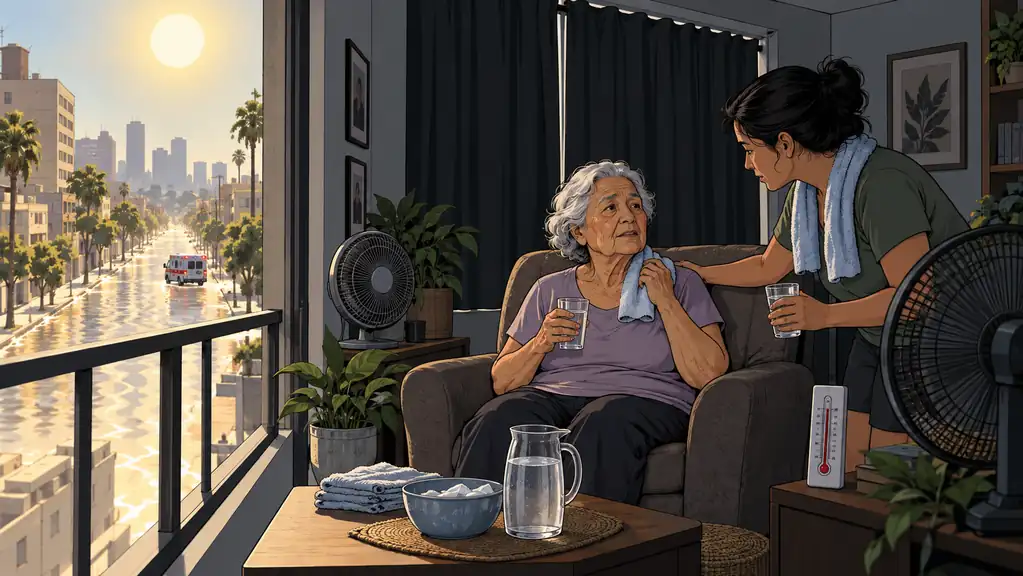
Most preparedness attention goes to weather that breaks things — wind that peels roofs, water that fills basements. Heat breaks nothing. No wind, no wreckage, no dramatic footage. That’s exactly why people under-rate it, and in a normal year it kills more Americans than any other kind of weather.
A heat wave isn’t an impact you brace for and clean up after. It’s a load you carry, hour after hour — heat your body has to shed continuously, day and night. When the air stops letting it shed, people die. Quietly, indoors, mostly the old and the alone. That’s not a storm you survive; that’s a slow overload of the one system you can’t replace.
On a 1-to-9 scale this scores 5 for likelihood and 7 for impact. Likelihood sits mid-scale because dangerous heat is near-annual and worsening across the South and other hot regions, but for a typical U.S. household a health-threatening heat wave runs closer to an every-few-years event — so the national baseline is middling and your county lifts it sharply where summers are hot. Impact is high because the thing that fails is a person, not a building — and because heat waves tend to knock out the exact system people count on to survive them: the grid.
How heat actually hurts you
Your body holds its core near normal by dumping heat, and in real heat it does that mainly one way: sweat evaporating off your skin. That works fine in dry air. It stops working in humid air, because the air is already near-full of moisture and the sweat just sits there. This is why the heat index — temperature plus humidity — predicts danger far better than the thermometer alone. A humid 95°F night can be more dangerous than a dry 105°F afternoon.
It’s also why warm nights are the real killer. Your body pays down its heat debt overnight, when things cool off. If the low never drops far enough, the debt just carries over and stacks up day after day. A single hot afternoon rarely kills. Four days with 80°F nights does.
The progression is worth knowing because catching it early is most of the fight:
- Heat exhaustion — heavy sweating, weakness, dizziness, headache, nausea, cramps. Reversible with cooling, fluids, and rest — if someone notices.
- Heatstroke — core temperature climbs past roughly 104°F, sweating may stop, the skin goes hot, and the person gets confused, agitated, then collapses. That’s not a bad afternoon; that’s a call-for-help-right-now emergency that damages organs and kills.
The mistakes that get people hurt
The failures here are boring and repeatable:
- Trying to cool the whole house. You can’t, especially without power. Fighting the entire structure means you cool nothing well.
- Running a fan into hot, dry air. Above roughly 95°F–100°F, a fan blowing dry air on you just adds heat — it works like a convection oven. A fan only helps in extreme heat if you pair it with wetting your skin.
- Opening the windows during the hot day. If it’s hotter outside than in, open windows let heat in. You seal up by day and open at night.
- Waiting to feel thirsty. Thirst lags behind what your body already needs, especially in the elderly. By the time you feel it, you’re behind.
- Leaving the vulnerable to call for help. Heat clouds judgment. The person in trouble usually won’t pick up the phone. “Call me if you need anything” fails the exact people it’s meant to protect.
The history says the same thing every time
The deadliest heat waves combine high heat, high humidity, warm nights, and a vulnerable city population — and they routinely kill more people than the hurricanes that get all the coverage. The 1995 Chicago heat wave killed 739 people in five days, most of them elderly and living alone. The 2003 European heat wave killed on the order of 70,000 people across the continent. The 2021 Pacific Northwest heat dome pushed Portland to 116°F and killed roughly 250 people in the U.S. and 400 more in Canada — in a region where air conditioning was rare precisely because nobody had ever needed it.
The CDC ties an average of about 1,220 deaths a year to extreme heat, and the National Weather Service calls it the leading weather-related killer in the country — ahead of hurricanes and tornadoes. Two lessons repeat: the people who die are usually the ones no one checked on, and the grid failing at the worst moment is what turns a survivable heat wave into a deadly one.
Who’s actually at risk
Even a fit household should plan, but the real target is the vulnerable person — in your home or on your street:
- The elderly regulate temperature poorly and often don’t feel the heat at all.
- Infants and small children heat up fast for their size.
- People on certain medications — diuretics, some psychiatric drugs — sweat or hold fluids poorly.
- Anyone in a top-floor unit, a place with no AC, or a home that can’t cross-ventilate.
- Outdoor workers who can’t get out of it.
What preparedness looks like
You’re buying two things: one cool room that works without the grid, and a way to protect the people who can’t protect themselves.
Engineer one cool room. Pick the room that stays coolest on its own — interior, lower floor, fewest sun-facing windows — and put your effort there instead of the whole house. Block the sun outside the glass with awnings, exterior shades, or reflective panels, because once sunlight is through the window, inside blinds only catch it as it re-radiates. Run the close-by-day, open-by-night cycle: keep the house sealed and shaded while it’s hotter outside than in, then throw the windows open and cross-ventilate once the outside air finally drops below the inside. In dry climates that cycle alone can hold a livable room. In humid climates the night purge is weaker, because the incoming air is carrying its own moisture.
Use fans the right way — with water. A fan over damp skin, or a wet cloth on your neck, wrists, and the inside of your thighs, uses evaporation directly and costs almost nothing. Wetting the person is the highest-value move per watt you’ll make. Just remember the dry-air limit above — fan plus water, not fan alone.
Store water and drink on a schedule. Heat drives fluid loss well above normal, and a heat wave can land on top of a boil-water notice or a pump outage. Do the math for the whole stretch, not a single day: four people through a seven-day heat wave at 2 gallons a day is 8 a day — about 56 gallons before you replenish a drop, and extreme heat pushes the per-person number up from there. Drink by the clock, not by thirst.
Plan for the grid to drop at the worst time. When everyone runs AC at once, that’s exactly when the grid is most likely to fail — so assume it will. Know how you’ll keep your cool room usable without AC, keep phones charged, and keep some water cold with frozen bottles and a cooler. If anyone in the house depends on refrigerated medication or powered medical gear, backup power stops being optional — and it’s a reason to leave early for a powered building rather than tough it out.
Build the check-in list. Write down the elderly, isolated, sick, or AC-less people near you, and commit to checking on them in person during a heat event. A knock on the door beats a phone call, because the person in trouble often won’t answer. This one habit addresses the single biggest reason people die in heat waves — and it’s the cheapest life-saving prep on the whole list.
Bottom Line
- Heat is a load, not an impact — the deadliest weather killer in a typical year, near-annual where summers are hot but closer to an every-few-years event for a typical household.
- Watch the heat index and the overnight low, not the thermometer — humidity and warm nights are what actually kill.
- Engineer one cool room that works without power — sun blocked outside the glass, close-by-day/open-by-night, fans plus wetting — and know the cooling center you’d fall back to.
- Plan for the grid to fail at peak, especially for anyone on refrigerated meds or powered medical support.
- Keep a check-in list for the vulnerable — isolation is the biggest reason people die, and a knock on the door is the cheapest prep there is.
Heat doesn’t destroy anything you own. It just quietly overloads the one system you can’t replace — so build a cool room that outlasts the power, and go knock on your neighbor’s door.
Plan your extra water storage for a hot stretch with the Food & Water Storage tool, and if backup power for cooling or medication is on the table, the Solar and Generator calculators help you size it.