


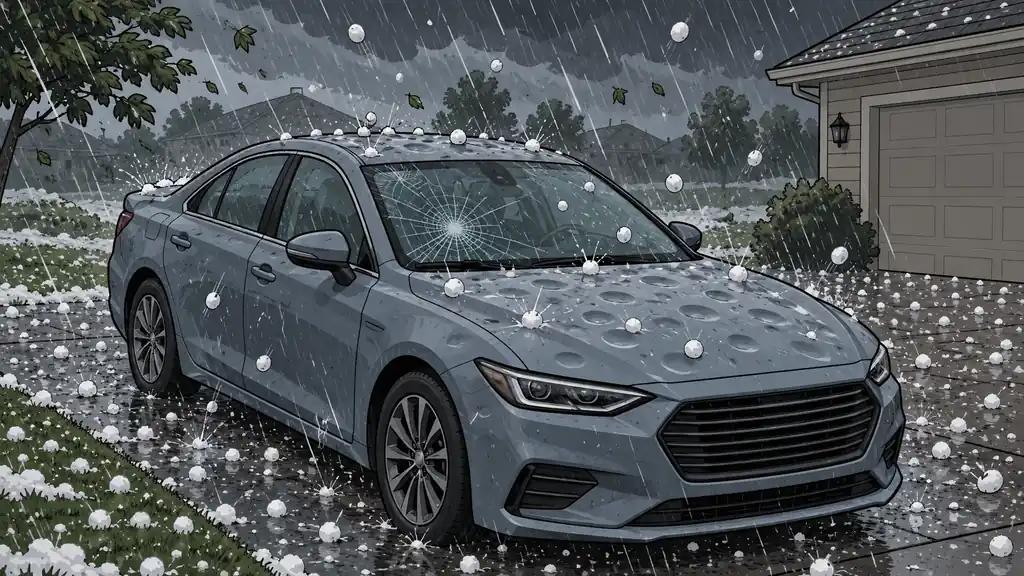
Hail sits in an odd corner of the threat list: likelihood 6 out of 9, impact 3 out of 9. It shows up all the time and it almost never hurts anyone who’s indoors. That combination decides everything about how you handle it. You’re not planning to survive a hailstorm. You’re planning to keep it from turning your roof and your cars into a five-figure repair bill. And nearly all of that work happens in the hours before the storm and in the paperwork around it — not during.
That’s not a survival threat; that’s a money threat. Treat it like one and it stays cheap.
How hail actually gets big enough to hurt
Hail grows inside the updraft of a strong thunderstorm. A raindrop gets carried up above the freezing line, freezes, and then rides the updraft up and down, adding a layer of ice on each trip. The stronger the updraft, the longer it can hold a stone up there, and the bigger that stone gets before it’s finally too heavy to hold and it drops. So the worst hail comes from the strongest storms — the same storms the forecast is already tracking.
Here’s why size is the whole story. A hailstone falls harder the bigger it is, and its weight climbs fast — double the diameter and the stone weighs about eight times as much, because weight goes up with the cube of the width. On top of that, bigger stones fall faster. NOAA’s National Severe Storms Laboratory puts severe hail (1 to 1.75 inches) at roughly 25 to 40 mph on the way down, and the biggest stones (2 to 4 inches) at 44 to 72 mph. Heavier and faster means the jump from pea-sized to golf-ball isn’t a small step up in damage — it’s the difference between a little cosmetic pitting and a windshield you have to replace.
The practical version: the forecast stone size is your trigger. Severe-thunderstorm warnings usually name the expected hail size. Marble hail is a nuisance you can mostly ignore. Golf-ball and up is a property event, and it’s the signal to move everything under a hard roof.
Where and when it shows up
Hail is common across a lot of the country, but it’s worst through the central and southern plains — the interior stretch people call “hail alley.” It concentrates in spring and summer, in the afternoon and evening, when storms have the most energy. Because it rides along inside tracked thunderstorms, you almost always get hours of lead time. That lead time is the entire reason the fix is proactive: you get a heads-up, and the whole job is using it.
What a bad storm actually costs you
- Roof — the big one. Hail bruises and cracks shingles, knocks loose the protective granules, and splits the mat underneath. A lot of that damage doesn’t look like anything at first. It shows up later as a leak. A severe storm can mean a full re-roof, and that’s a five-figure line item.
- Vehicles. Dents across the hood, roof, and trunk; cracked or shattered windshields. Minor cases can be pulled out with paintless dent repair, but a hard-hit car can get written off as a total loss on hail damage alone.
- Glass. Big hail can break windows and skylights. That’s the one way hail actually reaches you indoors — through broken glass, with water coming in right behind it.
- The bill that compounds. This is the mistake that costs the most. Roof damage you never inspect becomes a leak, and the leak becomes interior water damage and mold. A bounded hail bill turns into an unbounded water bill because nobody went up and looked after the storm.
All of that is money, and all of it is recoverable. That’s why the impact is only a 3. But “only a 3” still means real money if you’re caught unprepared or under-insured.
A worked example — the number that actually bites
Most people think their exposure is their normal deductible. In hail country it usually isn’t. Many states in the storm belt put a separate wind/hail deductible on the policy, and it’s frequently written as a percentage of the home’s value, not a flat dollar amount.
Additionally, for roof replacements, it’s normally prorated against the life of your roof. If you have a claim on 25-year shingles that were installed 15 years ago, you’ll only get 40% of the replacement costs covered, and that’s before the deductible is applied.
Because of this, a major hail storm can result in a five-figure bill for you that you never saw coming.
The common mistakes
- Waiting until hail is falling to move the car. Once large stones are coming down, going outside is the one genuinely dangerous move hail offers. Move the car on the forecast, not the first bang on the roof.
- Never documenting the roof. With no “before” photos, an adjuster can call your fresh hail damage pre-existing wear — and pay accordingly.
- Skipping the post-storm inspection because nothing looks wrong. The damage that leaks later is exactly the damage you can’t see from the ground.
- Learning your deductible at claim time. A percentage-based wind/hail deductible surprises people by thousands of dollars.
What preparedness looks like
Measure readiness here in habits and paperwork, not gear.
1. Get the cars under cover — the highest-value move. Cars are expensive, they live outside, and they’re wide open to the sky. Build the habit: hail in the forecast means the cars go in the garage, under the carport, under anything with a hard roof. If you live in hail country and never have covered parking, that’s worth fixing for real — a carport can pay for itself against a single totaled roof. As a last resort, thick moving blankets over the hood, roof, and windshield cut down the denting. Watch the forecast in storm season so you’re never caught flat.
2. Keep the roof sound, and document it. A roof in good shape takes hail better than a worn one. And when it’s time to re-roof, impact-resistant (Class 4) shingles are worth specifying in hail country — they often earn an insurance discount too. Once a year, photograph or video the roof, gutters, siding, and the cars. That “before” set is what makes a claim clean, because it separates new hail damage from old wear — which is the exact thing an adjuster argues about.
3. Read your policy before the storm. Know how it treats hail. Is the roof covered at replacement cost or at actual cash value, which depreciates an aging roof and can leave a big gap? Do you have a separate percentage-based wind/hail deductible? Is cosmetic-only damage excluded? Those answers are your real out-of-pocket exposure. After any significant storm, get a professional roof inspection even if nothing looks wrong, and file inside your policy’s window.
4. During the storm — almost nothing. Get inside, bring the pets in, stay away from windows and skylights. Don’t run out to move a car once large hail is already falling. The storm is short, and your personal safety costs you nearly zero if you’re indoors.
Bottom Line
- Hail is common (6/9) but low-danger (3/9) — it’s a property and insurance problem, not a survival scenario.
- The forecast stone size is your trigger. Golf-ball and up is a property event; you almost always get hours of warning to act on.
- Get the cars under a hard roof before the storm — the single highest-value move. Solve covered parking for real if you live in hail country.
- Maintain and photograph the roof every year, and inspect it after any significant storm — that’s what stops a hail bill from becoming a water-damage bill.
- Know your wind/hail deductible before you need it — a percentage-based one can be many thousands out of pocket.
Hail is a threat where the whole fight is won before the first stone falls. Watch the forecast, move the car, photograph the roof, read the policy — and the storm stays a line item instead of a crisis.
Hail risk varies sharply by region — the county Threat Report shows how it ranks where you live against your other local hazards.