


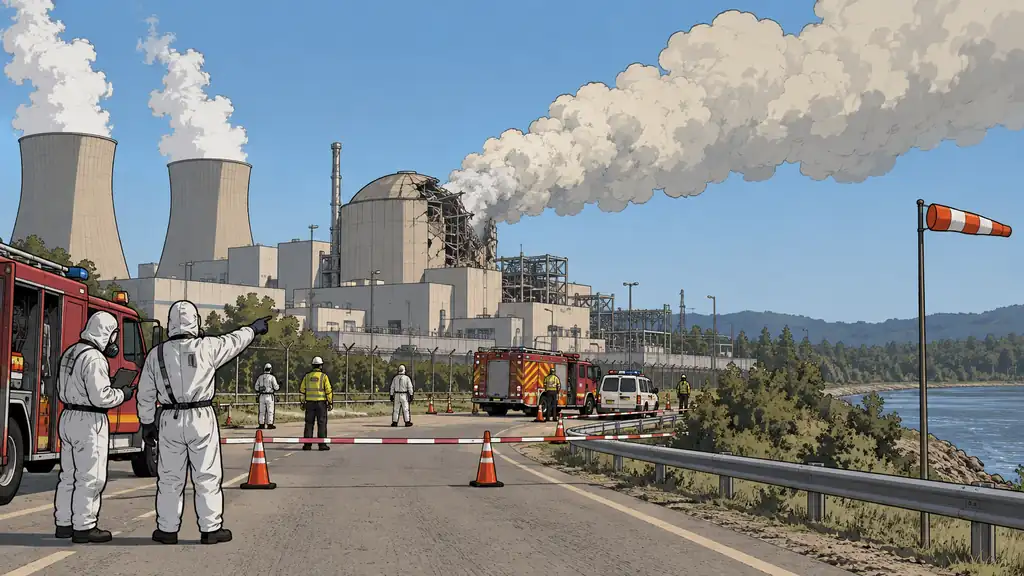
Most people file “meltdown” next to “nuclear bomb.” That’s the first thing to get straight: a reactor can’t detonate. There’s no blast, no fireball, no flattened city. What a bad accident does is release radioactive material into the air, and the wind carries it downwind as a plume — an invisible cloud that settles on the ground in its path.
That one fact changes the whole problem. This isn’t a bomb you survive by luck. It’s a wind problem you solve on a map. Whether it ever touches you comes down to two things: how close you live to a reactor, and which way the wind usually blows. There are only about 90 nuclear reactors in the US, and serious releases are rare. Live far from all of them and this isn’t your threat. Live near one and downwind of it, and a cheap, specific kit puts you far ahead of everyone around you.
What a release actually does to you
A plume doesn’t hit you all at once, and it doesn’t threaten you one single way. It shows up as three different problems on three different clocks, and each one has its own answer. Miss that and you’ll time everything wrong.
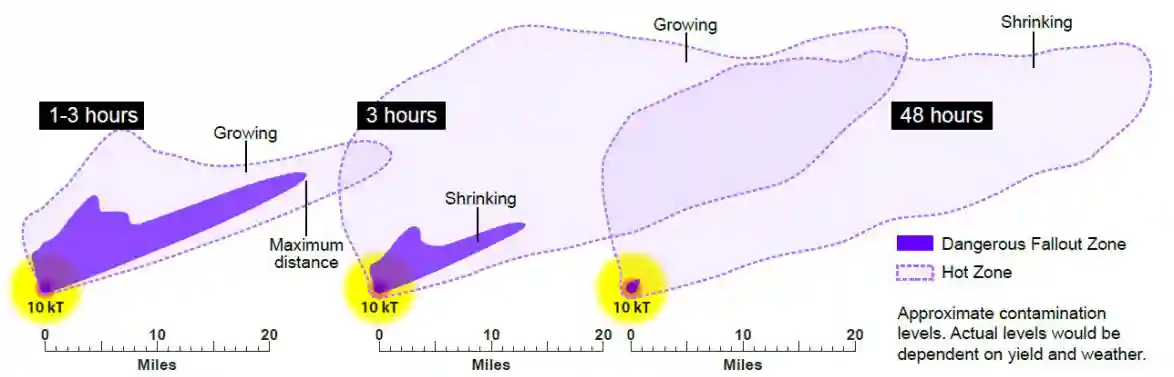
- Breathing it in — the first hours. While the plume is passing over you, the danger is breathing contaminated air. This is the sharp early hazard, and it’s the reason the first move is almost always to get inside and seal up. It’s over when the plume moves on.
- The dose off the ground — the next days. Once particles settle on the ground, roofs, and cars around you, they keep giving off radiation while you sit near them. Mass between you and that deposited material — walls, an interior room, a lower floor — cuts it down. So does time, as the short-lived material burns itself out.
- The food and water — the following weeks. Fallout lands on pasture, gardens, and open water. It works its way into milk, produce, and surface water for weeks after the plume is long gone. This is the slow one, and it reaches much farther out than the plume itself.
The plants near you are built around this. Authorities pre-draw two rings: roughly a 10-mile zone where breathing the plume is the concern, and a wider ~50-mile zone where the worry is contaminated food and water. Your ring sets your job — seal-or-leave close in, watch what you eat and drink farther out.
The precedent: three accidents, three lessons
- Three Mile Island (Pennsylvania, 1979). A partial meltdown where the containment building held. Very little got out, and no clear wave of public harm followed. The lesson: containment is the whole ballgame. When it holds, a wrecked core stays a wrecked core, not a disaster for the people outside.
- Chernobyl (Ukraine, 1986). A reactor with no Western-style containment blew open and caught fire, lofting contamination across a vast area. The 30-kilometer (~1,000-square-mile) exclusion zone it forced is still largely off-limits. Thirty-one people died in the first months — mostly plant workers and firefighters — and the WHO/IAEA Chernobyl Forum later estimated it could eventually cause up to about 4,000 cancer deaths among the most exposed. That’s the worst case, and it’s why containment isn’t optional.
- Fukushima (Japan, 2011). A tsunami knocked out the cooling systems. Cores melted, hydrogen explosions breached outer structures, and Japan pushed evacuation out to a 20-km radius with the main contamination track running about 50 km to the northwest — following the wind, not a neat circle. The lesson: the plume goes where the weather sends it, and the shelter-or-leave call is really a question about where you sit relative to that track.
Put them together and the pattern is plain. The hazard is airborne and wind-driven, containment decides how bad it gets, and your position decides what you do about it.
The common mistakes
- Prepping for a blast. Buying into the mushroom-cloud image and bracing for overpressure and fireball against a threat that produces neither. Wrong movie.
- Not knowing your position. Never having checked whether you’re in range, or which way the wind runs, so the seal-or-leave decision becomes a panicked guess at the worst possible moment.
- Treating KI as a force field. Potassium iodide protects one organ against one kind of material. People stock it and think they’re covered. They’re not.
- Standing down when the plume passes. The air clears and folks go back to eating garden produce and drinking from the rain barrel — straight into the weeks-long ingestion problem.
- Running the wrong direction. Evacuating “away from the plant” straight down the plume’s path instead of crossing out of it.
What to actually do, in order
Position first. It’s free, and it decides everything else.
1. Find out if you’re in range, and which way the wind blows. Pull up the plants near you and see whether you sit inside those 10- and 50-mile rings. Then look at your prevailing wind. A household usually upwind of the nearest plant is in a much better spot than one usually downwind at the same distance — it’s the difference between a plume that almost always misses you and one that usually finds you. This single check tells you whether to build the rest of this plan or file it.
One way to do this is by using our Nuclear Fallout Simulator which maps every nuclear site in the country and maps fallout plumes using real weather patterns.
2. Stock potassium iodide and learn the timing. KI floods your thyroid so it can’t absorb radioactive iodine — but only in a window around exposure, and only the thyroid. It does nothing for the rest of you. Stock a supply per person. The FDA dose is 130 mg for adults, 65 mg for children aged 3–18, and less for the very young. Store it where you can grab it in seconds, and take it on official guidance, not on a hunch. It’s cheap insurance against one specific harm — not a cure-all.
3. Build a shelter-in-place you can actually live in. Early on, sealing yourself inside is usually the right first move — it cuts how much of the plume you breathe. Pick an interior room now. Have tape and plastic staged to seal doors, windows, and vents, and know how to shut off the HVAC so it isn’t pulling outside air straight in on you. Plan for hours to a few days sealed in. For a family of four over a two-day seal, that’s water at two gallons a person a day — 16 gallons — plus no-cook food and a bucket-and-bags sanitation setup, staged in that room, not scattered around the house.
4. Stage a go-bag and downwind-smart routes. If they order you out, speed and direction both matter. You want to move crosswind or upwind, out of the plume — not drive along its track. Pre-plan two or three routes for different wind directions, keep the go-bag packed, keep the tank above half, and follow official channels for the plume’s real heading, which can shift.
Bottom Line
- A meltdown is a plume, not a bomb — no blast, no fireball, just contamination the wind carries downwind. Prep for that, not for the movie.
- Your address decides most of it. Low odds, and meaningful only near the ~90 US reactors — so your first move isn’t buying anything, it’s finding out whether you’re in range and downwind.
- It’s three problems on three clocks — breathe it (hours), the dose off the ground (days), the food and water (weeks). Each has its own answer; don’t stand down early.
- KI is narrow. Right dose, right timing, thyroid only. Stock it, understand it, don’t lean on it.
- Seal first, then leave smart. A sealed interior room for the plume-passage window, then a crosswind exit out of the plume — never along it.
A reactor can’t detonate. It can only send a plume where the wind takes it — so the whole fight is knowing your position before the sirens, not scrambling for it after.
See whether a plume could reach you and how the downwind geography lays out on the Nuclear Fallout Simulator, and pre-plan your evacuation routes in Area Recon.