


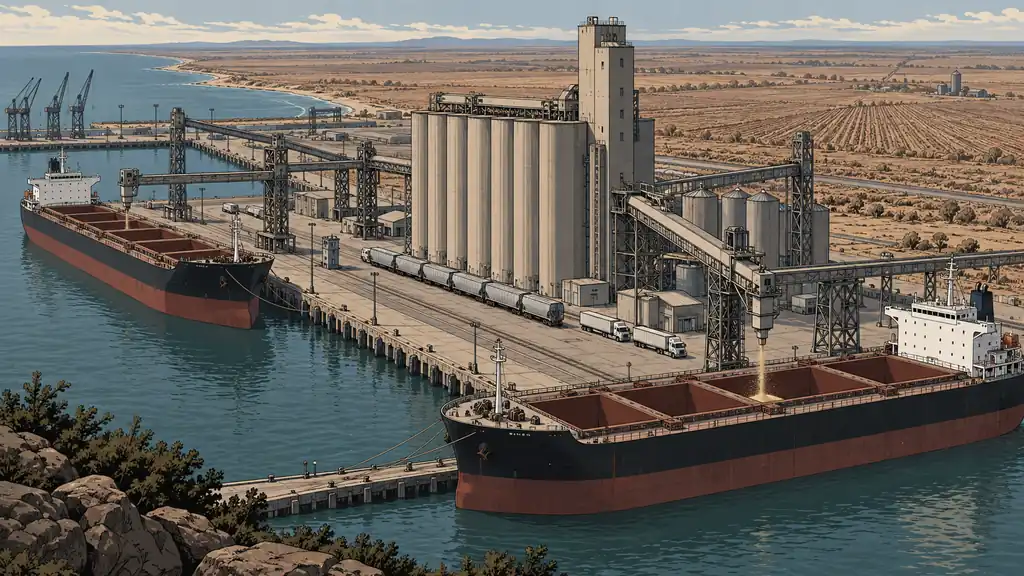
Every threat has an honest place on the odds scale, and this one sits dead last. A global crop collapse — the world’s staple harvests failing across multiple continents for years at a stretch — is the least likely thing we analyze, and we won’t pretend otherwise. The reason is built into how farming works. Global agriculture is spread across dozens of climates, both hemispheres, and several different staple crops. That spread is a deep, redundant cushion. Regional failures happen every single year and the system absorbs them — one hemisphere’s bad year is the other’s good one. To break all of it, for years, takes a shock big enough to overwhelm that cushion everywhere at once. That’s why it earns likelihood 1. And it’s still worth understanding, because it sits at the very top for impact (9) — and because you prepare for it with the exact same food-security work that covers nearly every likelier threat below it.
Improbable, but as bad as it gets
Rate it impact 9, likelihood 1. The likelihood floor comes from that spread: staple food is grown across the Americas, Europe, Asia, Africa, and Oceania, across wheat, rice, corn, soy, and more, and across both growing seasons. That redundancy shrugs off the regional shocks that hit every year. The impact ceiling comes from what a real collapse would mean: sustained, worldwide scarcity of the calories that feed humanity — a slow-burn catastrophe you can’t escape by moving, because it’s global by definition. Bad odds, worst-case damage. That’s a textbook tail risk: not something to reorganize your life around, but the logical far end of taking food security seriously.
What it would actually take
For a threat this rare, understanding the mechanism keeps the analysis honest instead of alarmist. A true multi-year global collapse needs a shock that knocks down harvests across several breadbaskets at once and keeps them down. There aren’t many candidates:
- A big, lasting climate shock. A very large volcanic eruption can throw enough haze into the high atmosphere to cool the planet and shorten growing seasons worldwide for a year or more. History records it directly: the 1815 eruption of Mount Tambora — the largest in recorded history — cooled global temperatures and gave 1816 its nickname, the “Year Without a Summer,” with Northern Hemisphere crop failures, Europe’s worst famine of the century, and food-price spikes across two continents.
- Several breadbaskets failing at once. Multiple major grain regions hit by severe drought, heat, or flood in the same window, defeating the usual geographic averaging. This could come with a severe El Nino or La Nina system, and some are forecasting that 2027 could be affected by the worst El Nino in recorded history that is currently forming in the Pacific.
- A new, widespread crop disease overwhelming a globally dominant staple that has too little genetic variety to resist it.
The common thread: it takes a genuinely planet-scale forcing to beat farming’s built-in redundancy. Ordinary bad years don’t do it — which is exactly why the redundancy is there.
What it would do
A crop collapse is a slow-motion disaster, measured in seasons and years, not days:
- Staples get scarce and expensive, and stay that way. The basic calorie sources — grains above all — go short and pricey worldwide across multiple failed seasons.
- There’s no geographic escape. Because it’s global, you can’t relocate out of it the way you’d flee a regional disaster. Everyone is drawing on the same shrunken harvest.
- It bleeds into everything. Sustained food scarcity is one of the most destabilizing forces there is — price crises, hoarding, unrest, migration, conflict. The food threat couples hard into the civil and economic ones.
- Duration is the whole problem. The danger isn’t one shortage; it’s feeding your household through years of it. That’s what sets crop collapse apart from every shorter food threat: it can outlast any purely stored reserve. Which is why growing your own stops being optional here.
What preparedness looks like — depth, then refill
The plan has two halves: depth (the larder that buys time) and refill (the growing that outlasts the larder). For this threat you need both, because the event can run longer than any household can store.
1. Build the deepest practical staple reserve — count it in months to years. Prioritize the calorie- and protein-dense staples that store for years: hard grains, beans and lentils, rice, oats, and the like, kept cool, dry, sealed, and low-oxygen. These are the backbone that carries you while your garden ramps up. Build gradually, buy what you’ll actually eat, and rotate hard — oldest first — so a deep larder stays fresh instead of spoiling. State it as months of full-calorie coverage for your household, the number that actually matters. A quick way to anchor it: four people at roughly 2,000 calories each is 8,000 a day, so a six-month reserve is about 1.44 million calories on your shelves — which tells you fast that this is a build-over-time project, not a single shopping trip.
2. Learn to actually grow food. This is the half stockpiling can’t cover. A stored reserve, however deep, is a finite buffer against an event that can run for years — so the decisive skill is growing food that renews each season:
- Grow staples and high-value crops at a scale that matters to your calorie budget, not just a hobby bed. Learn your season, your soil, and your real yields.
- Preserve the harvest — canning, drying, fermenting, root-cellaring, freezing — so a seasonal surplus feeds you year-round. Growing without preserving just moves the shortage to winter.
- Climb the learning curve now. Gardening at survival scale is hard and failure-prone the first few seasons. One season is one lesson, and you can’t rush it in a crisis. That’s not a reason to delay; it’s the reason to start now, while a failed crop costs you nothing.
Measure this in renewable calories per season — what your land, labor, and skill can actually put on the table, again and again.
3. Keep seed you can save — and know how. Store seed for the crops you’d rely on, specifically open-pollinated or heirloom varieties whose seed you can save and replant, so your growing keeps itself going without an outside seed supply (which would be disrupted too). Seed plus the knowledge to grow, harvest, and save it is the self-renewing unit. Seed alone is just a jar. Practice seed-saving now so the skill is real.
4. Diversify sources and build local networks. Resilience comes from not leaning on any single source. Mix deep storage, home growing, and local sourcing — nearby farms, ranchers, and gardeners — into a spread. And invest in community. In a long food emergency, a local network where different households grow different things, hold different skills, and trade and help each other far outperforms anyone going it alone. At the scale this threat implies, food security is a community property, not just a household one.
Bottom Line
- Global crop collapse is the least likely threat here (likelihood 1) — farming’s diversity is a deep, redundant cushion — but the most severe there is (impact 9), because a multi-year, worldwide shortfall is measured in years with no unaffected region to lean on.
- It’s a slow, multi-year, worldwide food emergency you can’t outrun — and it can outlast any stored reserve.
- Prepare with depth first: the deepest practical staple larder, counted in months-to-years of coverage.
- Growing is the decisive half — raise staples at real scale and preserve the harvest, measured in renewable calories per season.
- Keep save-able seed you know how to use, diversify sources, and build local networks — at this scale, food security is communal.
This is the rarest threat we cover, and the most reassuring paradox in prepping: you defend against it by building food security so deep and so self-renewing that everything likelier — job loss, shortages, hard years — is already covered on the way there.
Build the deepest practical larder with the Food & Water Storage tool, and turn effort into renewable calories with the Garden Planner.