


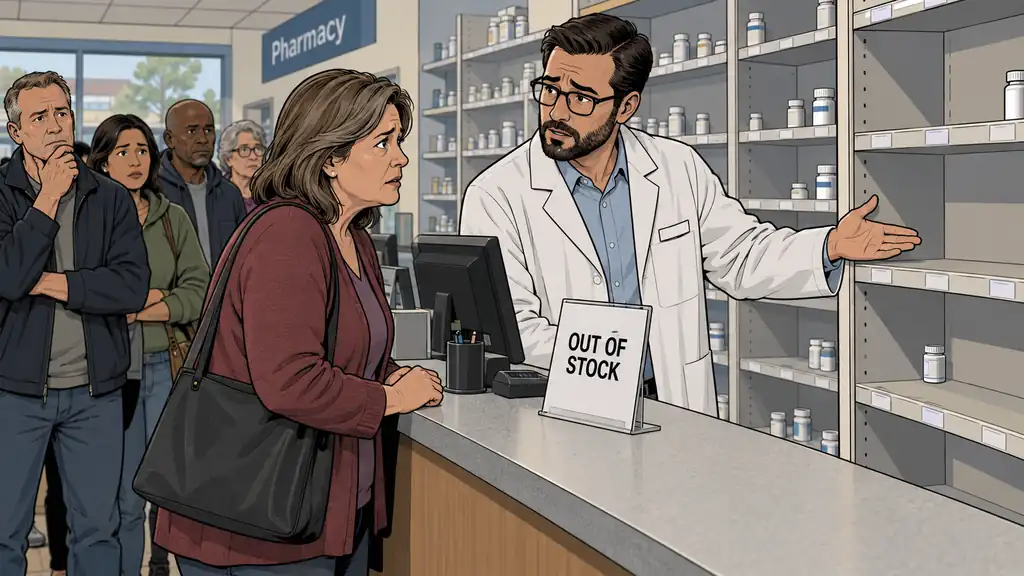
The pharmacy counter feels like the end of a very short chain: a doctor writes it, the pharmacy fills it, you pick it up. It looks local. It isn’t. That little orange bottle is the last inch of a supply line that often begins with a chemical plant on the other side of the planet, and every link in between is a place the chain can break.
That’s the reframe for this threat. For the person on a critical daily medication, “the pharmacy is out” isn’t bad luck at one store — it’s the visible end of a system that’s more fragile than it looks. And when that system hiccups, the consequence lands on your body, not on a spreadsheet. This article is about why it breaks, how to count the buffer that actually protects you, and the mistakes that quietly leave people exposed.
Why shortages happen — and keep happening
Start with the odds. This threat rates a likelihood of 4 out of 9, which surprises people. That’s because drug shortages aren’t a rare event; they’re a routine, ongoing condition of the modern pharmaceutical market. At any given time there’s a long list of drugs in short supply, and the list rarely goes to zero. It’s so common the FDA even built a website for it.
The reason is structural, and it comes down to where medications are actually made. A modern pill isn’t one thing — it’s a finished product built from an active pharmaceutical ingredient (API), the molecule that does the work, plus fillers and packaging. The finished pills might be pressed in the US or Europe, but the API underneath them is a global commodity, and a large share of it is manufactured in just a few countries — predominantly China and India. According to the FDA Drug Master Files, China and India command between 70 and 80% of registered generic API options.
That concentration is the fragility. When a huge fraction of the world’s supply of a given ingredient comes from a handful of plants, a single problem — a factory shutdown for quality violations, an export restriction, a shipping disruption, a raw-material squeeze — can ripple into a shortage of the finished drug everywhere. Generics make it worse in a specific way: they’re sold on razor-thin margins, so there’s little incentive to keep spare capacity or backup suppliers. The cheapest, most common medications — the ones people depend on daily — are often the ones with the thinnest, most concentrated supply behind them.
Layer your personal disruptions on top of the global ones and the picture is complete. The national supply can be fine and you can still be cut off: your pharmacy is temporarily out, your insurance flags the refill as “too soon,” a prior authorization stalls, a storm closes the roads, or you’re traveling and left the bottle at home. The threat isn’t only “the world ran out.” It’s “a medication you depend on is out of reach, for any reason, long enough to matter.”
Which gaps are actually dangerous
Not every missed dose is equal, and being honest about that is part of prepping well. For a lot of medications, a day or two off is a non-event. The ones that make this an 8-out-of-9 impact are the maintenance drugs where the gap itself is the danger:
- Insulin and other diabetes medications — blood sugar can climb into a genuine emergency without them, and insulin has the added problem of needing refrigeration (more on that in the advanced article).
- Heart and blood-pressure medications — stopping some of these abruptly can spike blood pressure or heart rate, sometimes worse than never having taken them.
- Anti-seizure medications — a missed stretch can bring seizures back in someone who was fully controlled.
- Psychiatric medications — many are not meant to be stopped suddenly; abrupt gaps can cause withdrawal effects and a return of the underlying condition.
- Anything for a chronic condition your day depends on — thyroid, blood thinners, transplant anti-rejection drugs, and more.
The common thread: these aren’t drugs you take to feel better in the moment. They’re drugs that hold a system in your body steady, and the body was counting on them being there. The danger isn’t discomfort; it’s decompensation — the condition coming roaring back, sometimes worse than baseline. That’s not a headache; that’s an ER visit.
I’m naming classes, not doses, on purpose. Which of these applies to you, how long you can safely go, and how any of them should ever be adjusted is a conversation for you and your prescriber — never a website, and never a guess.
Count your real days of buffer
Here’s the math that matters, and like water, it’s measured in time, not dollars.
Your buffer is simply: the pills you have on hand ÷ the pills you use per day = days of cushion.
Say you take a medication once a day and you always refill when the bottle hits empty. Your buffer is zero days — you’re betting the entire system delivers perfectly, every single month, forever. Now say you refill when you’ve still got 10 days left. Your buffer is 10 days — a hiccup at the pharmacy is invisible to you. Move to a 90-day supply and refill at the 30-day mark, and you’re carrying a 30-day cushion at all times, rolling forward automatically every time you fill.
That rolling buffer is the whole game. It’s not hoarding — it’s the same refill-early-not-empty discipline, just made deliberate. You’re not buying extra medication; you’re shifting your reorder point earlier so there’s always a cushion between you and the next disruption. Pick a target — two weeks minimum for a critical med, a month if you can get there — and never let it run below that line.
The mistakes that leave people exposed
- Refilling at empty. The most common one. Zero buffer means every refill is a single point of failure. Move your reorder date earlier and the problem mostly disappears.
- Assuming insurance won’t allow more. Many plans permit a 90-day supply, and many allow an early “vacation” or emergency refill — but you have to ask, and sometimes push. People assume “no” without ever asking the question.
- No written med list. When you’re at an urgent care or a strange pharmacy, “I take the little white one” doesn’t cut it. A current list of drug, dose, and prescriber is what lets someone actually help you.
- One pharmacy, one option. If your only pharmacy is out and you don’t know that a generic equivalent exists or which nearby pharmacy stocks it, a small shortage becomes your emergency. Know your alternatives before you need them.
- Letting the samples/backup expire. A cushion you built two years ago and never rotated may be past date. A buffer only works if it rolls.
A prescription looks like a local errand and behaves like a global supply chain. Build your buffer as if the chain will break, because on a long enough timeline, some link always does.
What preparedness looks like
1. Set a reorder point, not an empty bottle. Decide your minimum cushion — say two to four weeks for anything critical — and refill the moment you hit it. Automate refills and reminders if your pharmacy offers it.
2. Ask for the bigger supply and the backup. Talk to your prescriber and pharmacist about a 90-day fill and an emergency backup prescription for your critical medications. Ask specifically what your insurance allows for early and vacation refills. These conversations are free and they’re the highest-leverage thing you can do.
3. Keep a living med list. Every drug, dose, prescriber, and pharmacy, kept somewhere you can always reach it — including when the power’s out. Update it whenever anything changes.
4. Build redundancy. Know your generic alternatives, know a second pharmacy, and if you use a mail-order plan, understand what happens when a shipment is late.
5. Keep it in proportion. This matters intensely if you depend on a critical daily medication and barely at all if you don’t. Aim your effort where your actual exposure is.
Bottom Line
- Shortages are structural, not flukes — a large, concentrated share of generics and their raw ingredients is made overseas, so the supply is more fragile than it looks (likelihood 4/9).
- The dangerous gaps are the maintenance meds — insulin, heart/BP, anti-seizure, psychiatric — where stopping is itself the emergency (impact 8/9).
- Count your buffer in days: pills on hand ÷ daily use. Refilling at empty is a zero-day buffer and a single point of failure.
- Build a rolling cushion by moving your reorder point earlier and asking about a 90-day supply plus an emergency backup script.
- Add redundancy — a written med list, a second pharmacy, and known generic alternatives — and size the whole effort to how much you actually depend on your meds.
Turn “I think I have about two weeks left” into a number you can see — keep your medications, doses, prescribers, and reorder dates in the Digital Binder, an encrypted list that’s there even when the grid and the internet aren’t.